No. HARDING1973-002
Saint Marcel Magdalenian bullroarer pendant
France · Saint-Marcel, Indre · Western Europe
Function not recorded
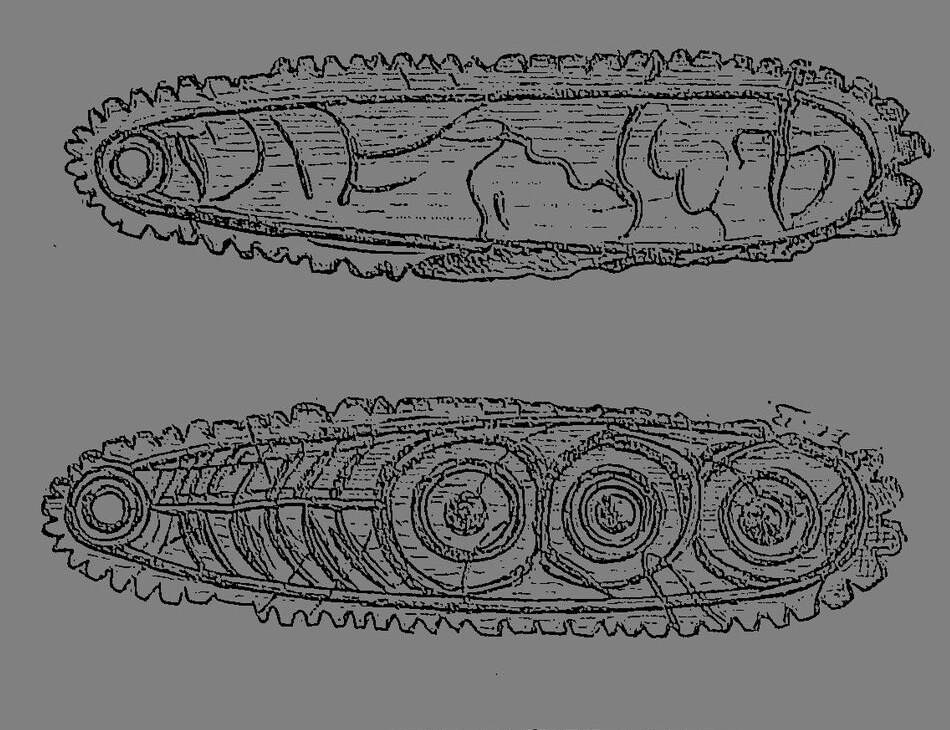
Source term: bull-roarer pendant
A small Magdalenian pendant from the cave of Saint Marcel, in the Indre of France, has serrated edges and an engraved design of lines and concentric circles. J. R. Harding reproduces it as a "Magdalenian bull-roarer pendant," drawn at twice natural size from a figure first made by the Abbé Henri Breuil and later reproduced by Paolo Graziosi in Palaeolithic Art. The argument is one of resemblance: the toothed blade-shape is read as a miniature copy of a bull-roarer, and Harding notes the engraving recalls "some of the designs shown by Australian churinga," the sacred boards whose appearance early prehistorians borrowed to interpret Ice Age Europe. Breuil himself, publishing the piece in 1902, claimed nothing of the kind: he described a pendeloque — a pendant — that "does indeed seem to be an amulet." No bull-roarer of wood survives from the period; Harding writes that the wooden prototypes these pendants suggest "have not, of course, been preserved."
bone-, ivory- and sometimes stone-pendants, exactly imitating the blade of the instrument, from deposits of Magdalenian age in France
Harding 1973:40 (African Music 5(3))
Particulars
- Object
- A small serrated-edged bone pendant, pierced once at the narrow end for a cord. Breuil's 1902 figure draws both faces: one bears an engraved animal, the other a row of concentric circles above a hatched panel.
- Function
- Not recorded.
Source
Harding, 'The Bull-roarer in History and in Antiquity,' African Music 5(3) (1973): 40-42, at pp. 40-41 and fig. 1; H. Breuil, 'Station de l'âge du Renne de Saint-Marcel (Indre),' L'Anthropologie 13 (1902), fig. 4, pp. 152-154; W. J. Sollas, Ancient Hunters, 2nd ed. (1915), fig. 272 no. 5