No. LUND1998-002
Kongemose bone bullroarer
Denmark · Aamose · western Zealand · Northern Europe
Function not recorded Candidate only
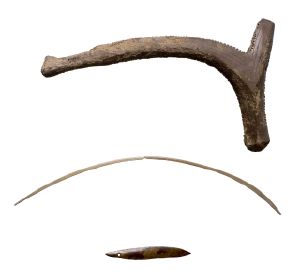
Source term: bullroarer (?) / brummer
In 1955, Danish archaeologists digging at Kongemosen on Zealand turned up a thin bone object about 11 centimeters long, shaped like a propeller, from a settlement some 8,500 years old. Nobody knew what it was for — a fishing tool, perhaps, or a utensil for weaving. Then, almost by chance, someone tied a string to one end and swung it through the air, and out came a strange rising and falling buzz. The piece was hailed as Denmark's oldest musical instrument and an organological sensation, and for decades it traveled through scientific publications and lectures as Scandinavia's oldest-known sound tool. But Cajsa Lund, who ran practical experiments in 1981 using an exact casting of the original, was unconvinced: the fact that an artifact can produce a sound does not prove it was ever used to make one. As she put it, a string fastened to a ruler, a key, or a rubber eraser will whir perfectly well, yet whirring is not their purpose.
... the possibility also exists that the Kongemosen find is not a bullroarer at all!
Lund 1998:20 ("What is Wrong with Music Archaeology?")
Particulars
- Object
- Thin propeller-shaped worked-bone object, 11.1 cm long, from the Mesolithic Kongemose settlement.
- Function
- Not recorded.