No. EUROPE-003
La Vache cave
France · Magdalenian final, Ariege · Europe · Pyrenees
Sacred / spirit

rhombe
French for "rhombus," the standard French term for a bullroarer — a flat blade whirled on a cord.
Etymology. French scholarly label from Greek rhombos, applied to whirled prehistoric bullroarers.
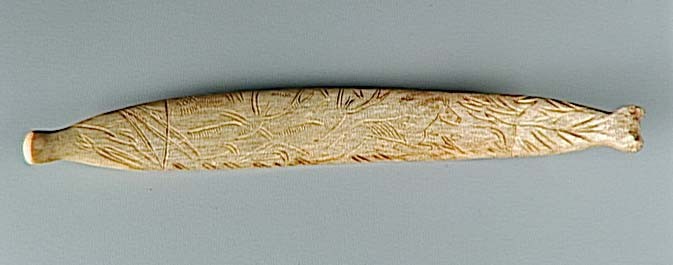
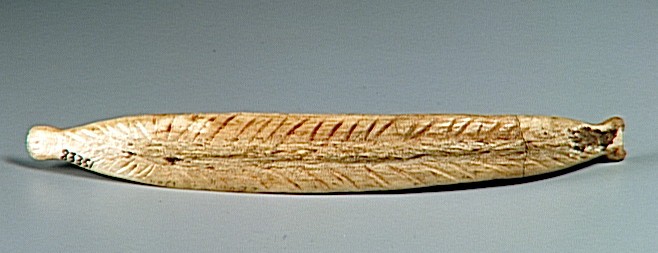
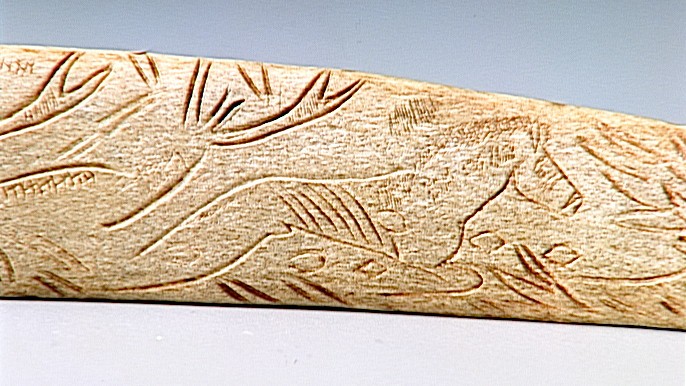
From the final-Magdalenian deposits of the cave of La Vache, at Alliat in the Ariège, the excavations of Romain Robert and Romain Gailli yielded a series of decorated bullroarers of bone and antler — among them pieces nicknamed for their engravings, the "two reindeer" and the "jumping horse." Barandiarán assigns three complete pieces to the bullroarer type, alongside plainer and broken fragments. Nougier and Robert grouped many of the carved strips as pendants, and the catalogue of the Musée d'Archéologie nationale by Chauvière and Delporte files the elongated plaques among "ellipsoids" and "pendants"; Barandiarán picks the bullroarers out from among them. The deposits belong to the reindeer- and ibex-hunters who wintered here some fifteen thousand years ago and almost certainly painted the nearby cave of Niaux, across the valley.
las que justamente consideran bramaderas (las ‘de los dos renos’, ‘del caballo saltando’ etc)
those they rightly regard as bullroarers (the ones 'of the two reindeer', 'of the jumping horse', etc.)
Barandiarán Maestu 2015, Kobie (BAI nº6):154, n.10
Particulars
- Object
- Three complete decorated bone blades assigned to the bullroarer type, plus plainer and broken fragments (incl. 'rhombe of the two reindeer', 'jumping horse rhombe'); Robert/Gailli excavations. The 'jumping horse' piece is inventory 83351: a reindeer-antler blade 16.3 × 2 × 0.7 cm bearing red hematite and engraved horse and fish imagery, excavated in Salle Monique, level 4, square 208, Upper Magdalenian.
- Function
- Whirled-cord aerophone.
Source
L.-R. Nougier and R. Robert, Préhistoire Ariégeoise 25 (1970), 29 (1974) and 33 (1978); F.-X. Chauvière and H. Delporte, 'Ellipsoïdes,' and H. Delporte et al., 'Pendeloques,' in J. Clottes and H. Delporte (dir.), La Grotte de La Vache II (2003), pp. 384-394; I. Barandiarán Maestu, Kobie BAI 6 (2015), p. 154 n. 10