No. KODAS2019-001
Boncuklu Tarla figured bone plaque (Kemik Plak 3)
Turkey · Upper Tigris · Dargeçit, Mardin province, southeastern Anatolia · Near East
Function not recorded Candidate only
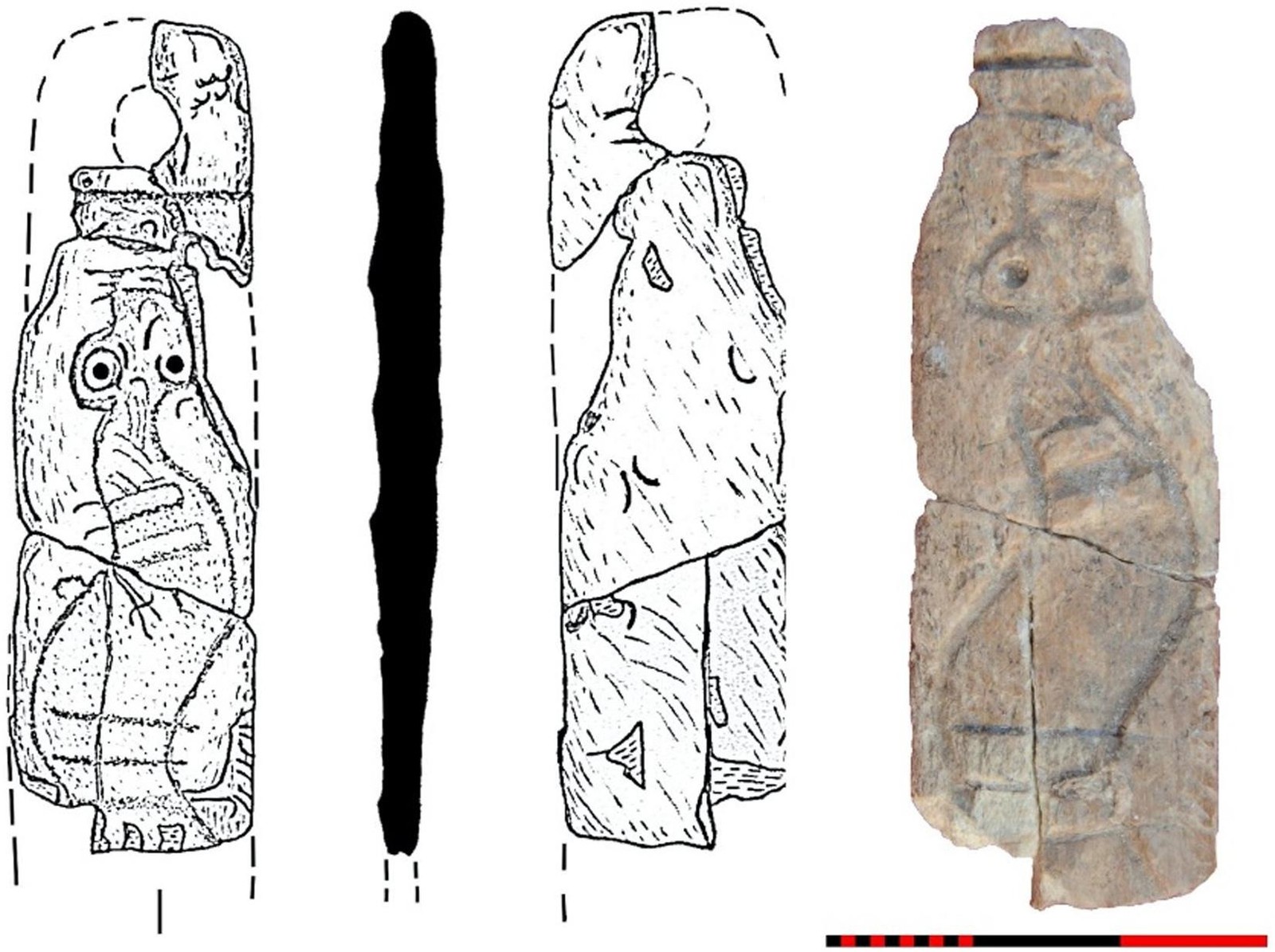
kemik plak (Turkish, excavators' term); yılan motifi "snake motif"
Source term: figürlü kemik plak / figured bone plaque
kemik plak: Turkish, 'bone plate' — the excavators' class term for the decorated perforated bone plaques of the Pre-Pottery Neolithic Upper Tigris.
Kemik Plak 3 came out of the ground at Boncuklu Tarla, a Pre-Pottery Neolithic village on a tributary of the Tigris in Mardin province, in eight pieces. Put back together it is a thin flat blade of bone, 68 mm long, 20 mm wide and 5 mm thick, incised with a snake and a horizontal band, and bored through with a single hole just above the band, near the narrow top. The snake has a broad triangular head, wide-set eyes and a neck pinched narrower than its body, a face the excavators liken to the region's vipers and to the snake carved on Pillar 22 at Göbekli Tepe. They published it as a pendant from a necklace, and the graves at Boncuklu Tarla are so thick with beadwork that the reading needs no defending. What makes the plate worth a second look is the company it keeps. Decorated perforated bone plates of this kind turn up across the Upper Tigris — at Körtik Tepe, Hallan Çemi, Gusir Höyük and Çayönü — and the class is serpent-coded wherever it appears, one Hallan Çemi piece cut into an S-curve so that the snake is the whole silhouette rather than the ornament on it. Oliver Dietrich and Jens Notroff have argued that some of these plates were bullroarers. At Körtik Tepe the one plaque with an unmistakable serpent is broken off exactly where a hole would have been. This plate is the only one in the class that carries both at once, and it is flat along its length, which is the thing a blade must be if it is to fly. Its top edge is lost and the hole sits a little off the centre line, but this is still the closest the Neolithic Tigris comes to putting the snake and the cord on the same object.
Yatay çizginin hemen üzerinde de, plağın üst bölümünde, bir delik bulunmaktadır.
And immediately above the horizontal line, in the upper part of the plaque, there is a hole.
Kodaş, Genç, Labedan-Kodaş, İpek and Erdoğan, Artuklu İnsan ve Toplum Bilim Dergisi 4(1), 2019, p. 4
Particulars
- Object
- Flat bone plate, 68 x 20 x 5 mm (L:W 3.4, T:W 0.25), recovered in eight fragments from an Early PPNB context; find no. K9/0002/Q/03. Incised with a snake motif and a horizontal line, with two small drilled pits on the obverse, and pierced by a single hole through both faces in the upper part of the plate, just above the line. Published edge-on profile is a thin, essentially parallel-sided bar with no longitudinal curve. The snake runs lengthwise, its body crossed by two sets of incised double bands, with a narrow neck, broad triangular head and wide-set eyes.
- Function
- Worn as a necklace pendant, its excavators judge from the hole and the plate's size.
Sources
- E. Kodaş, B. Genç, C. Labedan-Kodaş, B. İpek and N. Erdoğan, “Boncuklu Tarla Çanak-Çömleksiz Neolitik Dönem’e Tarihlenen Bir Grup Figürlü Kemik Plak,” Artuklu İnsan ve Toplum Bilim Dergisi 4(1) (2019), pp. 1-6, at p. 4, Şekil 6 View · archived
- Ergül Kodaş, Sera Yelözer, Yunus Çiftçi and Emma L. Baysal, “Symbolism in action: Techno-typology, function, and human-artefact dynamics in figured/non-figured bone plaques from Pre-Pottery Neolithic Boncuklu Tarla, Turkey,” Journal of Anthropological Archaeology 65 (2022), 101393, pp. 5–6, fig. 6 View