No. EA-XINGLONGGOU-001
Xinglonggou House 22 jade bi-shaped blades (匕形器)
China · Aohan Banner, Chifeng, Inner Mongolia; Xinglonggou site, Xinglongwa culture (c. 6050 BC) · East Asia
Function not recorded Candidate only
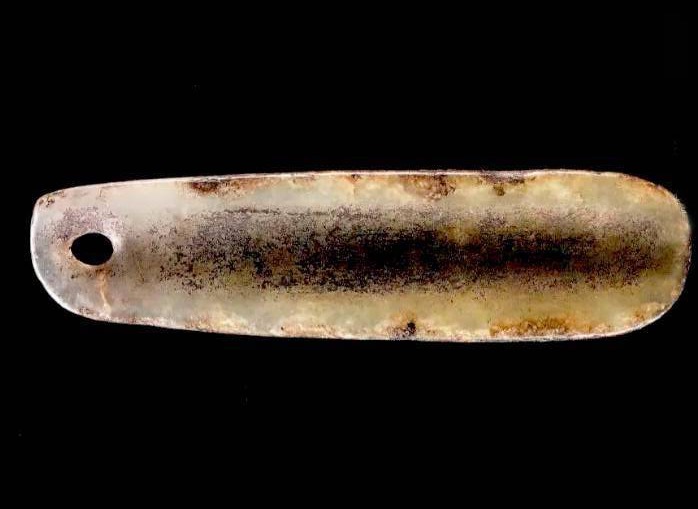
玉匕形器
Source term: yu bixingqi (jade bi-shaped object)
匕形器 (bǐxíngqì): 'bi-shaped object' — an elongated spoon- or tongue-shaped blade named after the ancient Chinese bi eating-spoon; thin nephrite blades pierced at one end.
Xinglonggou, a village of the Xinglongwa culture in the dry hills of Aohan Banner, is one of the places where archaeologists have caught jade-working itself in the act — eight thousand years ago its people were grinding and drilling nephrite a short walk from where they lived. From House 22 come two of the thin, tongue-shaped jade blades that Chinese archaeology calls bi-shaped objects: narrow strips ground to a slender section and pierced at the upper end by a small drilled hole. Everywhere else in this early world the little blades turn up mostly on the bodies of the dead, which is why they are read as ornaments; here they belong to a house floor in a village of makers.
Particulars
- Object
- Two jade bi-shaped blades from House 22 at Xinglonggou, the Xinglongwa-culture village ~13 km from the type-site where the CASS Institute of Archaeology (2001–2003 excavations, Liu Guoxiang) also documented early jade-working. A published photograph captioned to House 22 shows a narrow, rounded, cream-colored nephrite blade with a single biconically drilled hole at the upper end — a textbook member of the end-pierced thin-blade class, here from a house/settlement context rather than a grave. Date: Xinglongwa culture, c. 6250–5450 BC; no separate radiocarbon isolated for House 22.
- Function
- Catalogued within the Xinglongwa ornament repertoire.
Source
Institute of Archaeology, CASS, Xinglonggou excavations (2001-2003), house 22; Yang Hu, Liu Guoxiang & Tang Chung (邓聪), 《玉器起源探索——兴隆洼文化玉器研究及图录》 (Chinese University of Hong Kong Press, 2007); Kumbani, Bradfield, Rusch & Wurz, 'A functional investigation of southern Cape Later Stone Age artefacts resembling aerophones,' Journal of Archaeological Science: Reports 24 (2019)