RIEK1934-001 - archaeological find
Vogelherd perforated ivory baton
Germany - Lone Valley - Swabian Jura, Baden-Württemberg - Europe
Function not recorded Candidate only
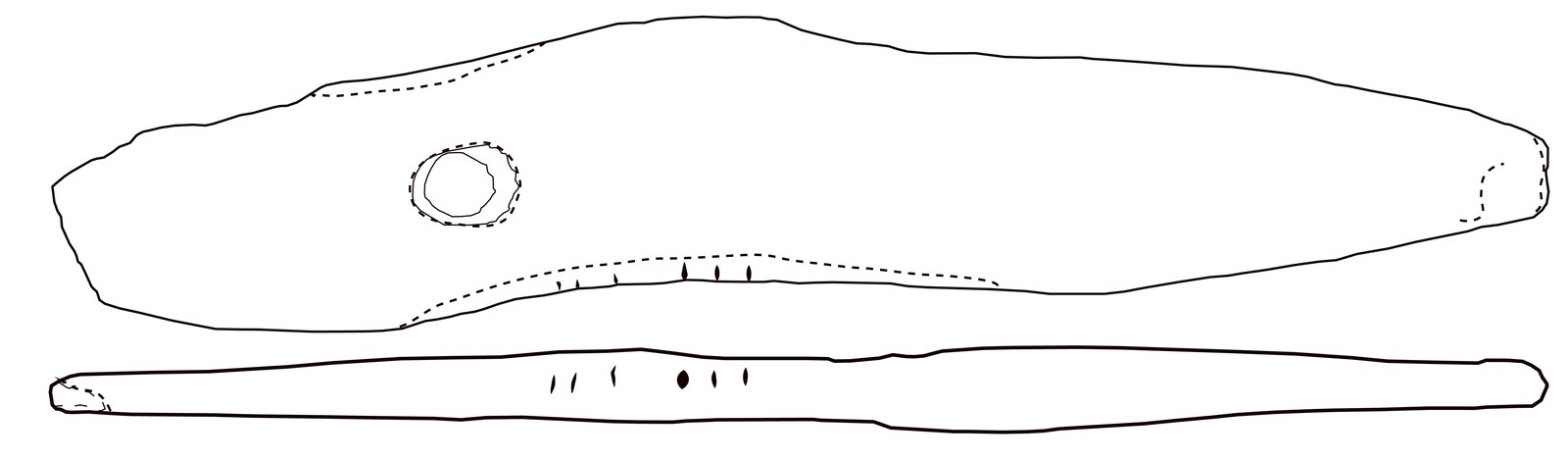
Source term: Schwirrblatt
Schwirrblatt: German 'whirring blade', the archaeological term for a bullroarer plate.
Gustav Riek pulled a perforated blade of mammoth ivory out of the Aurignacian layer at Vogelherd in 1931 and published it three years later as a Schwirrblatt, a whirring blade: twenty-four centimetres long, four wide, with a single end hole whose bore carries helical drilling marks. That would make it among the oldest sound-makers anyone has claimed, some thirty-five thousand years old. The object itself is gone. What survives is Riek's plate, a modern measured drawing, and catalogues that now file the piece more soberly as a perforated baton - and even the identification wavers, since a later description of the Vogelherd Schwirrblatt gives it two holes rather than one.
- Object
- Perforated mammoth-ivory baton, 237 x 41 x 13 mm, with a single helically marked hole; almost complete in the historic record and now lost. SignBase object vhc0161.
- Function
- Not recorded.
- Source
- Gustav Riek, Die Eiszeitjägerstation am Vogelherd im Lonetal (Tübingen, 1934), Taf. XXX.1, published the piece as a Schwirrblatt; the 1934 volume is print-only and the plate citation is also relayed by Narr 1963:72. Object data and the exact face-and-edge drawing come from Dutkiewicz, Bentz, Hahn and Lee, SignBase 2.0, object vhc0161, DOI…
- Source location
Page references
Riek 1934, Taf. XXX.1; SignBase 2.0 object vhc0161; Conard and Rots 2024, Table 2
- Source confidence
- high Vogelherd cave anchor near Stetten ob Lontal, Niederstotzingen, from the published public coordinate for the cave; not a layer or findspot coordinate.