KOCH1992-008 - archaeological find
Hohen Viecheln whirring device
Germany - Mecklenburg - former Kreis Wismar - Europe
Function not recorded Candidate only
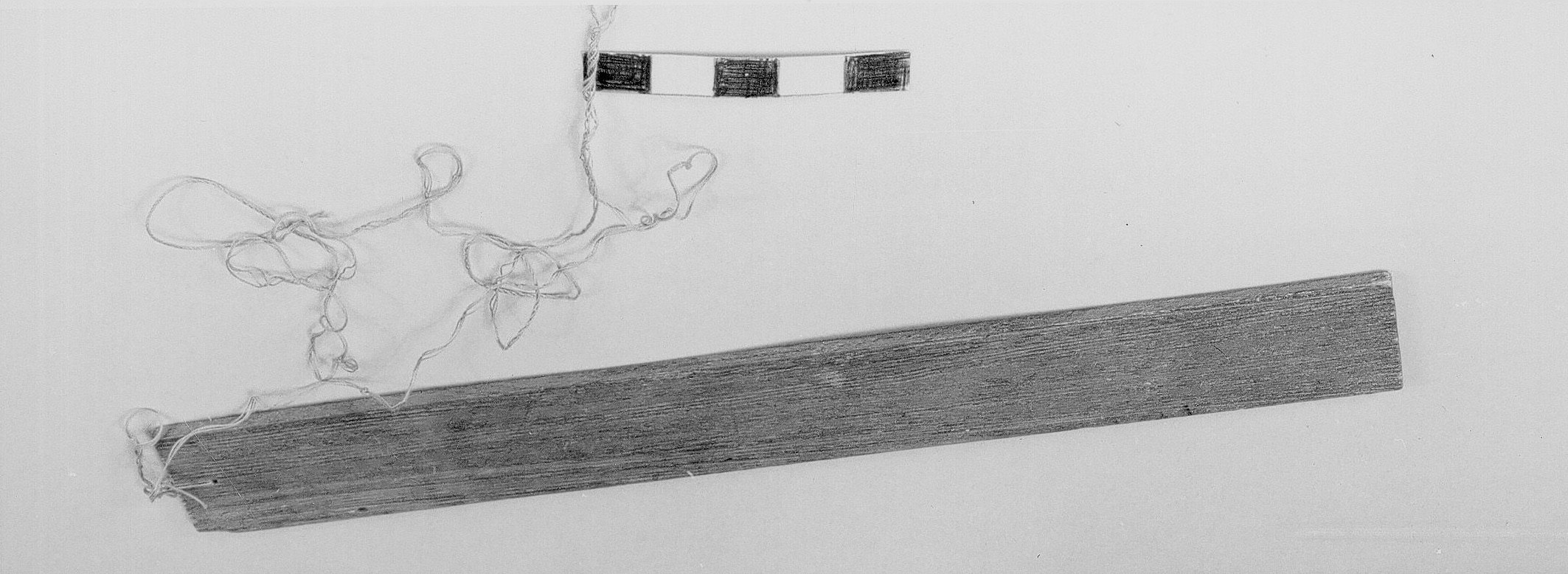
Source term: Schwirrgerät (?)
Schwirrgerät: German, "whirring device" - the standard archaeological term for a bullroarer.
At the north end of the Schweriner See, one Mesolithic object from Hohen Viecheln was proposed as a whirring device - and the proposal came with its own doubt attached. Klaus-Peter Koch put it in his list of whirled aerophones but printed a question mark beside it, and in his text called it a piece that can be read as a Schwirrgerät only conditionally. He then set it apart from the rest: the long oval bone blades pierced at the broad end, the shape he gives for every other Mesolithic find in the group, are described with Hohen Viecheln expressly excepted. So what it looks like is not something the record will say. A perforated bone rod from the same place appears in a separate list of Koch's; whether that is this object, nobody has shown.
Die Form der mesolithischen Funde ist, sieht man von einem nur bedingt als Schwirrgerät zu deutenden Exemplar aus Hohen Viecheln ab, länglich-oval mit Tendenz zur Stromlinienform.
The form of the Mesolithic finds is - leaving aside one specimen from Hohen Viecheln that can be interpreted as a whirring device only conditionally - elongated-oval with a tendency towards a streamlined shape.
Koch 1992:119
- Object
- No object-level description has been recovered, and none can be borrowed from the group. Koch expressly sets the Hohen Viecheln piece aside from the elongated-oval, streamlined form and terminal perforation he gives for the other Mesolithic finds, so its shape, its size and how it was suspended are all unknown. Only the statement that the surviving objects of the group are bone rather than wood appears to include it.
- Function
- Not recorded.
- Source
- Klaus-Peter Koch, Musikarchäologische Quellen aus dem östlichen Deutschland: Zwischenbericht, Jahresschrift für mitteldeutsche Vorgeschichte 75 (1992), pp. 101-136, at p. 132 (Fundliste 7: Aerophone
- Source location
Page references
printed p. 132, Fundliste 7 (Mesolithikum), entry marked (?); qualification and group exclusion p. 119
- Source confidence
- low to medium Hohen Viecheln village anchor from public OpenStreetMap/Nominatim gazetteer data (Hohen Viecheln, Nordwestmecklenburg, at the north end of the Schweriner See; formerly Kreis Wismar). Locality anchor only, not a findspot; the well-known Mesolithic site lies by the lake shore, but Koch gives no find location.