No. TALBOT1912-001
Ekoi Enyara Akum club bullroarers
Nigeria · Cameroon · Cross River · Oban District · West Africa
Restricted
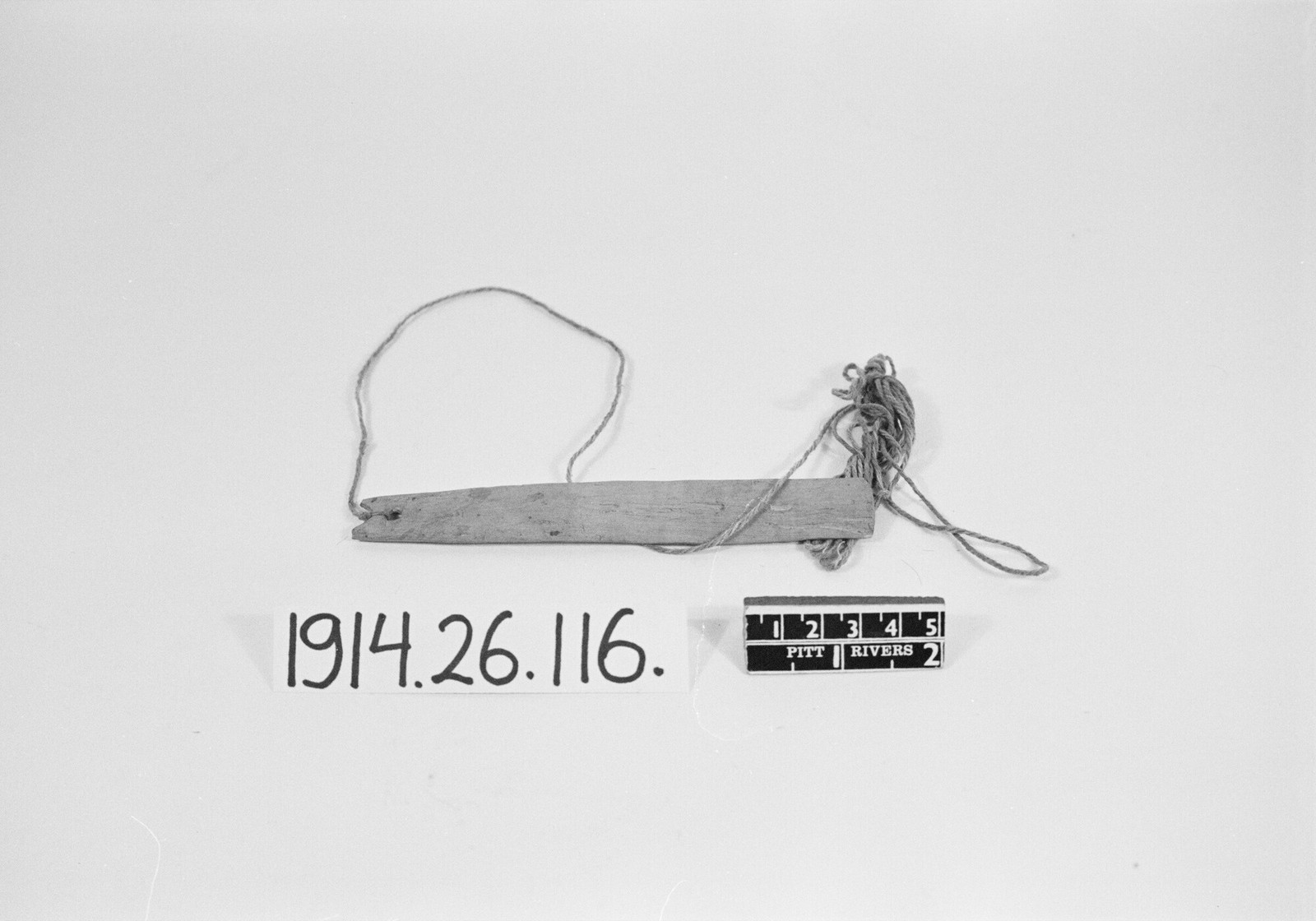
Enyara Akum
Source term: bull-roarers
Enyara Akum: Ekoi for "the dark things of the clubs," Talbot's gloss for the bull-roarers used in certain men's clubs.
Etymology. Akum is the Ekoi plural of okum, "club," the name for the secret societies of an Ekoi town; enyara are the "dark things" that belong to them.
Among the Ekoi of the Cross River, Percy Amaury Talbot recorded bull-roarers used in some of the men's clubs and called them Enyara Akum, "the dark things of the clubs." Formerly they were sounded only in secret, and women were not allowed to see them or to learn what made the whirring noise. The club-houses those roarers belonged to were seeded with serpent. Water-worn oval stones were set into a hole made in the mud base of the principal pillar of the Egbo house, placed there to promote fertility and looked upon as the "Eggs of Nimm," the great river goddess, "whether in crocodile or serpent shape"; Nimm herself, the object above all of the women's devotion, "manifests herself sometimes as a huge snake, sometimes as a crocodile," and the raised figures on the club-house walls at Abijang were explained to Talbot as Nimm in her three shapes — woman, snake, and crocodile. In 1920 Robert Lowie seized on the case: he set the Ekoi beside the Bororo of Brazil as peoples who bar women from the bull-roarer, and took the coincidence as evidence that the practice had spread from a single common source rather than arising twice over in two hemispheres.
I know of no psychological principle that would urge the Ekoi and the Bororo mind to bar women from knowledge about bull-roarers and until such a principle is brought to light I do not hesitate to accept diffusion from a common center as the more probable assumption.
Lowie 1920, Primitive Society, p. 313 (citing Talbot 1912, In the Shadow of the Bush, p. 284)
Particulars
- Object
- Two small wooden blades with their cords, 149 and 178 mm long, from the Oban district, named Enyara Akum and attributed to the Ejagham (Pitt Rivers Museum 1914.26.116 and 1914.26.117).
- Function
- Secret club bullroarers used in male club contexts; formerly played only in secret, with women barred from seeing them or knowing the source of the sound.
Sources
- Percy Amaury Talbot, In the Shadow of the Bush (1912), p. 284; pp. 2, 96, 217 View
- Robert H. Lowie, Primitive Society (1920), pp. 312-313, citing Talbot (1912), p. 284
- Pitt Rivers Museum, Oxford, object 1914.26.117