GALIN1988-002 - candidate identification
Vlasac wooden bullroarer
Serbia - Vlasac - Iron Gates (Đerdap), Danube Gorge - Europe
Function not recorded Candidate only
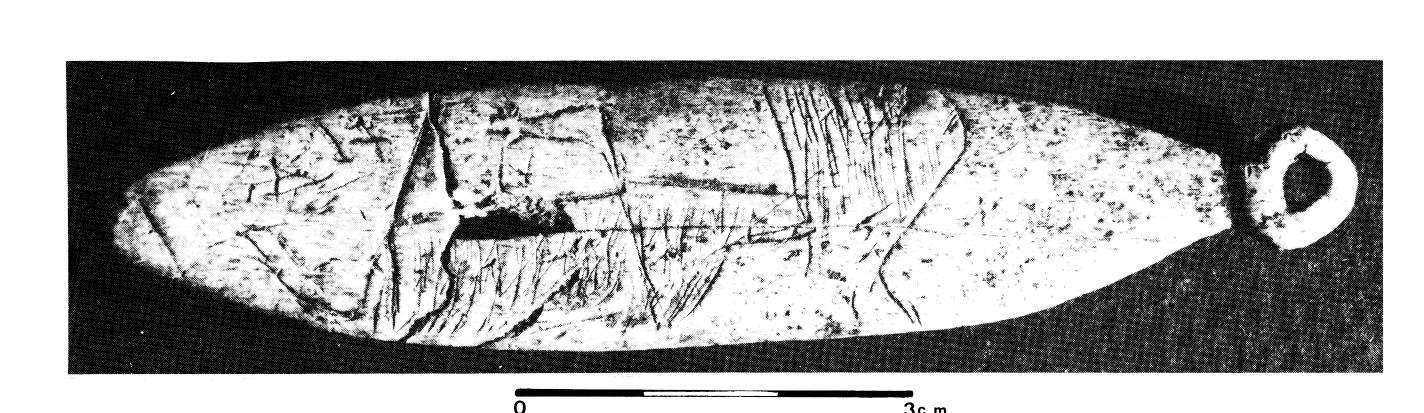
Source term: wooden bullroarer / drvena brnjača (untranslated by Galin)
Among four bullroarers Krešimir Galin catalogued from Yugoslavia in 1988 — from an Alpine cave, from Dalmatia, from central Bosnia — the fourth he places at Vlasac, on the Danube in the Iron Gates gorge, and describes in a single clause: it is made of wood. No drawing of it has ever come to light, and no independent account of the object exists anywhere in the Vlasac literature. A wooden bullroarer surviving from Mesolithic or Early Neolithic Vlasac would be remarkable — organic material this old rarely survives at all. The claim stands exactly where Galin left it: named, numbered, and unseen.
The bull roarers of the early Neolithic correspond to comparative specimens of bull roarers found in Bosnia and Hercegovina, from the site of Obre (Fig. no. 37) (A. Benac, 1979, 363), but also from Serbia, at the Vlasac site (D. Srejović, 1979, 75) This example is made of wood (Fig. no. 38).
Krešimir Galin, "Archeological Findings of Musical Instruments in Yugoslavia," Narodna umjetnost Special Issue 2 (1988), p. 136
- Object
- Known only from Krešimir Galin's own description of his unrecovered figure: a wood object he calls a bullroarer. No dimensions, shape, perforation, or cordage are recorded, and no drawing or photograph of it survives.
- Function
- Not recorded.
- Source
- Krešimir Galin, "Archeological Findings of Musical Instruments in Yugoslavia," Narodna umjetnost Special Issue 2 (1988), pp. 123-148; Hrčak record 53672 (issue 4281). Printed p. 136: "...but also from Serbia, at the Vlasac site (D. Srejović, 1979, 75) This example is made of wood (Fig. no. 38)." Galin's own citation, Srejović 1979 p. 75 (in Srejović…
- Source location
Page references
Galin 1988 p. 136 and Fig. 38 (plate pp. 147-148, not digitized, not recovered)
- Source confidence
- low Vlasac site anchor in the Danube Gorges (Iron Gates), a few km downstream of Lepenski Vir near the village of Dobra, Serbia — a well-known, resolved site locality; not an object find-spot, since no in-site provenance for Fig. 38 survives.