No. DIET2016-011
Stellmoor Ahrensburg reindeer-bone bullroarer
Northern Germany · Ahrensburg culture · Central Europe
Function not recorded
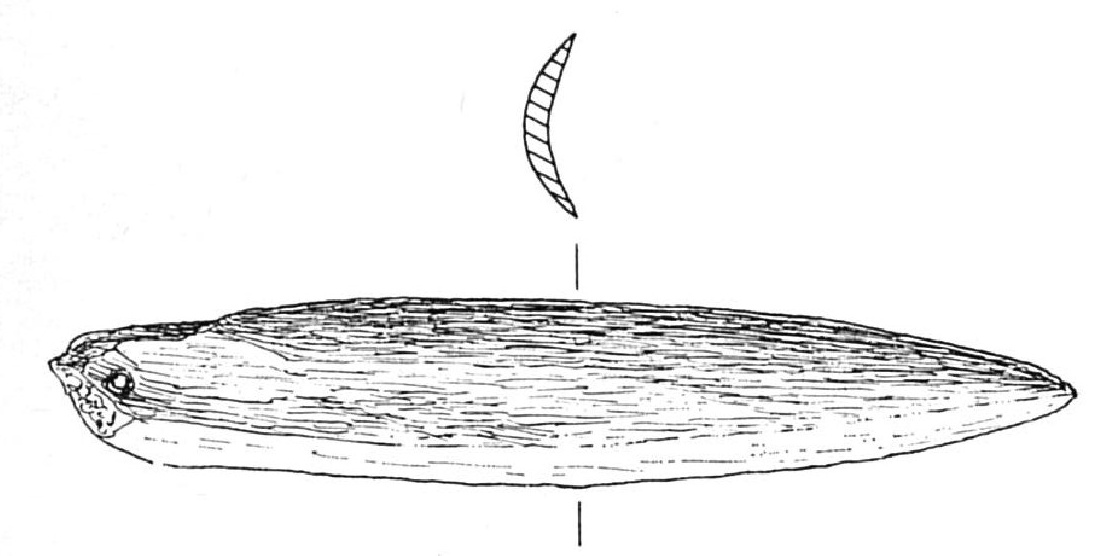
Source term: late Upper Paleolithic bullroarer
Swing it on a cord and a thin blade of reindeer bone moans — as its excavator, Alfred Rust, discovered. The piece comes from Stellmoor, a silted glacial lake northeast of Hamburg where Ahrensburg hunters waited for the seasonal reindeer herds some 12,000 years ago, and where Younger Dryas cold preserved what should long since have rotted: pine arrow shafts, worked bone, the remains of hundreds of slaughtered reindeer. Cut from a reindeer limb, the polished blade keeps the bone's natural curve, one face hollow and one rounded. On a metre of cord, swung over the first snow of winter, the blade itself raised a steady hum, likened to an aircraft propeller; whether the Ahrensburg hunters ever sounded it, and why, rests on a single scholar's identification.
Das Brummen, vergleichbar dem Geräusch eines Flugzeugpropellers, blieb bei langsamen oder schnellen Schwingungen gleichartig.
The humming, comparable to the sound of an aircraft propeller, remained the same under slow or fast swings.
Rust, Harburger Jahrbuch 13 (1968/72):17
Particulars
- Object
- Willow-leaf blade cut from reindeer limb bone, 13.3 × 2.5 × 0.3 cm, polished smooth with knife-sharp edges, pierced by a 2 mm hole at the broad end, and curved in concave-convex section.
- Function
- Not recorded.
Source
Alfred Rust, ‘Das Schwirrholz eines Linkshänders aus der Ahrensburger Kultur,’ Harburger Jahrbuch 13 (1968/72), pp. 16–17, fig. 1