No. DIET2016-007
La Roche de Birol Magdalenian bullroarer
Dordogne · Europe · Southwest France
Function not recorded
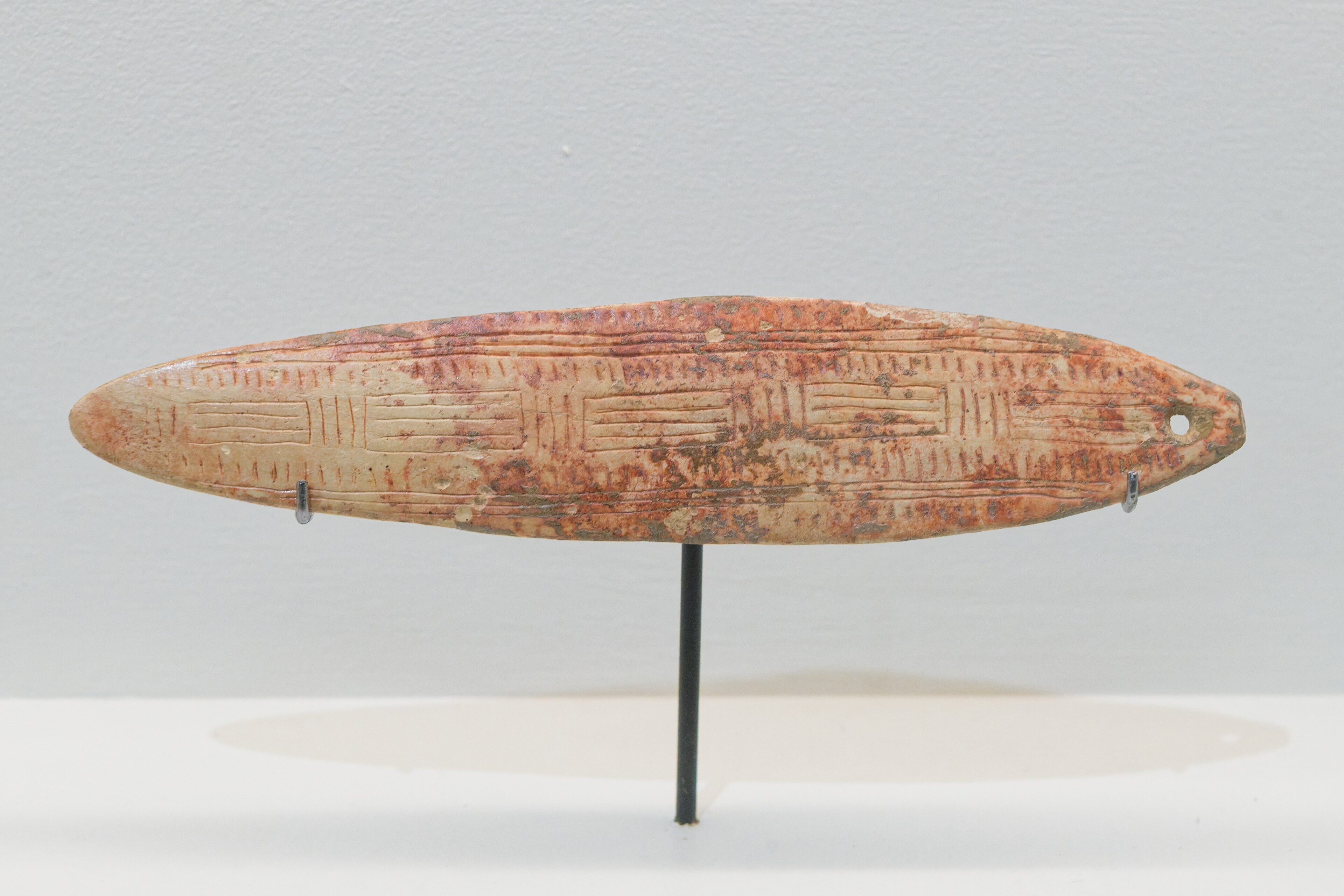
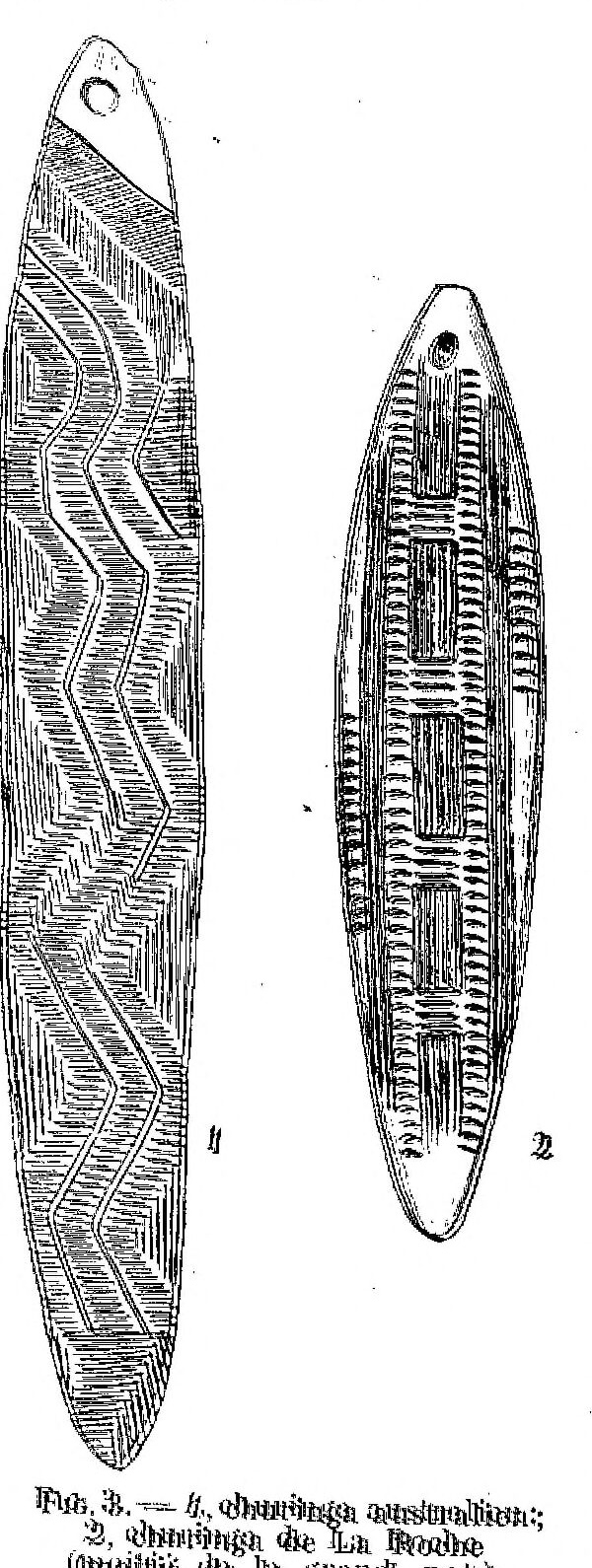
Source term: Paleolithic bullroarer / Magdalenian churinga
Some fifteen to thirteen thousand years ago, in a Magdalenian camp in the Dordogne, someone shaped a slip of reindeer antler into a slender fish-without-a-tail, drilled it for a cord, painted it with red ochre, and then incised it with neat ranks of parallel lines and dots. Pulled from the cave of La Roche de Birol (also called the grotte de la Roche) near Lalinde in a hastily dug 1927 excavation, it became the first object European prehistory ever recognized as a bullroarer: Denis Peyrony, publishing it in 1930, saw in it "an instrument identical to the one certain Australian natives call a churinga" — the bull-roarer, the planche ronflante of French usage; Henry Field, reporting the Abbé Breuil's identification, called it the first complete Magdalenian "churinga" ever found. The identification has held up, and Dauvois's acoustic experiments on a copy of it recorded the voice: a fundamental sweeping from 35 to 205 hertz with every revolution of the cord. The same shelter, in the same last-Magdalenian occupation, yielded a limestone block cut deep with eleven women in profile, headless and footless, pared down to a few geometric strokes. What it once meant, who was allowed to hear it, and who had to flee its voice are lost with the people who made it; the ochred original is kept at Saint-Germain-en-Laye.
La pièce de La Roche, présentant les mêmes caractères que les « churingas » australiens, devait certainement avoir la même destination.
The piece from La Roche, showing the same characters as the Australian 'churingas', must certainly have had the same purpose.
D. Peyrony, "Sur quelques pièces intéressantes de la grotte de La Roche près de Lalinde (Dordogne)", L'Anthropologie 40 (1930), p. 25
Particulars
- Object
- Engraved reindeer-antler pendant with incised geometric decoration, pierced for suspension, from La Roche de Birol at Lalinde, Dordogne.
- Function
- Not recorded.
Sources
- Oliver Dietrich and Jens Notroff, “A Decorated Bone ‘Spatula’ from Göbekli Tepe,” Neo-Lithics 1/16 (2016):22–31, p. 28; citing Morley (2003) and Dauvois (1989) View · archived
- D. Peyrony, “Sur quelques pièces intéressantes de la grotte de La Roche près de Lalinde (Dordogne),” L’Anthropologie 40 (1930):19–29, pp. 22, 24–25
- Delluc, Delluc & Guichard, Préhistoire du Sud-Ouest 16/2008-2 (2008), pp. 200, 204
- Iain Morley, The Evolutionary Origins and Archaeology of Music, Darwin College Research Report DCRR-002 (Cambridge, 2003), pp. 34–35, figs. 3.1–2, via Dietrich and Notroff (2016)
- M. Dauvois, “Son et musique paléolithiques,” Les Dossiers d’Archéologie 142 (1989):2–11, via Dietrich and Notroff (2016)
- Field, Man 54 (1954), p. 162
- Barandiaran Maestu, La bramadera de hueso, Kobie BAI 6 (2015), p. 152
- Musée d’Archéologie nationale, MAN 74482, accession documented by Delluc, Delluc & Guichard (2008), p. 200