No. EA-XIBENBAOLENG-001
Xibenbaoleng jade blades at the waist
China · Bairin Right Banner, Chifeng, Inner Mongolia; Xibenbaoleng tomb, Xinglongwa culture (c. 6250–5450 BC) · East Asia
Function not recorded Candidate only
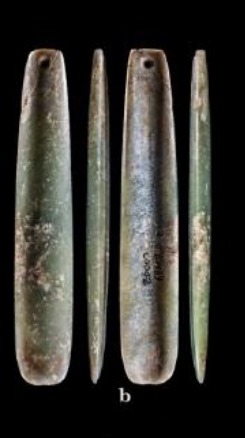
玉匕形器
Source term: yu bixingqi (jade bi-shaped object)
匕形器 (bǐxíngqì): 'bi-shaped object' — an elongated spoon- or tongue-shaped blade named after the ancient Chinese bi eating-spoon; thin nephrite blades pierced at one end.
In 1982, at a place called Xibenbaoleng in Bairin Right Banner, Inner Mongolia, a single shallow grave of the Xinglongwa culture — the eight-thousand-year-old horizon that produced the world's first systematic jade-working — was opened to reveal one person lying extended on their back, head to the north, with a slit jade ring at the head and two slender jade blades at the waist. The blades are the finest published pair of what Chinese archaeology calls bi-shaped objects: long, narrow tongues of nephrite, ground thin and pierced through one end, the larger of them nearly fifteen centimetres — well within the size range of working bullroarers, and more than twice the length of the little 6.4-centimetre shale whirler from Stone Age Tuv in Norway. They are read as waist ornaments, and lying against the body of the dead they may well have been. But it was these two blades that the jade archaeologist Tang Chung chose to set beside a strikingly similar pendant from Early Jomon Japan, tracing the same grooved manufacture and the same worn edges across the Sea of Japan — evidence, at the least, that this small end-pierced form travelled further and mattered more than a simple dress fitting.
Particulars
- Object
- Two jade bi-shaped blades and one slit jade ring (jue) from a single tomb found in 1982 at Xibenbaoleng, Bairin Right Banner — a shallow rectangular vertical-pit grave holding one extended supine burial, head to the north, assigned to the Xinglongwa culture. The jue lay at the head; the two bi-shaped blades lay at the waist. Photographs show two long, narrow, end-pierced nephrite tongues with rounded tips — the cleanest published pair of the type. One blade is reported at about 14.9 × 2.7 × 0.9 cm (Tang Chung). Held by the Bairin Right Banner Museum. Date: Xinglongwa culture, c. 6250–5450 BC (cultural attribution; no site radiocarbon published).
- Function
- Catalogued as ornaments worn at the waist.
Source
朝格巴图, 《内蒙古巴林右旗锡本包楞出土玉器》, 考古 1996(2); Zhao Binfu, Sun Mingming & Du Zhanwei, 边疆考古研究 14 (2014), figs. 3 and 5; Tang Chung (邓聪), 《桑野遺跡から見た縄文世界》, Awara forum lecture (2019), fig. 7; Kumbani, Bradfield, Rusch & Wurz, 'A functional investigation of southern Cape Later Stone Age artefacts resembling aerophones,' Journal of Archaeological Science: Reports 24 (2019)