AAS2008-001 - rock art depiction
Taru Thang held-implement figure
India - Upper Ladakh [Zhungkor], Ladakh Union Territory - South Asia
Archaeological datePossibly c. 8500–3000 BCAas's pre-farming analogy; not a direct date.
Function not recorded Candidate only
Source term: tjurunga / bullroarer
tjurunga — a Central Australian term borrowed as a visual comparison, not a Ladakhi name.
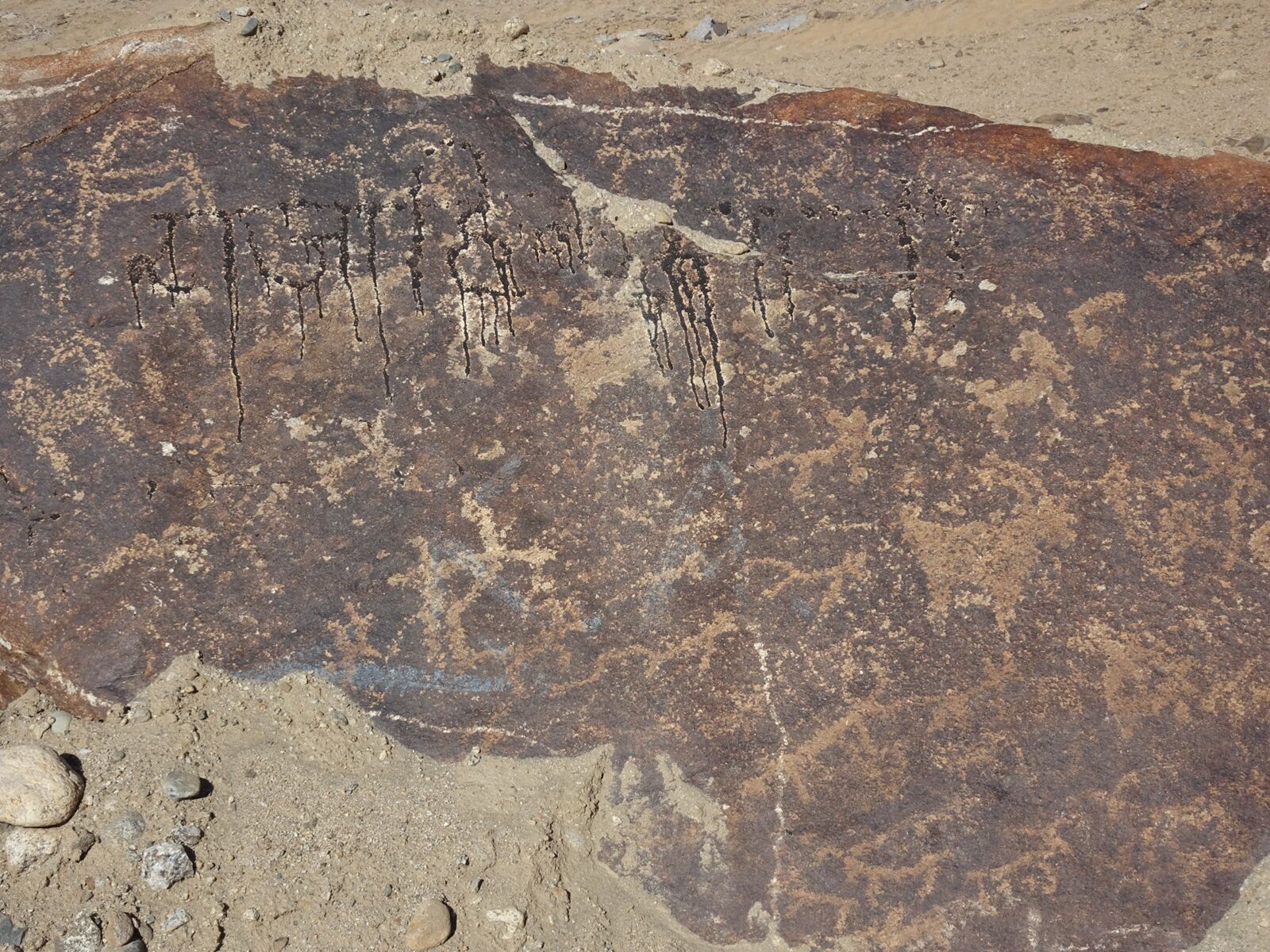
High in Upper Ladakh's Trans-Himalayan desert, human figures stride across a weathered rock panel. One holds the object that makes this carving so unusual: a bullroarer. No sound or motion survives in the stone, only a raised implement in a human hand.
One of the human figures is holding what can be interpreted as a tjurunga, a bullroarer (Scandinavian 'brummer').
Lars Reinholt Aas, The Rock Carvings of Taru Thang (MA thesis, University of Bergen, 2008), p. 40
- Object
- A pecked human figure on rock panel p315 at Taru Thang holds an object interpreted as a bullroarer.
- Function
- Not recorded.
- Source
- Lars Reinholt Aas, The Rock Carvings of Taru Thang: The Mountain Goat: A Religious and Social Symbol of the Dardic Speaking People of the Trans-Himalayas, MA thesis in archaeology, University of Bergen, spring 2008, printed p. 40: “One of the human figures is holding what can be interpreted as a tjurunga, a bullroarer (Scandinavian 'brummer').” Figure…
- Source location
Page references
Aas 2008, p. 40, fig. 4.4 (fig. 128 panel 6; fig. 18 panel 1)
- Source confidence
- medium Published archive coordinate for the exact Taru Thang p315 panel, Ladakh Archaeology / Nakala collection.