No. MUS2026-116
Pritzerber See Late Paleolithic bone bull-roarer
Germany · Pritzerber See, Havelland; Late Paleolithic (14000-10000 v. Chr.) · Central Europe
Function not recorded
Schwirrgeraet
German, "whirring device": the standard term for a bullroarer, a blade swung on a cord to produce a roaring sound.
Etymology. German for "whirring device," a plain descriptive compound for an object swung on a cord to make a roaring sound.
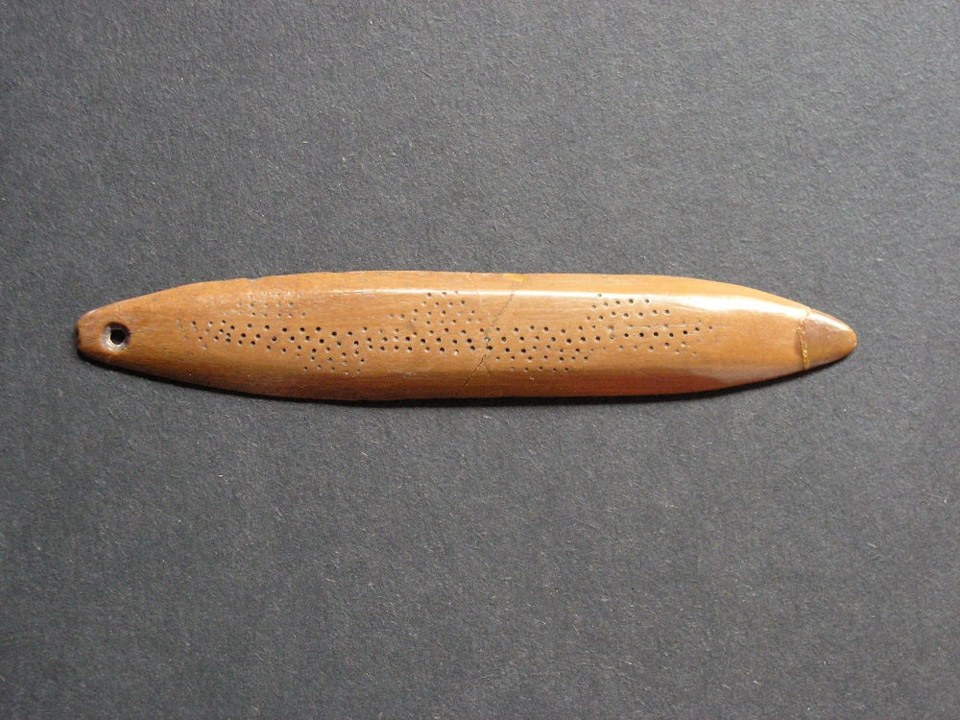
A polished bone blade just under thirteen centimeters long, double-pointed, decorated on both faces with a symmetric pattern of drilled dots and pierced by a single hole at one end for a cord. It surfaced in 1903 in the post-glacial clay beds of the Havel near the Pritzerber See, dug up with numerous other bone tools during the working of the lakeshore clay pits, and passed into the private collection of the country doctor Richard Stimming, whose holdings the Genthin museum bought in 1928. The blade is dated to the late Old Stone Age, roughly 14,000 to 10,000 BC. Its identification as a bullroarer rests on the resemblance: the curators note that the worked bone looks like the whirring sticks used by Aboriginal Australians, and label it a Schwirrgerät on that ground. Comparable Stone Age examples in Central Europe are scarce; the museum points to a find from Stellmoor in Schleswig-Holstein and to a cave in the Dordogne.
Dieses aus Knochen gearbeitete Gerät ähnelt den bei den australischen Ureinwohnern gebräuchlichen Schwirrhölzern und wird deshalb als Schwirrgerät bezeichnet. […] An einem Ende befindet sich ein Bohrloch, an dem vermutlich eine Schnur zum Schwingen befestigt war.
This implement worked from bone resembles the whirring sticks customary among the native Australians, and is therefore called a Schwirrgerät [bullroarer]. […] At one end there is a drilled hole, to which a cord for swinging was presumably attached.
Kreismuseum Jerichower Land, Genthin, museum-digital object 2731 (inv. IV 62–127)
Particulars
- Object
- A polished, double-pointed worked-bone blade with a symmetric pattern of drilled dots on both faces and a single drilled hole at one end for a cord.
- Function
- Not recorded.
Source
Kreismuseum Jerichower Land, Genthin, inv. IV 62-127 (museum-digital object 2731); Richard Stimming, 'Die Ancyluszeit in der märkischen Havelgegend,' Archiv für Anthropologie N.F. 21 (1928), pp. 109–121, figs. 141–141a