No. EA-CHAHAI-001
Chahai's thirteen jade blades
China · Liaoning, Fuxin Mongol Autonomous County; Chahai site, Xinglongwa culture horizon (c. 6050–5650 BC) · East Asia
Function not recorded Candidate only
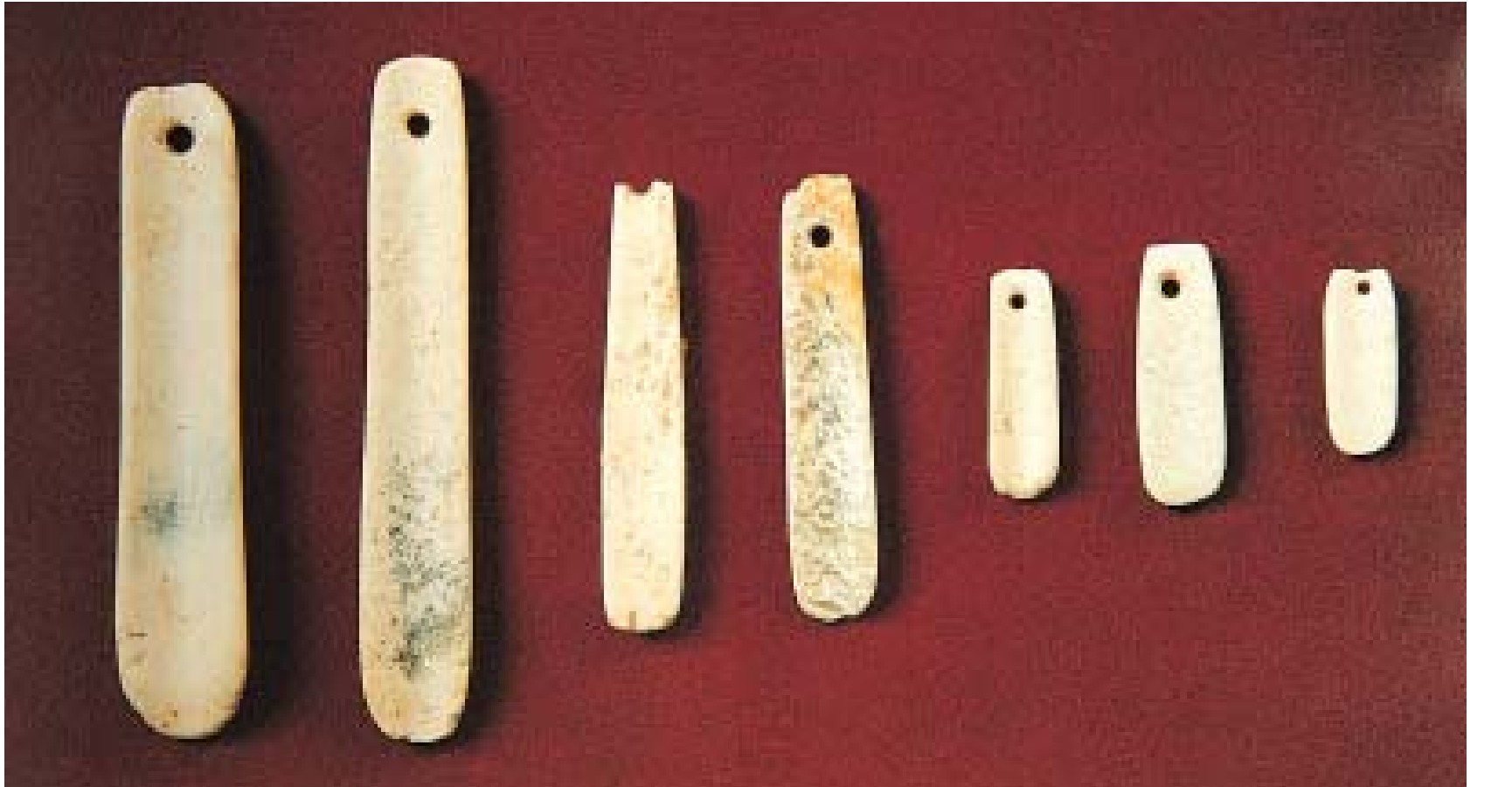
玉匕形器
Source term: yu bixingqi (jade bi-shaped object)
匕形器 (bǐxíngqì): 'bi-shaped object' — an elongated spoon- or tongue-shaped blade named after the ancient Chinese bi eating-spoon; at Chahai, thin nephrite blades pierced at one end.
At Chahai, an 8,000-year-old village site in Liaoning that holds some of the world's earliest worked nephrite, the commonest jade object is not the celebrated slit earring but a small, thin blade: thirteen tongue-shaped strips of milky white and pale green jade, five to ten centimetres long, ground to a slender lens and pierced through one end by a small pecked hole. Chinese archaeology calls them bi-shaped objects — 匕形器, after the ancient eating spoon — and reads them as pendants or dress ornaments, since they lie at the neck, chest, and waist of the dead, in one house burial as three matched pairs of descending size. But their outline is precisely that of a bullroarer: an elongated thin blade hung from a single hole at one end, the same form that led researchers to spin replicas of South African bone 'pendants' and hear them hum at 52–250 Hz. Nothing about the size forbids it — a shale blade from Stone Age Norway, 6.4 centimetres long and only 2 to 4 millimetres thick, gave 'a shrill, powerful sound' when its finder swung it on a fishing line. And these blades were not made in a silent world: bone flutes are reported from the same culture's sites, and its excavators expect drums beside them.
多出自墓主人的颈部、胸部或腹部,应是墓主人佩戴的项饰或衣服上的缀饰
Most come from the neck, chest, or abdomen of the tomb occupants — they should be necklaces worn by the dead or ornaments sewn to their clothing.
Excavation-report summary of the Chahai jade bi-shaped objects, Economic Observer, 1 December 2023
Particulars
- Object
- Thirteen thin nephrite blades from the Chahai settlement — the site's most numerous jade type (13 of 44 jade objects). Elongated tongue-shaped strips with a rounded tip, one face slightly concave and the other convex, ground to a slender lens section and pierced near one end by a single biconically pecked hole; milky white to light green tremolite-actinolite nephrite. They run from about 5 to 10 cm long; one Chahai blade measures 5 × 3.1 cm, and a Xinglongwa-area example 6.5 × 1.2 cm. Six lay in a child's burial inside House 7, at the neck, waist, and feet, in three graded pairs (large, medium, small). Curated by the Liaoning Provincial Institute of Cultural Relics and Archaeology.
- Function
- Catalogued as pendants or garment ornaments.
Source
辽宁省文物考古研究所, 《查海——新石器时代聚落遗址发掘报告》 (Cultural Relics Press, 2012); 'The 8000-year-old Chahai site,' Economic Observer, 1 December 2023; 「兴隆洼文化查海遗址出土玉器发微」, 赤峰学院学报 2014(1); Tang Chung (邓聪), Tohoku University Museum Bulletin 5; Kumbani, Bradfield, Rusch & Wurz, Journal of Archaeological Science: Reports 24 (2019): 693–711