No. PEUR2026-002
Altamira cave bramadera
Spain · Cantabria · Altamira; advanced Solutrean or Magdalenian attribution debated · Europe · Iberia
Function not recorded
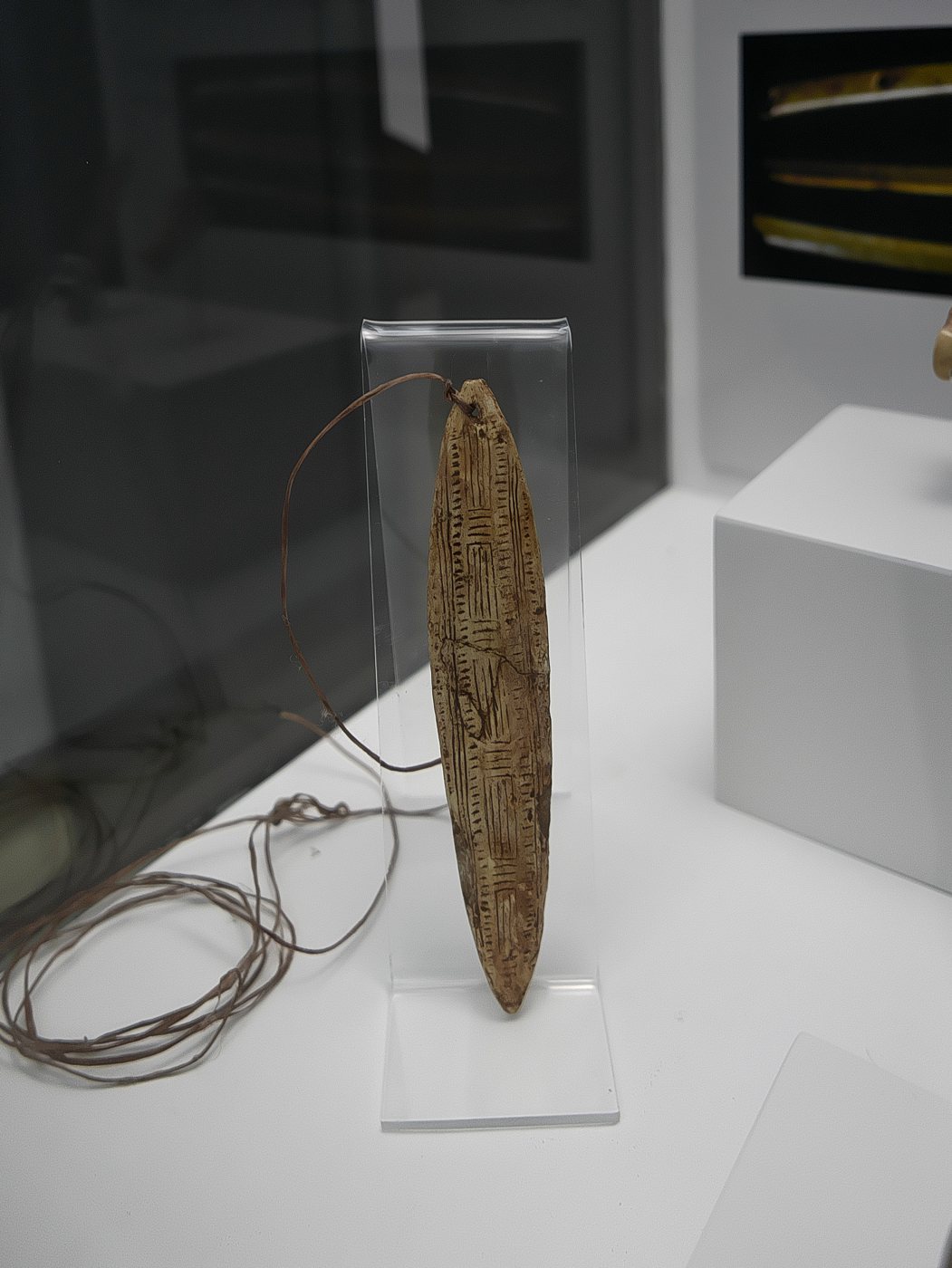
bramadera
bramadera: Spanish for "bullroarer," the standard term for the Paleolithic bone aerophones of this corpus.
Etymology. Spanish bramadera, "the roarer," comes from bramar, to bellow or roar. It is the name of a children's whirling toy, which the Real Academia defines as making a noise like the roaring of the wind.
Among the bone tools that Hugo Obermaier dug from Altamira in 1924 and 1925, and that passed to the prehistory museum at Santander, is a single fragmentary, undecorated sliver that Ignacio Barandiarán Maestu catalogued in 1966 as a bramadera — a bullroarer. He found it filed under the label "Solutrense," from a level of the very late Solutrean, when the new Magdalenian techniques were beginning to infiltrate. The piece belongs to a corpus of such objects from the Cantabrian coast to the Dordogne — thirty-four catalogued in all, most cut from rib bone into a thin spindle shape, 80 to 190 millimetres long and barely a couple of millimetres thick, pierced at one end for a cord. Whirled fast on a long line they hum and bellow, the larger blades giving the deeper note; Barandiarán reaches for the Australian churinga as the standing ethnographic parallel.
una fragmentaria (no decorada) de Altamira y una completa/reconstituida (decorada) del Pendo (Cantabria) cuyas atribuciones pueden discutirse (¿la de Altamira en el Solutrense, desde luego avanzado…)
a fragmentary (undecorated) one from Altamira and a complete/reconstituted (decorated) one from El Pendo (Cantabria) whose attributions can be disputed (that of Altamira to the Solutrean, certainly an advanced one…)
Barandiarán Maestu 2015, Kobie BAI 6:152
Particulars
- Object
- A single fragmentary, undecorated bone sliver.
- Function
- Not recorded.
Source
Ignacio Barandiarán Maestu, 'La bramadera de hueso,' Kobie BAI 6 (2015): 149-158