No. DIET2016-002
Körtik Tepe decorated perforated bone plaques
Turkey · Upper Tigris · southeastern Anatolia · Near East
Function not recorded
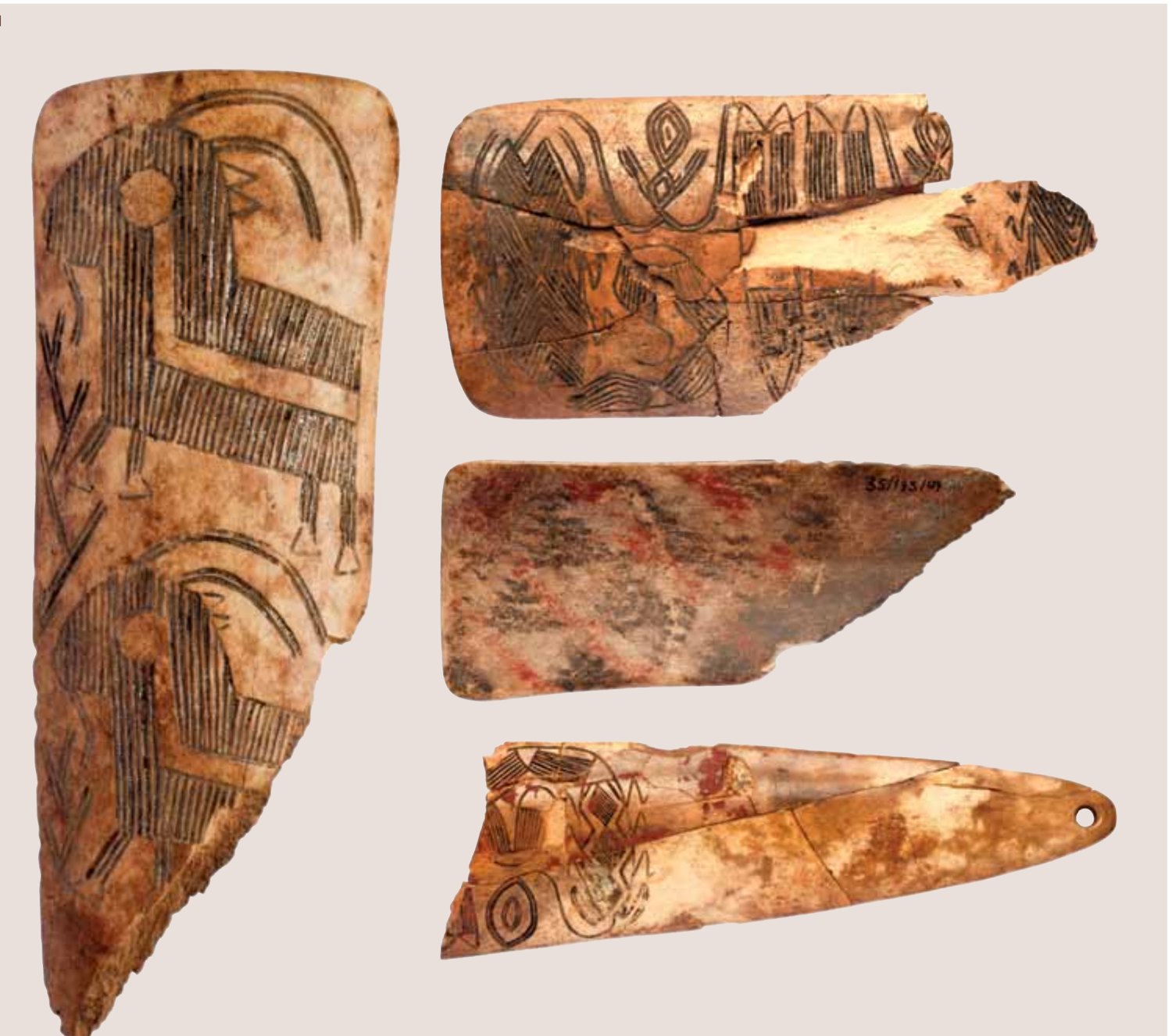
Source term: decorated perforated bone plaques / bullroarer
At least eleven painted bone plaques from Körtik Tepe, a Pre-Pottery Neolithic settlement on the Upper Tigris, were recovered from graves, part of a corpus of more than 125 decorated plaques from the site; the more complete examples are pierced so they could be hung or fixed to a cord. Seven of the painted plaques are perforated. Five carry a single hole at the narrow lower end, the geometry of a blade whirled on a cord; one is pierced in the middle and one at two upper corners, shapes that answer better to a pendant or a fitting. The carving is precise: two goats stacked in profile with eye and body-center left blank; a serpent with a lozenge eye and a slit mouth, its body doubling back in a long S-meander; a scorpion or centipede inside concentric circles, the bone still carrying traces of ochre; a painted panel of red lines and black triangles; and a band of three snakes worked as rows of hatched rhomboids. The most blade-like of the painted plaques lay in a grave beside a serpentine bead, more than eight hundred shell and stone beads and chlorite vessels: a plaquette of large-ungulate long bone painted with red ochre and black bitumen, 110 millimetres surviving of what was once nearly twice that, 42 wide and 7 thick, cut to a symmetric lens in section that thins evenly to both edges — a shape chosen rather than inherited from the curve of the bone it was split from — with a single hole of four or five millimetres at its lower end. Oliver Dietrich and Jens Notroff grouped these with similar perforated bone objects from Göbekli Tepe, Hasankeyf Höyük, and Nahal Hemar Cave and proposed they were bullroarers, instruments swung on a long cord to make sound; a hardwood replica built to the same forms and dimensions produced a deep vibrating tone. The excavators, for their part, read the hole as a way to hang the plaques.
An experimental reproduction of the presumed PPN bullroarers of hard wood serves its function very well and produces a deep vibrato sound.
Dietrich and Notroff 2016, Neo-Lithics 1/16:28-29
Particulars
- Object
- Decorated bone plaques from funerary contexts, carved or painted with goat, snake, scorpion or insect and geometric motifs: more than 125 plaques from the site, over seventy incised and eleven painted. Of the eleven painted plaquettes, seven are perforated: five by a single hole at the lower end, one (KE-60) by a single hole in the middle, and one (B-45) by a pair of holes at the two upper corners. The best bullroarer-shaped member is KTK'07 KE-295 from Burial M7 in Trench A44: a long-bone plaquette of a large ungulate painted with red ochre and bitumen, preserved to 110 × 42 × 7 mm (broken at the middle, originally almost twice as long), with one lower-end hole of about 4–5 mm on the long axis and a symmetric biconvex section.
- Function
- Not recorded.
Source
Oliver Dietrich and Jens Notroff, Neo-Lithics 1/16 (2016): 22-31, Appendix 1 nos. 5-11; Siddiq, Şahin and Özkaya, 'Local trend of symbolism at the dawn of the Neolithic,' Archaeological Research in Asia 26 (2021): 100280; Özkaya and Coşkun, 'Körtik Tepe,' in The Neolithic in Turkey: New Excavations, New Research – The Tigris Basin (2011): 89-127