No. LANG1904-001
Předmostí concentric-arc ivory pendant
Czech Republic · Moravia · Přerov; Gravettian (Pavlovian) mammoth-hunters' camp, labelled 'Solutréen' by Hoernes · Central Europe
Function not recorded
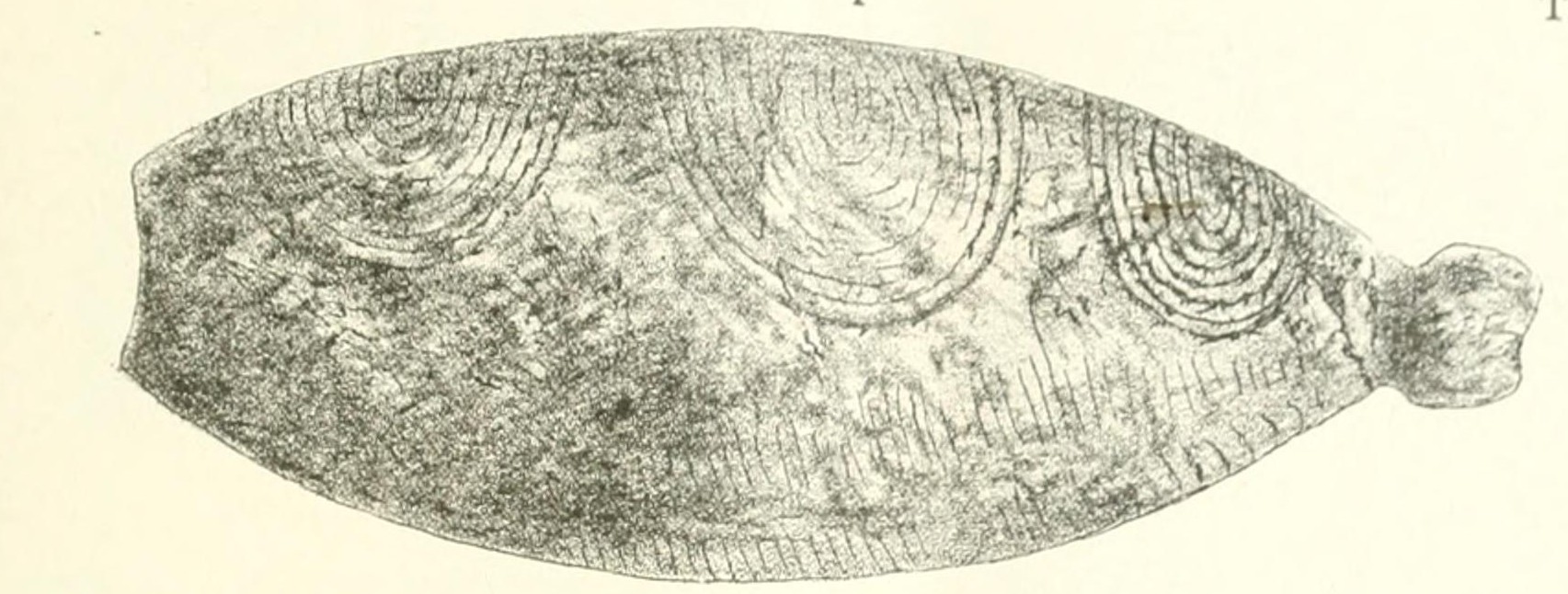
Source term: palaeolithic pendeloque of the bullroarer pattern
pendeloque (French, borrowed into English archaeology): a pendant, an object worked to hang from a cord.
Farmers at Předmostí, above the Bečva, once ground the giant bones from Hradisko hill into fertiliser. Beneath lay the camp of Ice Age mammoth hunters, and in the mid-1890s Martin Kříž took from its ash layers this small oval of mammoth ivory, under ten centimetres long, cut down to a knob for a thong and engraved with three nests of concentric arcs. He drew it on the same plate as the famous engraved geometric woman. In 1904 Andrew Lang saw in its outline an Australian bullroarer.
Dr. Hœrnes does not remark on the thoroughly Australian appearance of this object.
Andrew Lang, Man 4 (1904), No. 22, p. 37
Particulars
- Object
- A flat oval cut from mammoth ivory and smoothed, 95 mm long and 37 mm wide at the middle, with a small knob at one end, narrowed into a neck so that a thong could be tied round it; no hole is drilled. One face carries two kinds of engraving: three nested sets of finely cut concentric semicircles along one long edge, and rows of short parallel strokes along the other, partly worn away at the middle. The end opposite the knob is cut straight across. Thickness is not recorded.
- Function
- Not recorded.
Sources
- Andrew Lang, "Notes on Mr. Cook’s paper," Man 4 (1904), no. 22, pp. 37-38 View
- Martin Kříž, "Mé výzkumné práce u Předmostí a jich hlavní výsledky," Časopis Vlasteneckého spolku musejního v Olomouci 13 (1896), p. 9, item 5d; p. 61; Tab. I fig. 1 View
- Moriz Hoernes, Der diluviale Mensch in Europa (Braunschweig: Vieweg, 1903), p. 138, fig. 55 no. 8; pp. 139-146 View
- Breuil, L’Anthropologie 35 (1925), p. 542, quoted in Patte (1934), pp. 53-54
- Patte, Revue anthropologique 44 (1934), pp. 53-54, quoting Breuil (1925)