No. MALTA2026-001
Mal'ta engraved ivory plaque (churinga analogy)
Russia · Irkutsk Oblast, River Belaya; Mal'ta–Buret' culture (Gravettian-age) · South Siberia
Function not recorded Candidate only
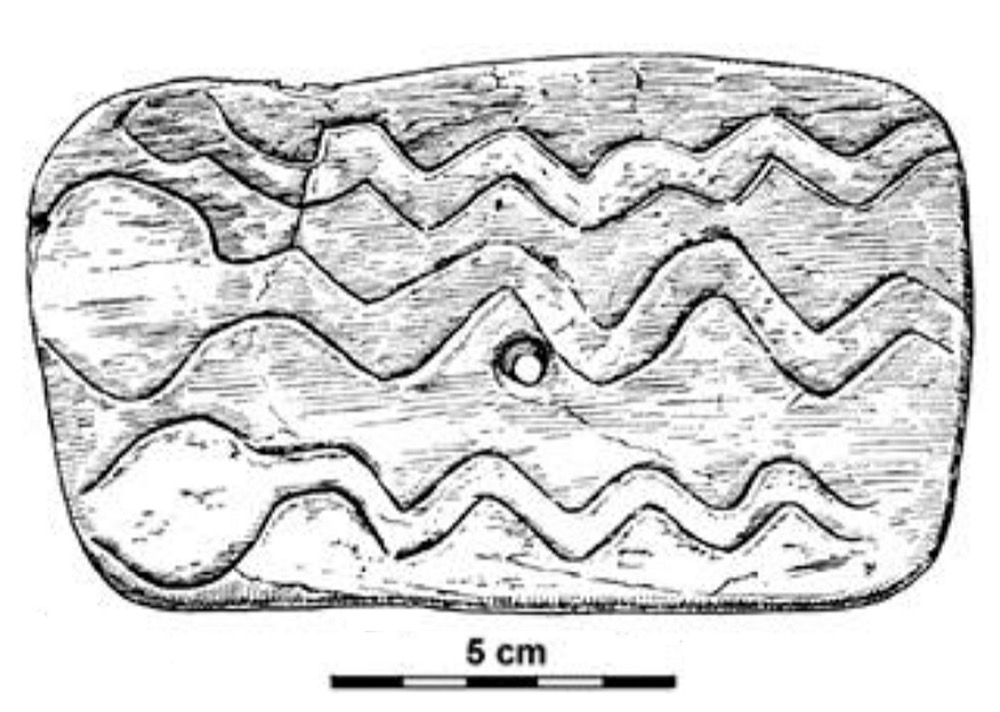
Source term: engraved ivory plaque / churinga analogue
churinga (tjurunga): among Aboriginal Australians, an incised sacred board or stone; whirled on a cord it is a bullroarer, unwhirled it is a sacred object in its own right.
Not a bullroarer. The perforation runs through the centre of this plaque, so it could never have been whirled on a cord. It bears directly, though, on the diffusionist case for the roarer itself. Joseph Campbell held that the instrument reached its two great strongholds out of exactly this quarter of the world: 'Passing eastward across Siberia into America, as well as southeastwardly to Australia, shamanism traveled as but one element of a living compound that included -- besides the x-ray style of animal painting and engraving, the atlatl, and the bullroarer -- an elaborate complex of social regulations, ceremonials, and associated mythological ideas, which scholars have designated by the very broad term totemism' (The Way of the Animal Powers). Mal'ta, on the Belaya River west of Irkutsk, sits at the head of that corridor. The site is the far eastern outpost of the Gravettian world, whose mammoth-ivory Venus figurines run from the Pyrenees to Lake Baikal, and it is the type-site of the 'Ancient North Eurasian' population whose DNA surfaces in both Europeans and Native Americans -- the proven human bridge between the Old World and the New. Among the ivory carvings M.M. Gerasimov dug from the encampment in 1929 is this flat plaque of mammoth tusk, a hand's breadth across: three wavy, cobra-headed snakes engraved on one face, a dotted spiral winding out from the central hole on the other. Snakes carved in the same ground as the Venuses, at the hinge between the continents -- very plausibly the snake cult itself, travelling with the goddesses. And if the plaque is not a roarer, it is likely the next thing to one: a spindle device. The analysts who examined it for the Mal'ta project found no trace of suspension at all -- a drilled channel worn away to nothing, the lips of the hole flared and polished on both faces, an object never rigidly fixed which, they concluded, rotated on an axis. That is the wear a centrally pierced disc leaves when it is spun on a doubled, twisted cord: a buzzer, the roarer's small cousin, and one of the oldest so documented anywhere. A Hermitage curator reads the same smoothing as the polish of a cord knotted through the hole and has the plate hanging level instead -- two specialists, one perforation, and only one of them has it spinning. If it did spin, the spiral was made to move: a spiral turned about its own centre appears to pour outward or draw inward without end, and the snakes on the reverse would have flickered in and out of view at every reversal. Kept still, it is close kin to the Australian churinga, the flat incised board that is a bullroarer when whirled and a sacred object in its own right when not.
Биконическое сверление не оставило цилиндрического канала, он стерся, вероятно, что предмет вращался на оси.
The biconical drilling left no cylindrical channel -- it has been worn away; probably the object rotated on an axis.
Art of Mal'ta project catalogue, technological record for Hermitage inv. 370/732 (malta.artemiris.org, find no. 4), section 'Техника изготовления'
Particulars
- Object
- A flat mammoth-ivory plaque, 138 x 81 mm, carved and polished, engraved on one face with nested dotted spirals and on the other with three undulating snakes, and pierced by a single biconical hole through its centre. The perforation's drilled channel has been worn away entirely and both lips are flared and strongly polished -- wear the Mal'ta project catalogue reads as rotation on an axis rather than suspension, and Demeshchenko (2022) as the smoothing left by a cord knotted on both faces. Excavated by M.M. Gerasimov (1928-1930) at Mal'ta on the Belaya River west of Irkutsk; State Hermitage, St Petersburg.
- Function
- The contested use-wear points either to a disc spun on an axis (a buzzer) or to a plate hung from a knotted cord.
Sources
- M. M. Gerasimov, Mal’ta. Paleoliticheskaya stoyanka (Irkutsk, 1931), pp. 15-17
- M. M. Gerasimov, “Paleoliticheskaya stoyanka Mal’ta,” Sovetskaya etnografiya 3 (1958), p. 31
- V. E. Larichev, Mal’tinskaya plastina iz bivnya mamonta (Novosibirsk, 1986)
- R. G. Bednarik, 'Pleistocene Palaeoart of Asia,' Arts 2(2) (2013), pp. 46-76, fig. 4 View
- N. Cauwe, G. Medvedev, E. Lipnina et al., “Mal’ta en Siberie,” Anthropologie et Prehistoire 107 (1996), pp. 109-130, at p. 118, fig. 12a
- Art of Mal’ta project catalogue, find no. 4, State Hermitage Museum inv. 370/732, section “Техника изготовления” View · archived