No. EA-KAWAJIRI-001
Kawajiri broken axes reground and pierced
Japan · Okajima, Esashi Town (Okhotsk Subprefecture), Hokkaido; Kawajiri site, now Horobetsu Right-Bank Terrace site · East Asia
Function not recorded Candidate only
有孔石斧
Source term: yūkō sekifu (perforated stone axe)
有孔石斧 (yūkō sekifu): 'perforated stone axe' — northern Japan's report-language for end-pierced re-worked axe blades.
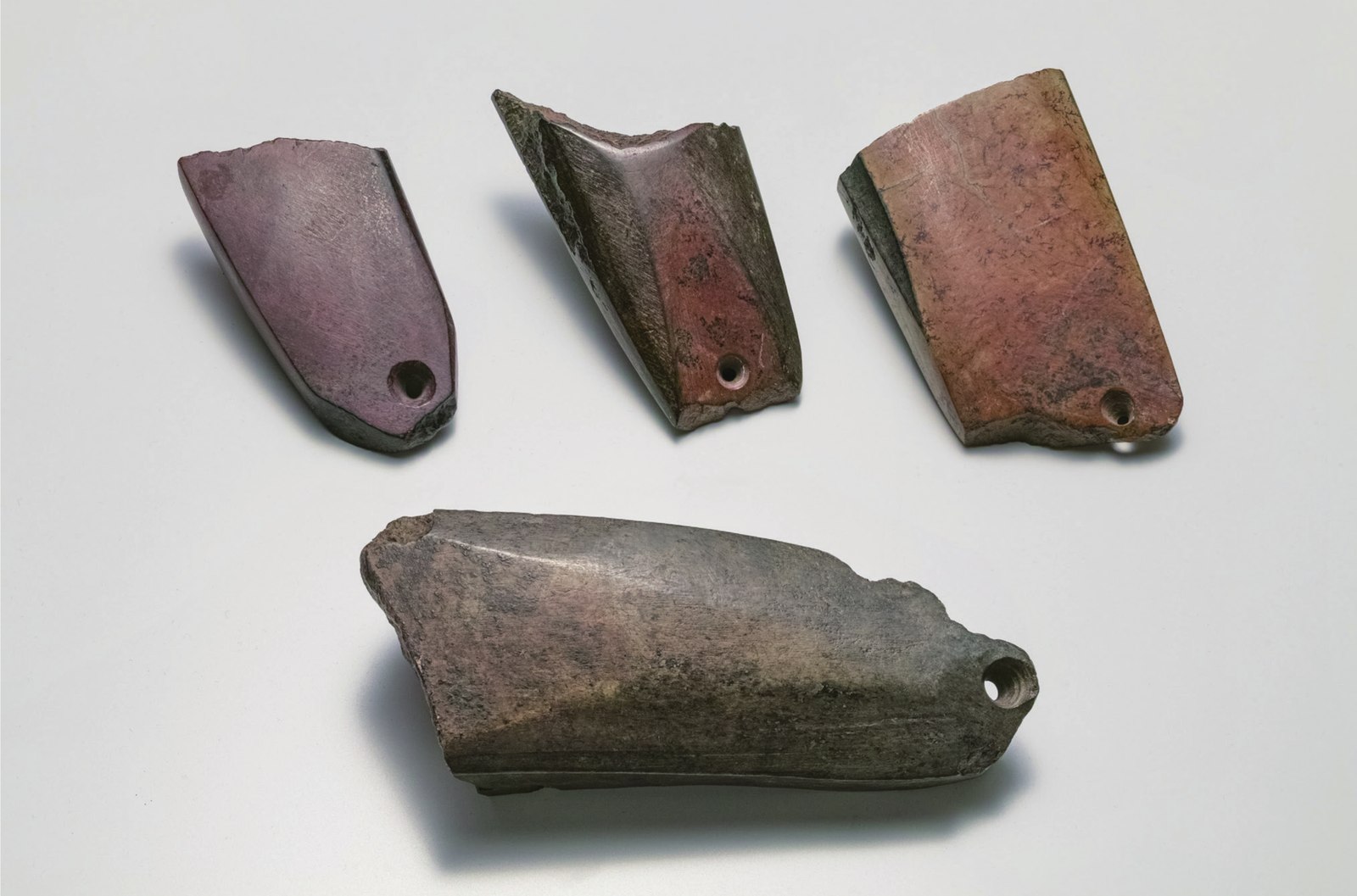
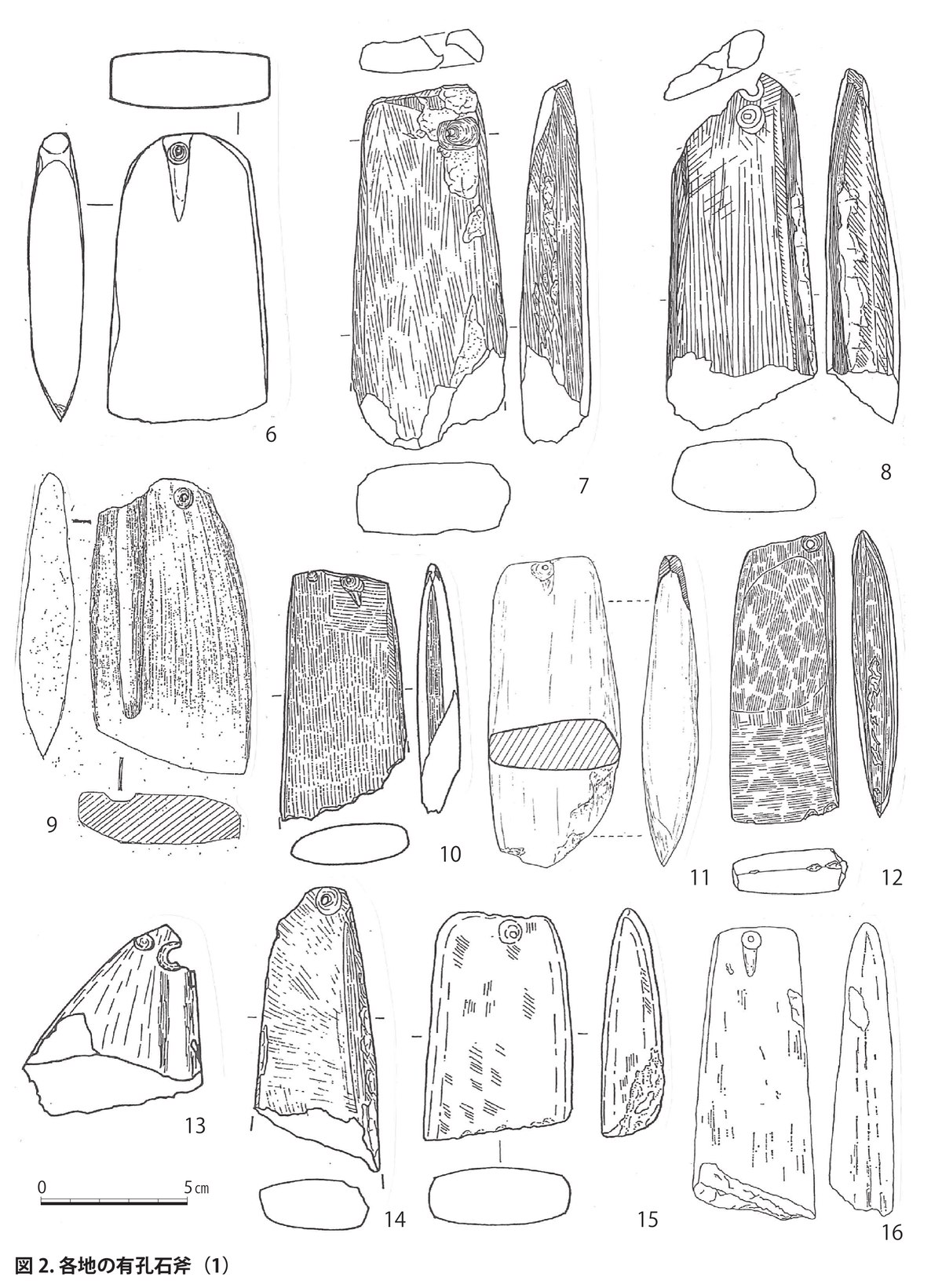
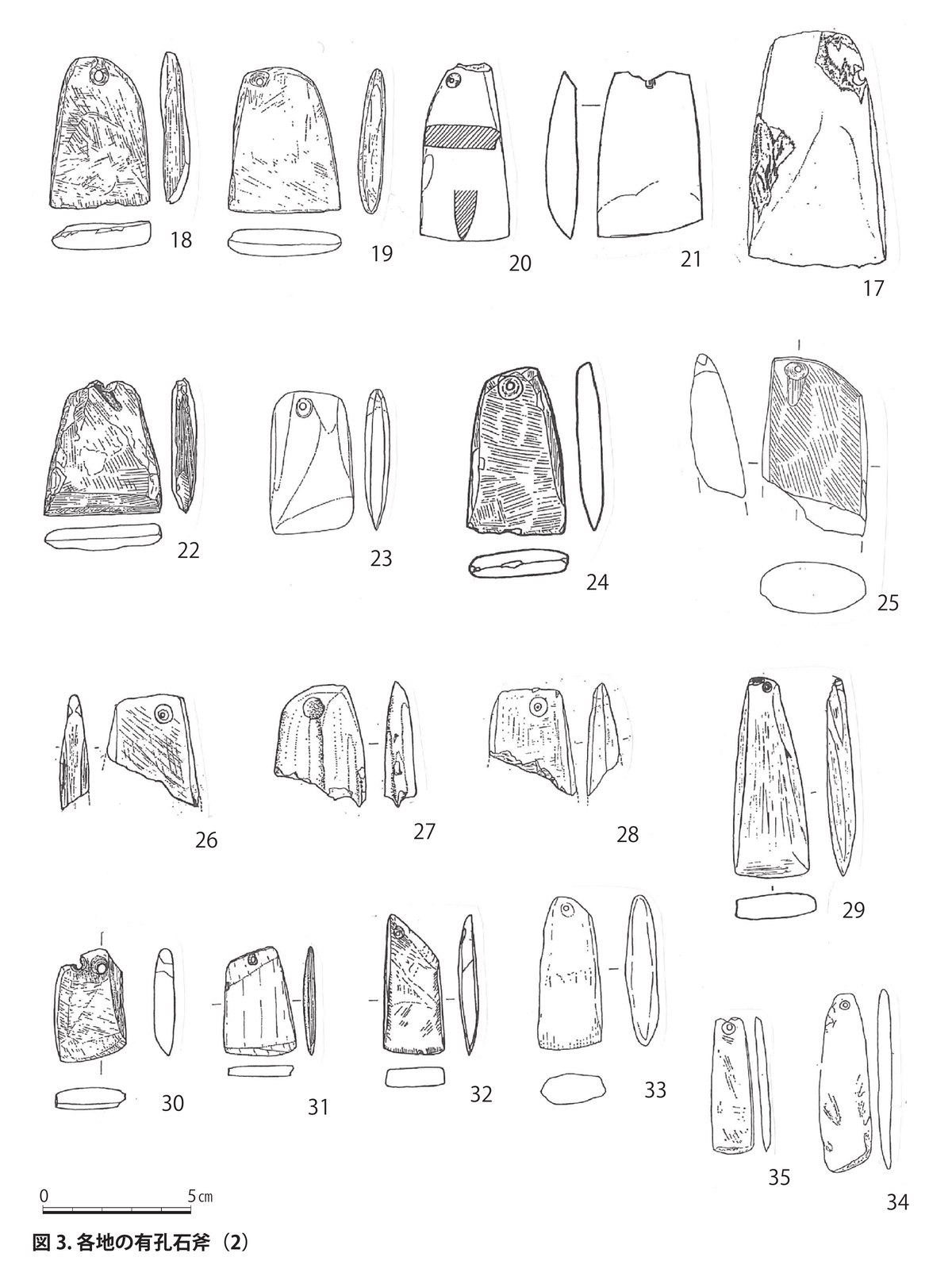
From one trench at the Okajima Kawajiri site on Hokkaido's Okhotsk coast came four perforated stone blades of the Initial Jomon. The largest is a 12.3-centimetre strip of dark stone with a red heart, biconically drilled near one end, the drill's rotary striations still legible in the hole — and at 228 grams, its base never even shaped, it would be a poor thing to whirl. But two of its companions were broken axes deliberately ground smooth again before being pierced, part of a northern class now numbering about forty, which archaeologists read as ornaments or worn-out tools re-hung at the waist. The open question belongs to the thinner survivors: when a broken polished axe became a light blade on a cord, did it ever become an instrument?
Particulars
- Object
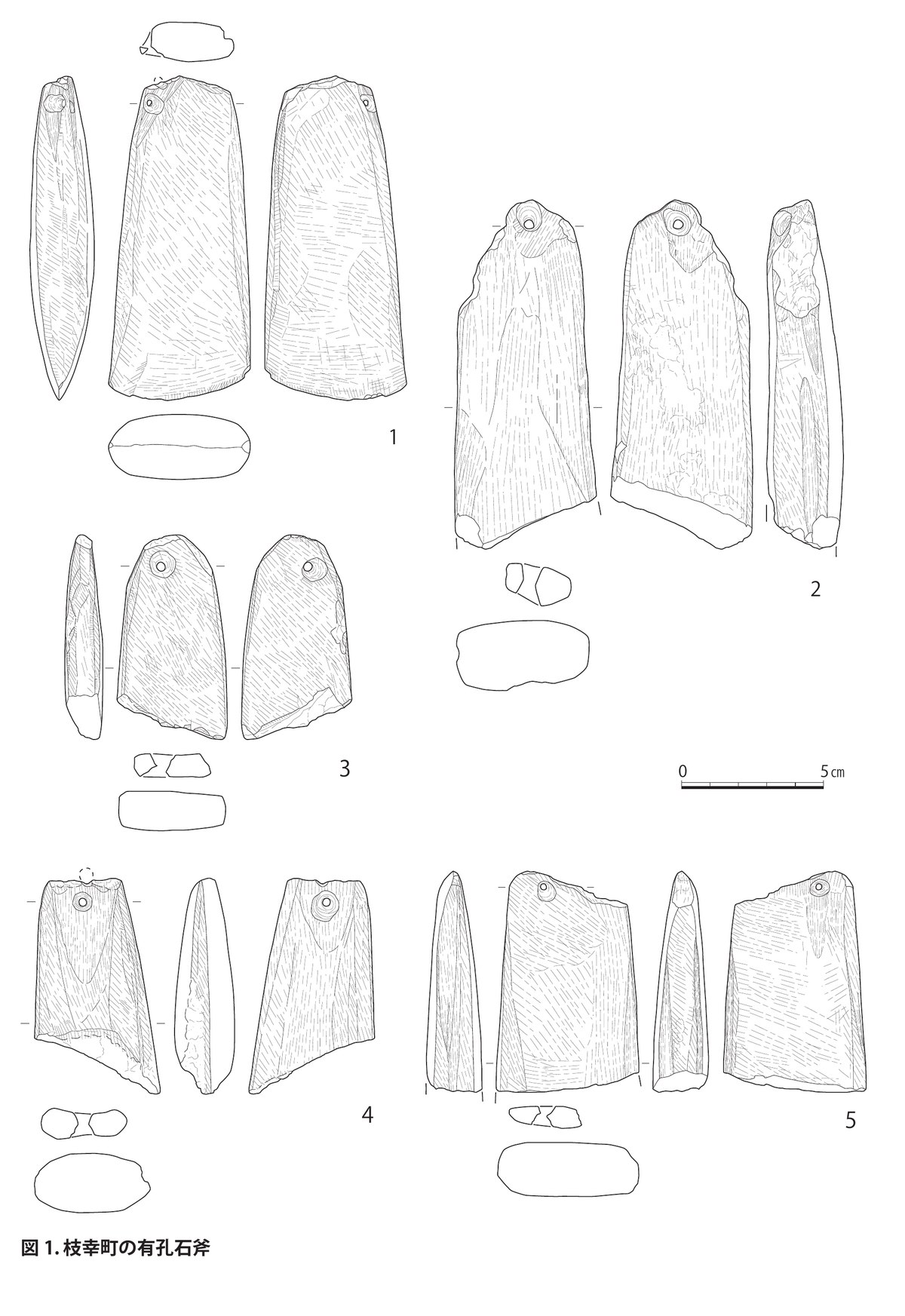
- Four perforated and reworked polished-stone axe objects from one trench. The largest, no. 2, is a strip-shaped (短冊状) slat, (12.3) × (5.0) × (2.7) cm and 228.4 g, biconically drilled with clear rotary striations, a saw-cut (擦切) groove, warped axis and unformed base — possibly unfinished. Nos. 3–5 are basal fragments of 55.0, 68.4 and 110.2 g; nos. 3–4 carry grinding on their fracture faces — broken axes deliberately reworked after breakage. Red argillaceous chert per the 1964 report, though Tatsuta notes the pieces look serpentinite-like and may be rodingite or tremolite rock. Same trench: Higashi-Kushiro I–IV pottery, ten stone-blade arrowheads, 120 net sinkers. Date: Initial Jomon, middle phase; serpentinite-axe phases III–IV, roughly 8,100–6,000 years ago (an uncalibrated class/site horizon).
- Function
- Published as perforated stone axes: broken polished axes deliberately reground and pierced for suspension, read as portable tools or stone stock carried on a cord — the site report imagined them slung from the waist. Whether the thinner pieces also sounded on that cord is the open question.
Source
Tatsuta Osamu (立田理), 「有孔石斧について(枝幸町岡島川尻遺跡(現・ホロベツ右岸段丘遺跡)出土の有孔石斧からの考察)」, Esashi Kenkyu 枝幸研究 (Bulletin of the Okhotsk Museum Esashi) 11 (2020): 25-32, Table 1, nos. 2-5, fig. 1 nos. 2-5 and photo 2; Okhotsk Museum Esashi, Niioka collection