No. DIET2016-009
Lespugue Solutrean hearth blade
France · Haute-Garonne · Pyrenees · Europe
Function not recorded
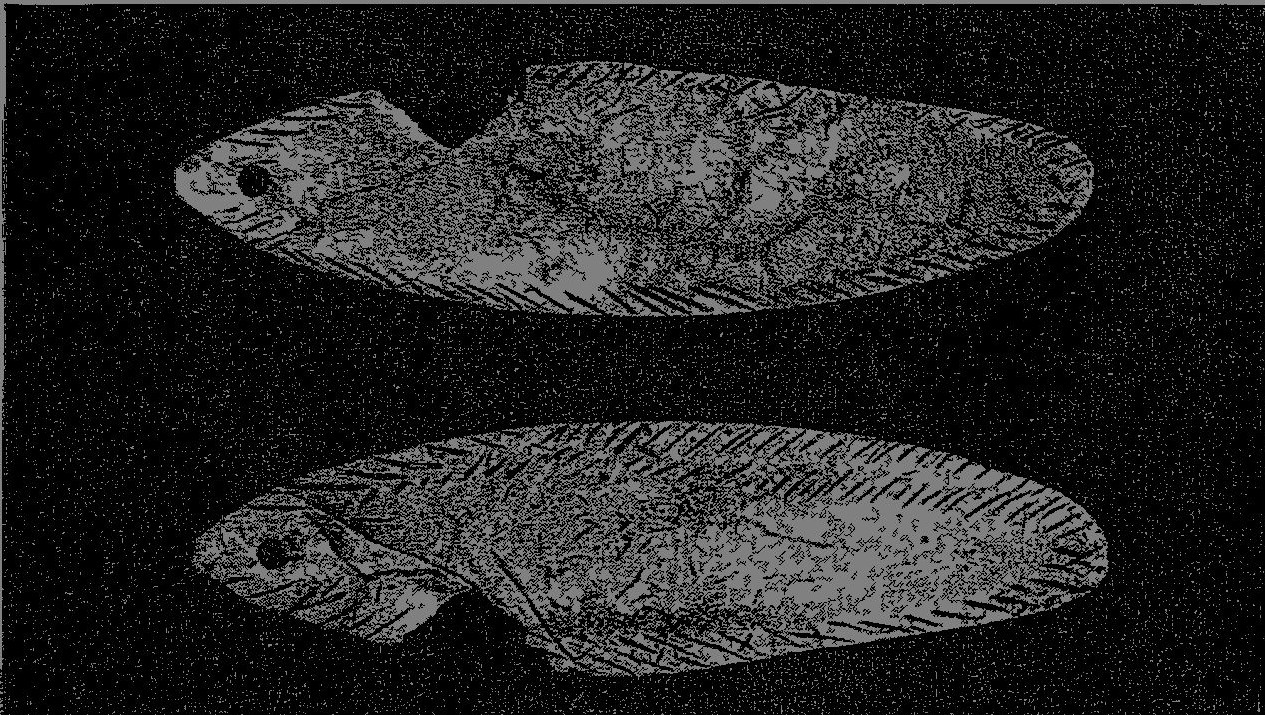
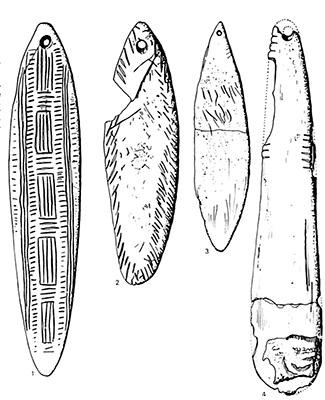
Source term: lame pisciforme (Saint-Périer); rhombe (Dauvois)
In 1926, about ten metres out from the overhang of the Grotte des Harpons at Lespugue, René de Saint-Périer uncovered a scatter of small Solutrean hearths, each ringed with quartzite pebbles. In one of them, among shouldered flint points with hollowed bases, lay a blade of bone ninety millimetres long, polished very thin, pierced at one end and fringed along both edges with groups of fine oblique cuts: the outline of a fish. Saint-Périer thought of the bone lures Inuit fishermen twirled on a line to draw salmon. Michel Dauvois, who set replicas of Ice Age blades roaring on a cord, placed it among the bullroarers of Solutrean France. The gorge of the Save holds women on either side of that fire: the ivory Venus of Lespugue, carved thousands of years earlier in the neighbouring Grotte des Rideaux, and a woman engraved on reindeer antler by the Magdalenians who later camped in the Harpons cave itself.
C'est dans l'un de ces foyers que gisait le premier objet que nous décrirons, accompagné de pointes à cran à base concave.
It was in one of these hearths that the first object we shall describe lay, accompanied by shouldered points with concave bases.
R. de Saint-Périer, "Engins de pêche paléolithiques," L'Anthropologie 38 (1928), p. 17
Particulars
- Object
- Thin, carefully polished bone blade, 90 mm long, fish-shaped in outline and pierced by one circular hole at one end; both edges carry groups of fine oblique parallel striations. The notch in one edge is an excavation break.
- Function
- Not recorded.
Sources
- R. de Saint-Périer, 'Engins de pêche paléolithiques,' L'Anthropologie 38 (1928), pp. 17-19, fig. 1 no. 1 View
- Michael Praxmarer, 'Blasinstrumente aus dem europäischen Jungpaläolithikum,' Archaeologia Austriaca 103 (2019), p. 89, table 1 no. 7
- Oliver Dietrich and Jens Notroff, Neo-Lithics 1/16 (2016): 22-31, p. 28
- Iain Morley, The Evolutionary Origins and Archaeology of Music (2003), pp. 34-35, fig. 3.1-2
- M. Dauvois, 'Son et musique paléolithiques,' Les Dossiers d'Archéologie 142 (1989): 2-11, p. 10
- Seewald (1934), cited in the Saint-Périer–Dietrich source chain