No. EA-BEIFUDI-001
Beifudi jade blade, sacrificial precinct
China · Yixian County, Baoding, Hebei; Beifudi site, Phase 1 (c. 6050–5050 BC), Taihang piedmont · East Asia
Function not recorded Candidate only
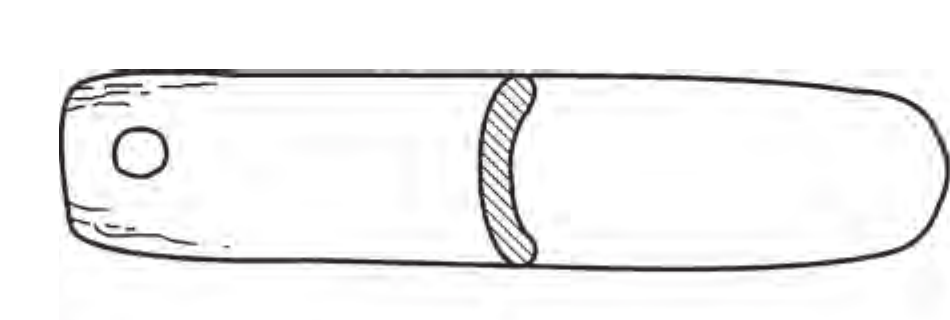
玉匕
Source term: yu bi (jade bi-shaped blade)
祭祀场 (jìsìchǎng): 'sacrificial ground' — a dedicated open-air ritual precinct; at Beifudi, a shallow rectangular area holding a deliberate deposit of stone, turquoise, crystal and jade.
Most of the little jade blades of this class were found lying on the bodies of the dead, which is why archaeologists read them as ornaments. Beifudi is the exception. At this eight-thousand-year-old village on a terrace above the Zhong Yishui River, in the eastern foothills of the Taihang mountains, the excavators uncovered not just houses but a sacrificial ground — a shallow rectangular precinct some eleven metres by eight, into which about ninety objects had been set down in clusters: stone tools, turquoise, rock crystal, and jade. Beifudi's jade comes in only two shapes, the slit ring and the bi-shaped blade, the same pair that recurs across the whole Xinglongwa world. Here the bi-blade is not a thing worn to the grave but a thing given to a ritual place. It is still catalogued as an ornament. But it is the one place in the bi-shaped series where the form steps out of the costume of the dead and into a rite — exactly where a sounded instrument would be expected to appear.
Particulars
- Object
- A jade bi-shaped blade from Beifudi, a Phase 1 Neolithic settlement on the north bank of the Zhong Yishui River in the eastern Taihang foothills of Hebei. Beifudi's small jade repertoire runs to just two forms — slit rings (jue) and bi-shaped blades (bi) — the same pairing seen across the Xinglongwa horizon. What sets Beifudi apart is find context: its jade came not from a grave but from a dedicated sacrificial ground (祭祀场), a shallow rectangular precinct about 10.8 by 8.4 metres in which some ninety objects — stone tools, turquoise, crystal and jade — were laid in deliberate clusters. Phase 1 is contemporaneous with the Cishan and Xinglongwa cultures.
- Function
- Catalogued as a jade ornament type, but recovered from a ritual precinct rather than a burial.
Source
Duan Hongzhen (段宏振), Hebei Provincial Institute of Cultural Relics, Beifudi excavations (1985; 2003-2004), Phase 1; comparison plate in 边疆考古研究 14, item 6; Kumbani et al. 2019