No. MUS2026-117
El Pendo Magdalenian bramadera
Spain · Cueva de El Pendo, Cantabria; Magdalenian attribution debated within the corpus · Europe · Iberia
Function not recorded
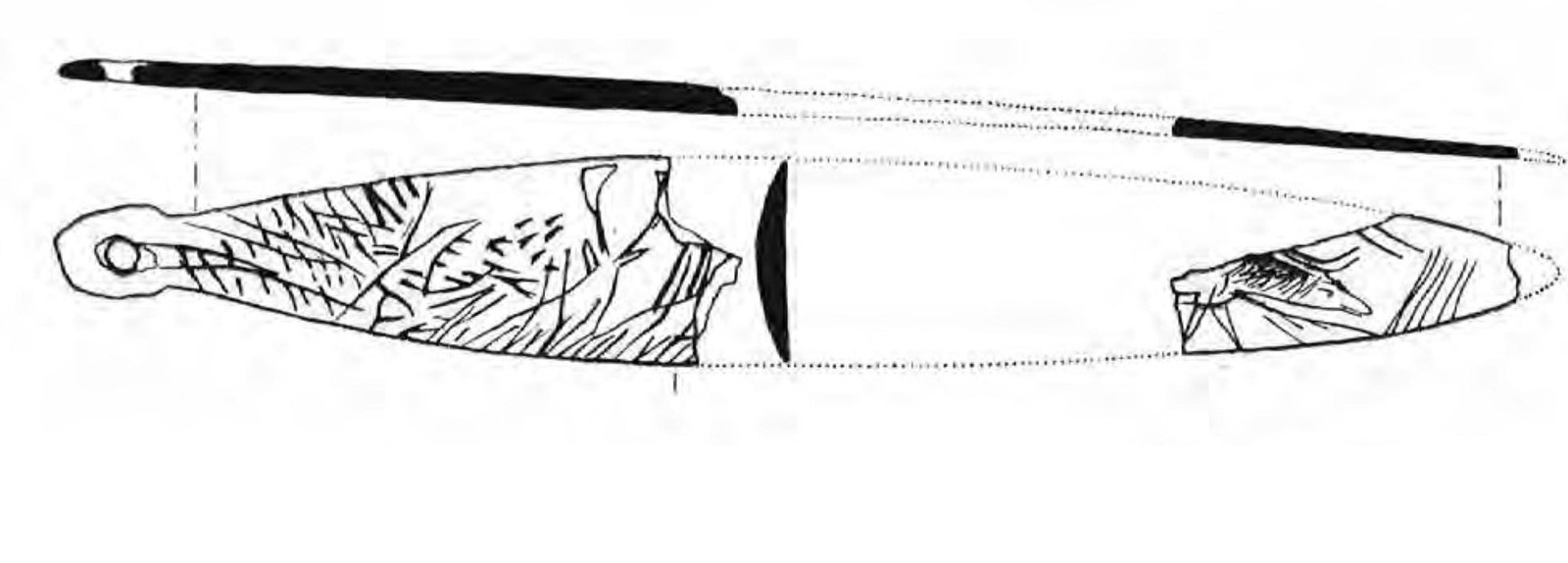
bramadera
Spanish for "roarer/bellower," the standard term for a bullroarer; in Paleolithic archaeology used (with rombo and zumbador) for thin perforated bone or stone plaques thought to be whirled aerophones.
Etymology. Spanish for the bullroarer, from bramar, "to roar, bellow"; Barandiarán describes it as the Castilian name applied by analogy to the children's toy bramador, and the dictionary sense ties the whirled board's noise to el bramido del viento, the roar of the wind.
From the Magdalenian deposits of El Pendo cave, near Santander in Cantabria, comes a whirled slip of bone, split from a rib, notched and pierced at its head for the cord. Ignacio Barandiarán reconstructed it from two end fragments that had been excavated in separate campaigns and published as unrelated objects; refitted, the whole would have run between 185 and 188 millimetres long, 27 wide, and under 4 thick. The full-length engraved scene on its dorsal face so resembles the bone pieces from Lortet and Mas d'Azil in the French Pyrenees that earlier writers supposed all three were made by the same hand, or copied from one another. The man who dug El Pendo, Jesús Carballo, held that all the decorated bone from the site lay in a single level he assigned to the final Magdalenian; Barandiarán keeps the object in his peninsular bramadera corpus but treats that dating as open, allowing that it might belong to an earlier Magdalenian stage. He files it with the few other northern Iberian examples — undecorated fragments from Altamira and La Paloma, and the pieces from Aitzbitarte IV — and calls it the most significant specimen from the Cantabrian region.
Así resultaría ser una bramadera de unos 185 mm. de longitud, con grabados realistas (un par de cérvidos, probables renos, y un dudoso carnívoro, formando escena) en su cara dorsal.
It would thus turn out to be a bramadera some 185 mm long, with realistic engravings (a pair of cervids, probably reindeer, and a doubtful carnivore, forming a scene) on its dorsal face.
Barandiarán, "Bramaderas en el Paleolítico superior peninsular," Pyrenae 7 (1971): 7 (resumen)
Particulars
- Object
- A thin slip of bone - a rib split lengthwise, plano-convex in section - with a head set off by opposed notches and a hole bored for the cord; its curved dorsal face engraved with a pair of cervids, probably reindeer, and a doubtful carnivore.
- Function
- Whirled-cord aerophone; site-level member of the Southwestern European Paleolithic bramadera corpus.
Source
Ignacio Barandiarán, '«Bramaderas» en el Paleolítico superior peninsular,' Pyrenae 7 (1971): 7-18, at pp. 7 and 9-15, figs. 1-2; Barandiarán Maestu, 'La bramadera de hueso,' Kobie BAI 6 (2015): 149-158, at p. 152; Museo de Prehistoria y Arqueología de Cantabria, inv. CE001030