No. DIET2016-010
Badegoule Palaeolithic bullroarer
Dordogne · Europe · Southwest France
Function not recorded
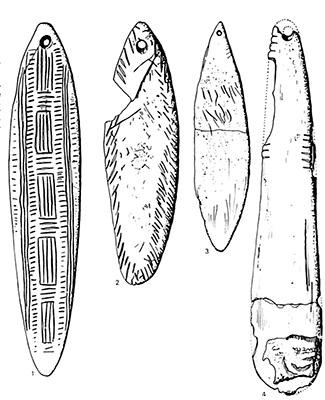
Source term: decorated Paleolithic bullroarer
Oliver Dietrich and Jens Notroff, surveying Paleolithic objects with a likely bullroarer function, list Badegoule in the Dordogne among the prominent French sites, following Iain Morley's catalogue of such pieces. The Badegoule artifact in question is a bone object that the abbé André Glory published in 1965 not as an instrument but as a "pendentif rhomboïdal osseux" — a rhomboidal bone pendant. Michel Dauvois, who reconstructed and acoustically tested Paleolithic rhombes, set out the criterion that divides the two readings: a true rhombe is thin, its thickness about a seventh of its width, so that it can spin on its own axis while swinging around the operator, and a comparably shaped object too thick for its width loses that double rotation and belongs instead with the pendants. Whether the Badegoule object was ever swung to make sound is undecided.
Un objet préhistorique de morphologie comparable, mais ayant une épaisseur trop forte par rapport à la largeur, ne présente plus la possibilité de la double giration, il s'apparente alors aux pendeloques.
A prehistoric object of comparable shape, but whose thickness is too great relative to its width, no longer offers the possibility of the double rotation; it then resembles the pendants.
Dauvois 2018, “Néandertal et Cro-Magnon, le renne et le son,” Revue de Paléobiologie 37(2):460
Particulars
- Object
- Rhomboidal bone blade, 190 mm long, pierced near its narrow end.
- Function
- Not recorded.
Sources
- André Glory, 'Pendentif rhomboïdal osseux à Badegoule (Dordogne),' Bulletin de la Société d’Études et de Recherches Préhistoriques 15 (1965), pp. 149-150
- Michel Dauvois, 'Néandertal et Cro-Magnon, le renne et le son,' Revue de Paléobiologie 37(2) (2018), pp. 457-468, sec. 7, pp. 460-461 View · archived
- Michel Dauvois (1989), p. 10, via Morley 2003 and Dietrich and Notroff 2016
- Iain Morley, The Evolutionary Origins and Archaeology of Music (2003), pp. 34-36, fig. 3.2(4)
- Oliver Dietrich and Jens Notroff, 'A Decorated Bone “Spatula” from Göbekli Tepe. On the Pitfalls of Iconographic Interpretations of Early Neolithic Art,' Neo-Lithics 1/16 (2016), pp. 22-31, p. 28 View · archived