No. EUROPE-006
Aitzbitarte IV cave
Spain · Magdalenian Cantabrian (Errenteria, Gipuzkoa) · Europe · Iberia
Sacred / spirit
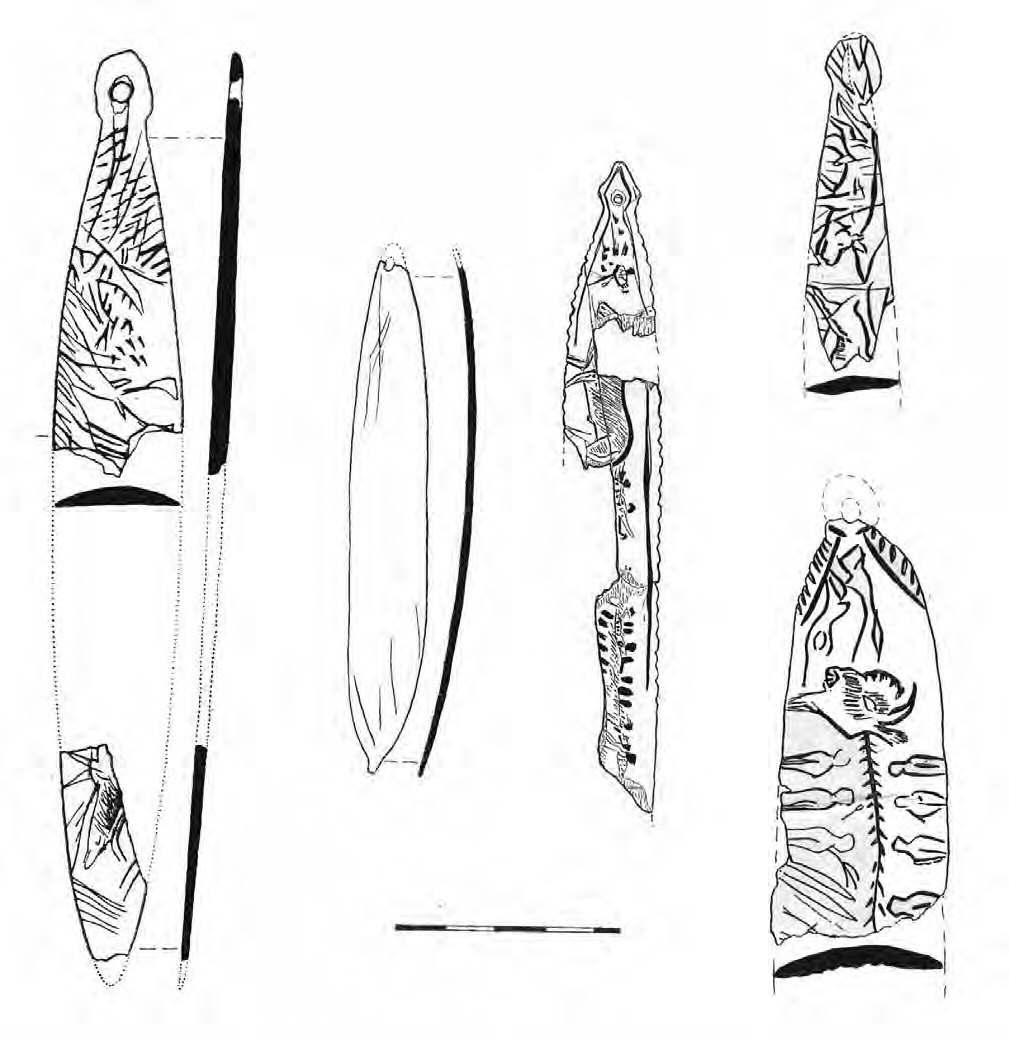
bramadera
bramadera: Spanish for a bullroarer; also called zumbador or rombo.
Etymology. 'Roarer/bellower' — named because the whirled sound is "like the bellowing of the wind"; a Castilian term shared with the children's noise-toy bramador or zumbador.
Four flat bone strips from the cave of Aitzbitarte IV, near Errenteria in Gipuzkoa, have been read as bullroarers — bramaderas, in Spanish — recovered by José Miguel de Barandiarán's excavations of 1963 and 1964 and kept in the municipal museum at San Sebastián. The most complete is a plano-convex sliver of bone about 106 by 15 mm, a small suspension hole near one end and the other tapering to a point, its only decoration plain longitudinal scratches grouped at each tip; it lay in the layer where the last Magdalenian gives way to the Azilian, the other three in the Magdalenian levels beneath. Whirled on a long cord, the type gives a roaring hum, like the Australian churinga.
varilla de hueso plana, con orificio de suspensión (bramadera)
flat bone rod, with a suspension hole (bullroarer)
Barandiarán, «Bramaderas» en el Paleolítico Superior peninsular (Pyrenae), quoting J. M. de Barandiarán's excavation report on Aitzbitarte IV (Campaña de 1964)
Particulars
- Object
- Four bone bramaderas (one complete, three fragmentary) from Magdalenian superior to Azilian transition levels.
- Function
- Whirled-cord aerophone.