No. EA-XIAONANSHAN-001
Two Xiaonanshan jade blades, one pierced
China · Raohe County, Shuangyashan, Heilongjiang; Xiaonanshan site on the Ussuri River, early jade horizon (c. 7250–6650 BC) · East Asia
Function not recorded Candidate only
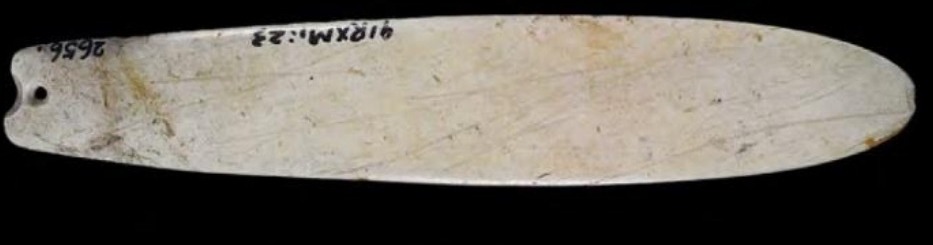
玉匕
Source term: yu bi (jade bi-shaped blade)
玉匕 (yù bǐ): 'jade bi' — the bi-shaped blade, an elongated tongue of jade pierced at one end; here in the earliest known jade-working tradition of Northeast Asia.
On a low hill above the Ussuri River, where China now meets the Russian Far East, a looted grave exposed in 1991 by men rebuilding a watchtower gave up sixty-seven pieces of worked jade — and when archaeologists returned to Xiaonanshan between 2015 and 2019 they found a burial ground so old that it pushed the origins of systematic jade-working back to around nine thousand years ago, a thousand years before the famous jades of Xinglongwa and a thousand kilometres to the north. Among the rings and slit earrings of tomb M1 lay two slender jade blades. One, catalogued M1:23, is a flat polished strip drilled through near its tip by a hole no wider than two millimetres; the other has no hole at all. They are classed as ornaments, as such blades always are. But the pierced one is a thin blade made to hang, and perhaps swing, from a single end hole — and here it appears at the very dawn of jade, at the edge of the known world of its makers: the earliest and northernmost member of the series.
Particulars
- Object
- Two jade bi-shaped blades (M1:23, M1:24) among the 67-piece jade assemblage of tomb M1 at Xiaonanshan, a hill on the west bank of the Ussuri River near the Russian border. M1:23 is a flat, finely polished strip pierced near the top by a small (~0.2 cm) biconically drilled hole; M1:24 appears unperforated. The tomb's jades — 45 rings, 11 slit rings, beads, an axe, a spear, a hairpin and the two bi-blades — belong to a burial horizon that recent radiocarbon dating places around 7250–6650 BC, roughly a millennium before the Xinglongwa jades and about a thousand kilometres further north.
- Function
- Catalogued within an early jade ornament set.
Source
Heilongjiang Provincial Institute of Cultural Relics and Archaeology, 'The excavation of Zone III of the Xiaonanshan site in Raohe County, Heilongjiang Province in 2015,' Chinese Archaeology 20(1) (2020); Zhao Binfu, Sun Mingming & Du Zhanwei, 《饶河小南山墓葬出土玉器的年代和性质》, 边疆考古研究 14 (2014), items 34-35; Kumbani, Bradfield, Rusch & Wurz, 'A functional investigation of southern Cape Later Stone Age artefacts resembling aerophones,' Journal of Archaeological Science: Reports 24 (2019)