No. KOCH1992-006Europe
Döberitz whirring blade
Germany · Brandenburg · Havelland, former Kreis Rathenow · Europe
Function not recorded
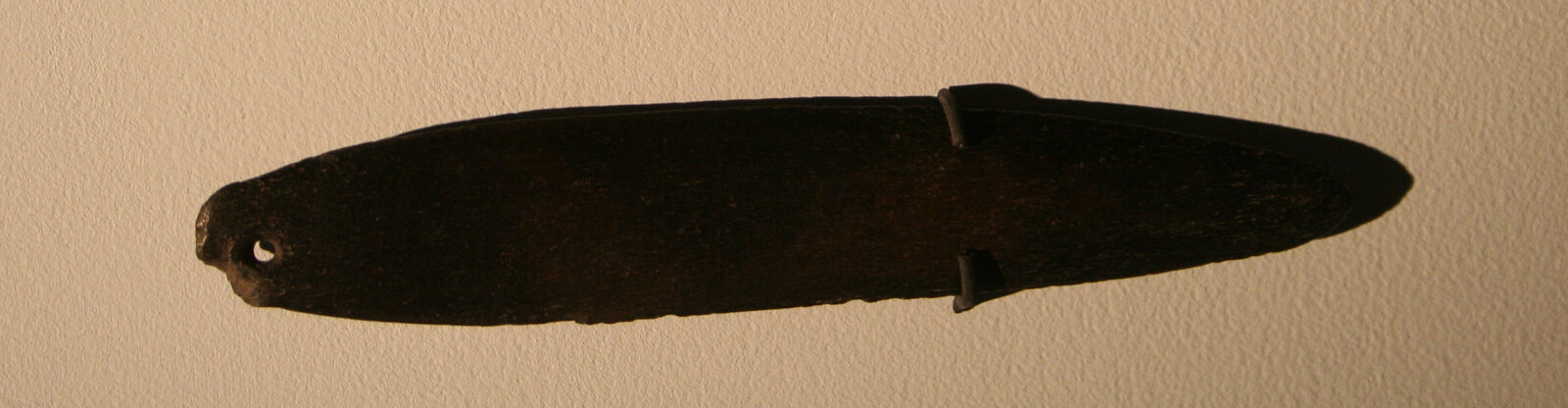
Source term: Schwirrer / Wirbelaerophon
Schwirrer / Wirbelaerophon: German, "whirrer" and "whirled aerophone" - the archaeological terms for a bullroarer.
Döberitz sits on the Havel a few bends from Pritzerbe, whose polished, dotted bone blade is the best-known whirring device of the region. Klaus-Peter Koch counts the Döberitz find as its kin among the Mesolithic whirled aerophones of eastern Germany, a blade of the same flat, pierced bone. The piece itself is lost, with no image or measurement of its own.
Fundliste 7: Aerophone. Wirbelaerophone (Schwirrer) […] Mesolithikum: […] Döberitz, Kr. Rathenow […]
Find list 7: Aerophones. Whirled aerophones (bullroarers) […] Mesolithic: […] Döberitz, district of Rathenow […]
Koch 1992:132
Particulars
- Object
- No object-level description has been recovered. Koch's find list gives the locality alone. His accompanying description of the East German Mesolithic set - the surviving pieces are bone, not wood; elongated-oval with a tendency to a streamlined form; the perforation at the one broader end; lengths between 13 and 21 cm, widths 2.0 to 2.5 cm, thickness under 0.7 cm - is stated for the group as a whole and is not a measurement of the Döberitz piece.
- Function
- Not recorded.
Source
Klaus-Peter Koch, 'Musikarchäologische Quellen aus dem östlichen Deutschland: Zwischenbericht,' Jahresschrift für mitteldeutsche Vorgeschichte 75 (1992): 101-136, at pp. 119 and 132 (Fundliste 7)