Atlas Essay · August 3, 2026
Venus & the Bull
Where Ice Age figurines and roaring blades share the same caves, shelters, settlements, and artistic worlds.
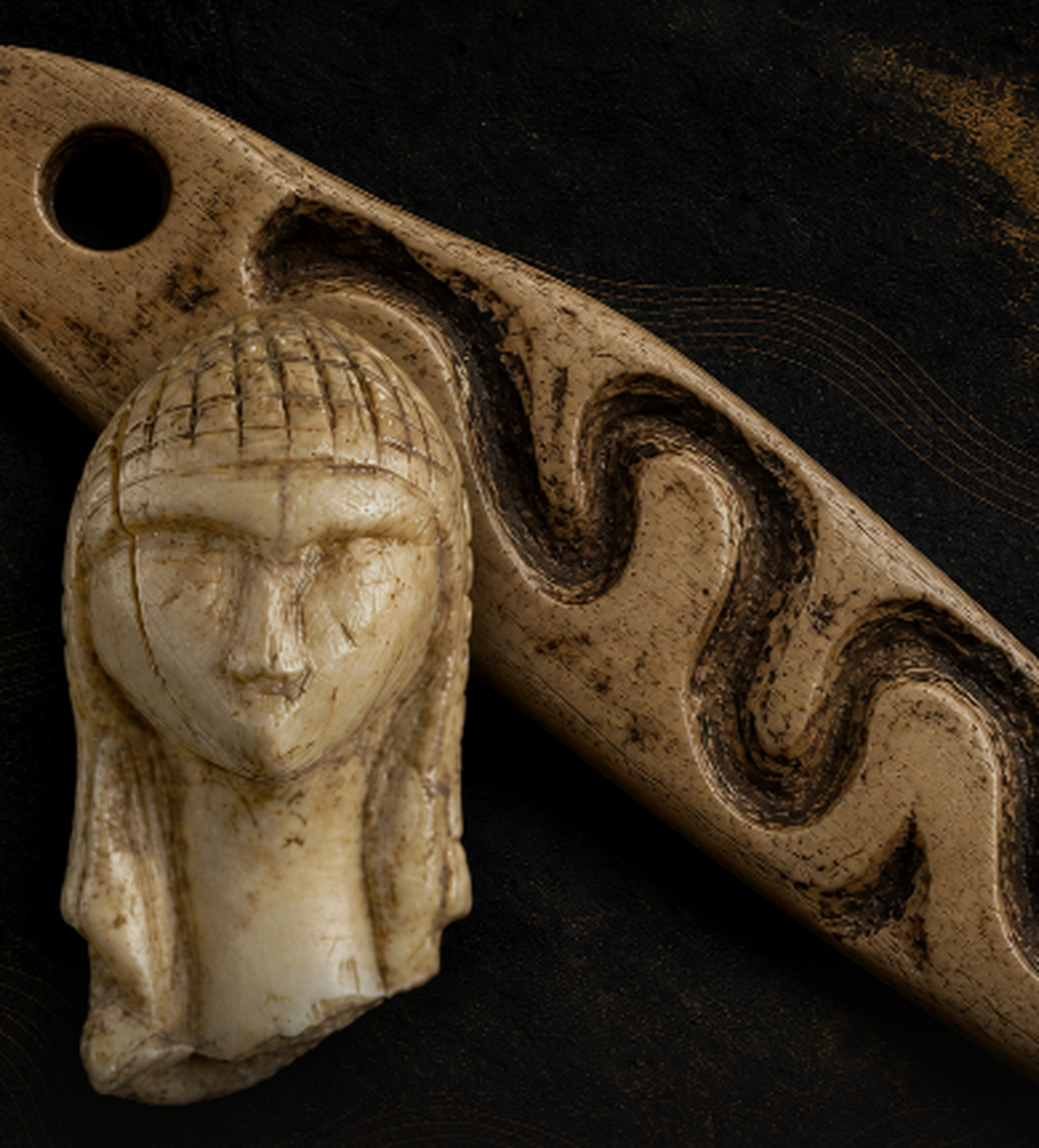
AI-generated image · Dame de Brassempouy + serpentiform blade
At Brassempouy, one cave entrance held two extraordinary inventions in ivory: a human face and a pierced blade carved over with serpents, made to take a cord and turn through air.
Ice Age Venus figures and bullroarers belong to the same makers, the same shelters, and the same imaginative world.
In brief
- Ice Age Venus figures and bullroarers belong to the same makers, the same shelters, and the same imaginative world.
- At Brassempouy, Laugerie-Basse and Lalinde, female images and perforated blades occupy the same caves or shelters—at Lalinde, the same occupation.
- At Fontalès, La Vache and Saint-Marcel, Magdalenian female signs and pierced blades recur in the same decorated shelter worlds.
- From the Swabian Jura to Pavlovian Moravia to Mal’ta, the broader Upper Paleolithic centers that made women in ivory or clay also preserve whirring or perforated sound-making forms.
The closest rooms
The best links are not abstract similarities. They are places a person could have crossed in a few steps: a cave mouth, a rock shelter, a single Magdalenian camp.
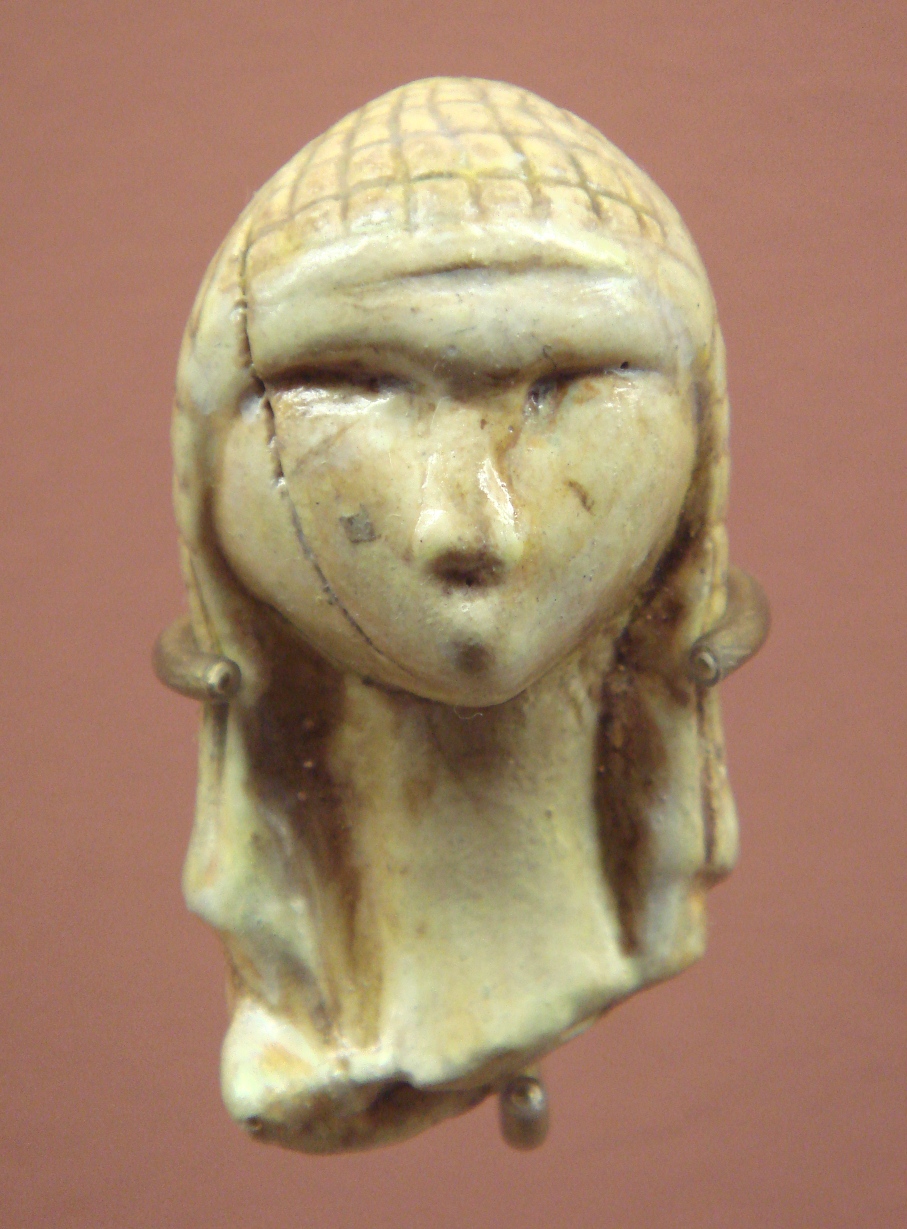
A face at the cave mouth
The Grotte du Pape produced nine female figurines, including the tiny face now called the Dame à la capuche. Near the entrance to its main chamber lay another mammoth-ivory object: a 7.8-centimeter blade, pierced through its rounded end, with three raised serpents running down its face. Both belong to Brassempouy’s Middle Gravettian world of ivory working, around 29,500–26,500 BC. The museum calls the blade a pendant; its end hole and tapered body also match Ice Age objects studied as bullroarers. Brassempouy on the map
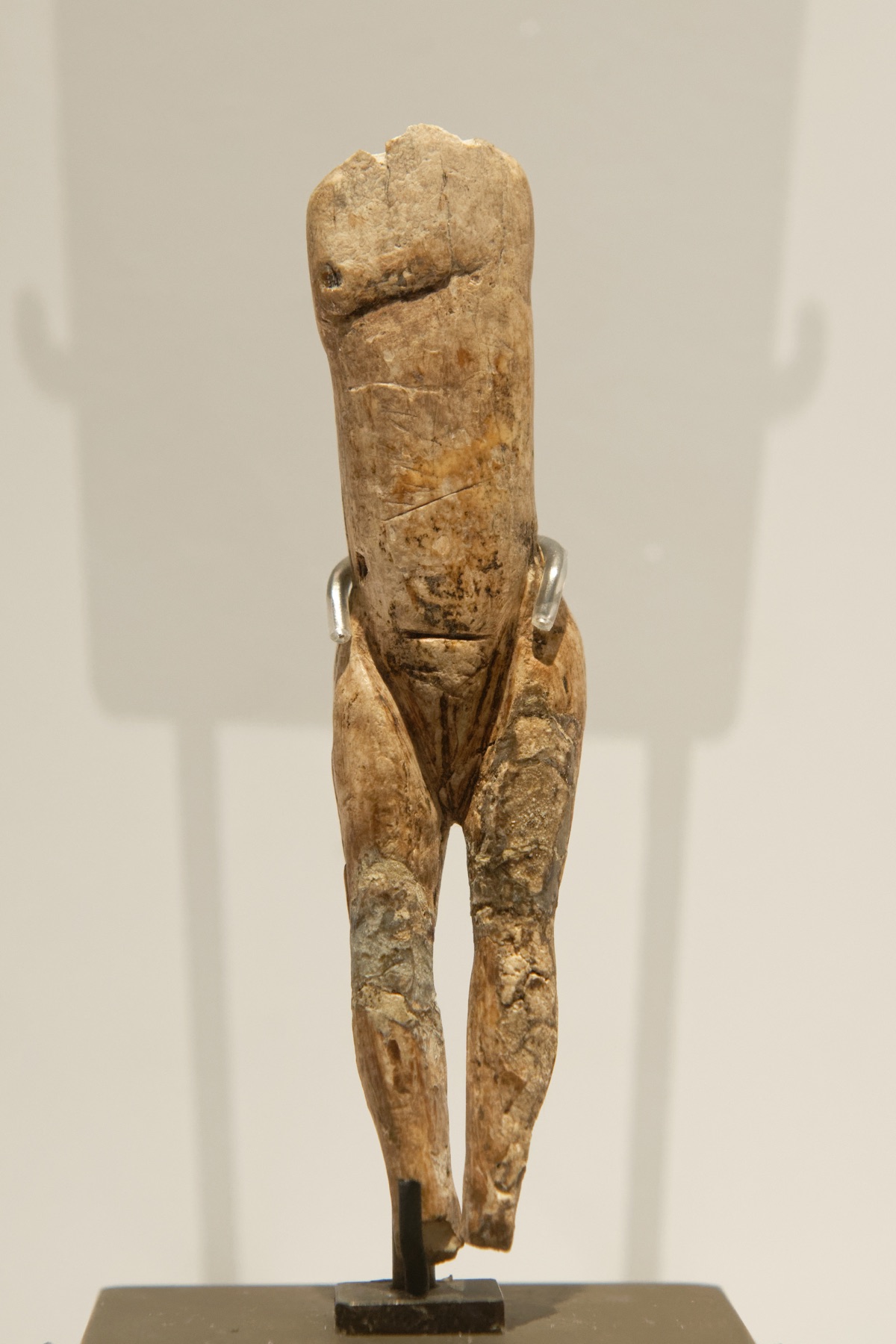
Where Venus got her name
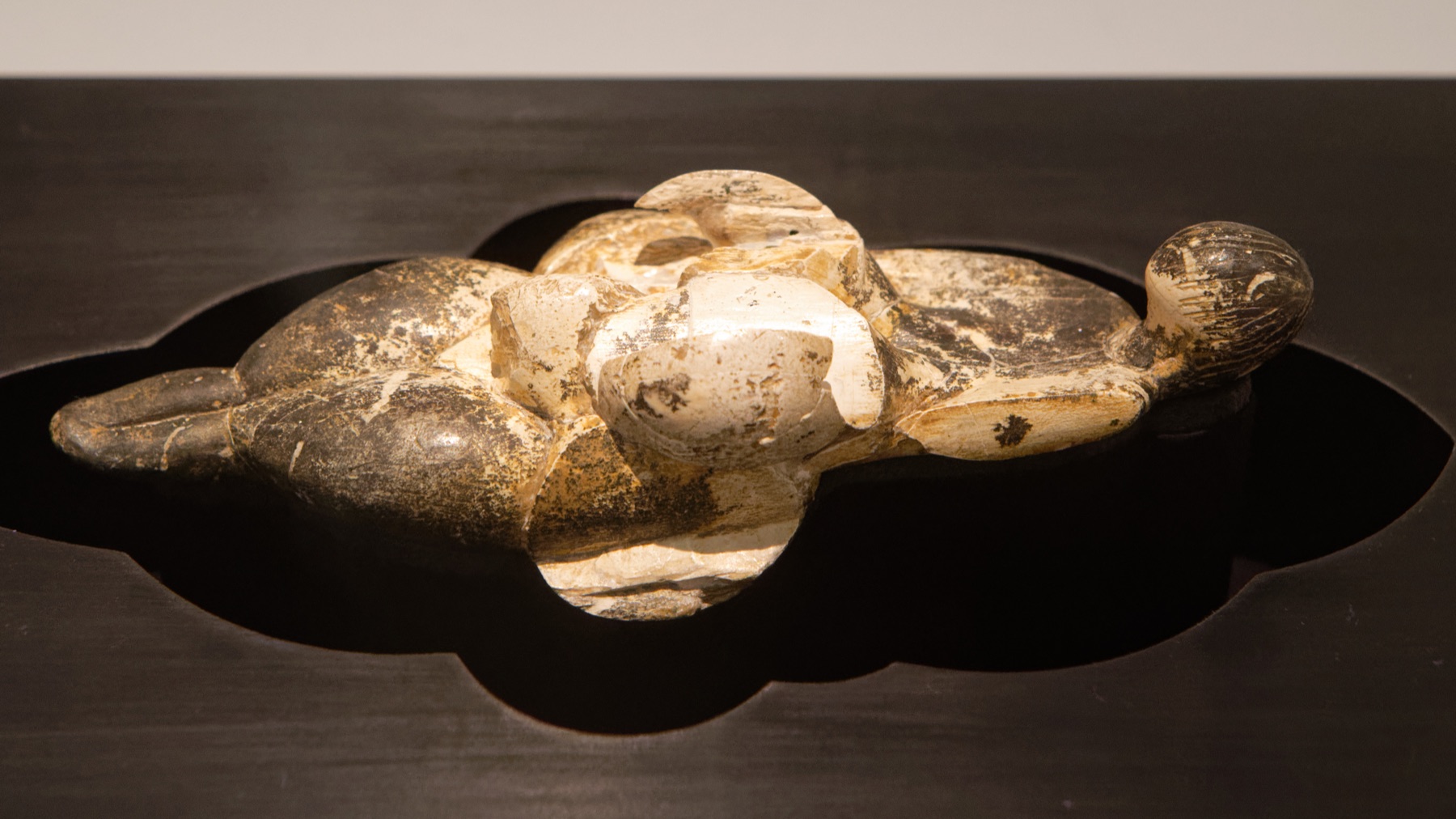
In 1864 the great rock shelter of Laugerie-Basse yielded a slim ivory woman, headless and emphatically nude. Her discoverer named her the Vénus impudique—the “immodest Venus”—and the nickname spread backward across the Paleolithic. The same shelter also supplied a 10.7-centimeter decorated blade that Michel Dauvois and Iain Morley placed among the most likely Ice Age bullroarers. The woman and the blade occupy the same Magdalenian span, c. 15,000–9000 BC. Laugerie-Basse on the map
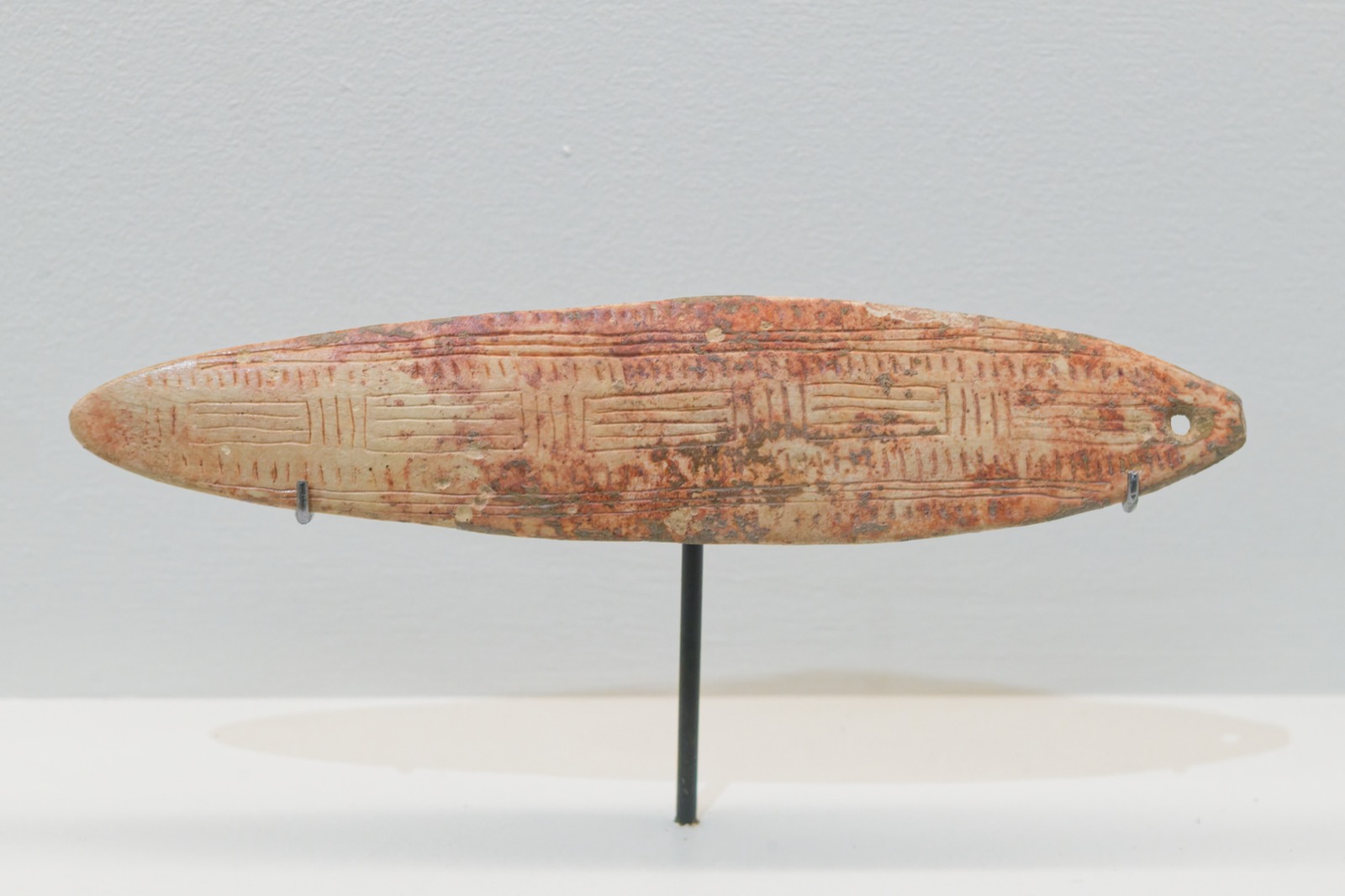
Eleven women and one roaring blade
La Roche de Birol gives the closest archaeological meeting. Its compact Final Magdalenian occupation produced the ochred antler blade recognized in 1930 as Europe’s first archaeological bullroarer. The same camp produced a limestone block engraved with eleven women: narrow waists, swelling hips, bodies reduced to a repeated sign. Here the roarer and female imagery belong to one homogeneous shelter assemblage. Lalinde on the map
The woman becomes a sign
By the late Magdalenian, the voluptuous ivory body had become a quick visual grammar: a waist, a hip, a buttock, sometimes only a nested curve.
At Fontalès, a fish-shaped blade with a terminal ring was deliberately placed in a small basin beneath the shelter floor during Magdalenian V. At the base of the next phase, Magdalenian VI, the shelter held a limestone plaque engraved with two schematic women. At La Vache, a pierced blade and an antler ellipse engraved with two women and three ibex heads both come from Salle Monique. At Saint-Marcel, the connection tightens until the categories touch: the pierced blade itself has been read as a schematic female body, while another pendant from the site shows a line of dancing women.
These are not lesser Venuses. They are the same concentration on the female body expressed in the rapid, portable style of the Magdalenian. The body travels from sculpture into line at exactly the sites where pierced blades were also being shaped, engraved, suspended, and perhaps sent roaring through the air.
The first figurine named a “Venus,” from the same shelter as a likely bullroarer.© Marie-Lan Nguyen / Wikimedia Commons. CC BY 4.0.
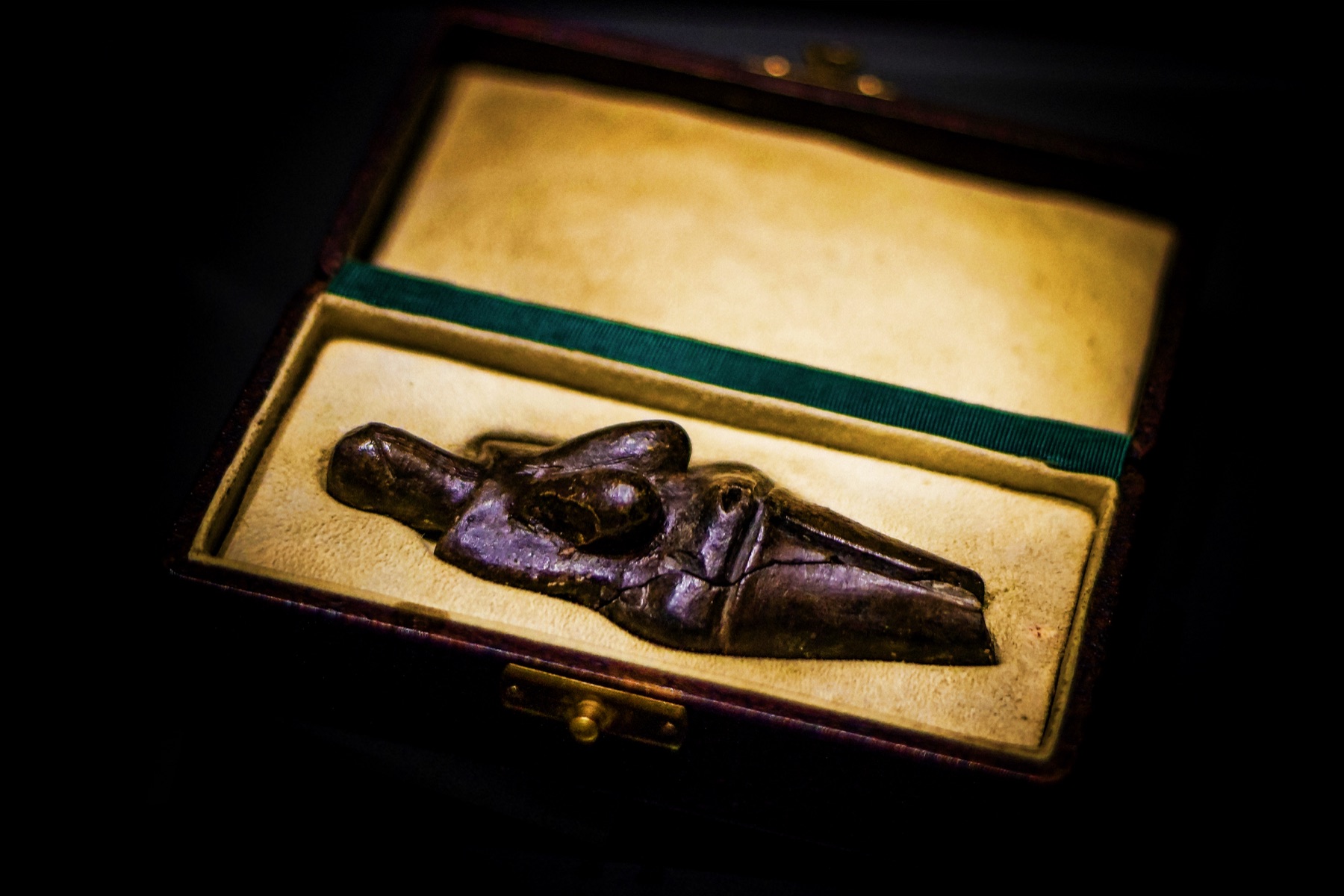
One gorge holds three moments: the Gravettian Venus, a Solutrean pierced blade, and a later female engraving at Abri des Harpons.© Marie-Lan Nguyen / Wikimedia Commons. CC BY 4.0.
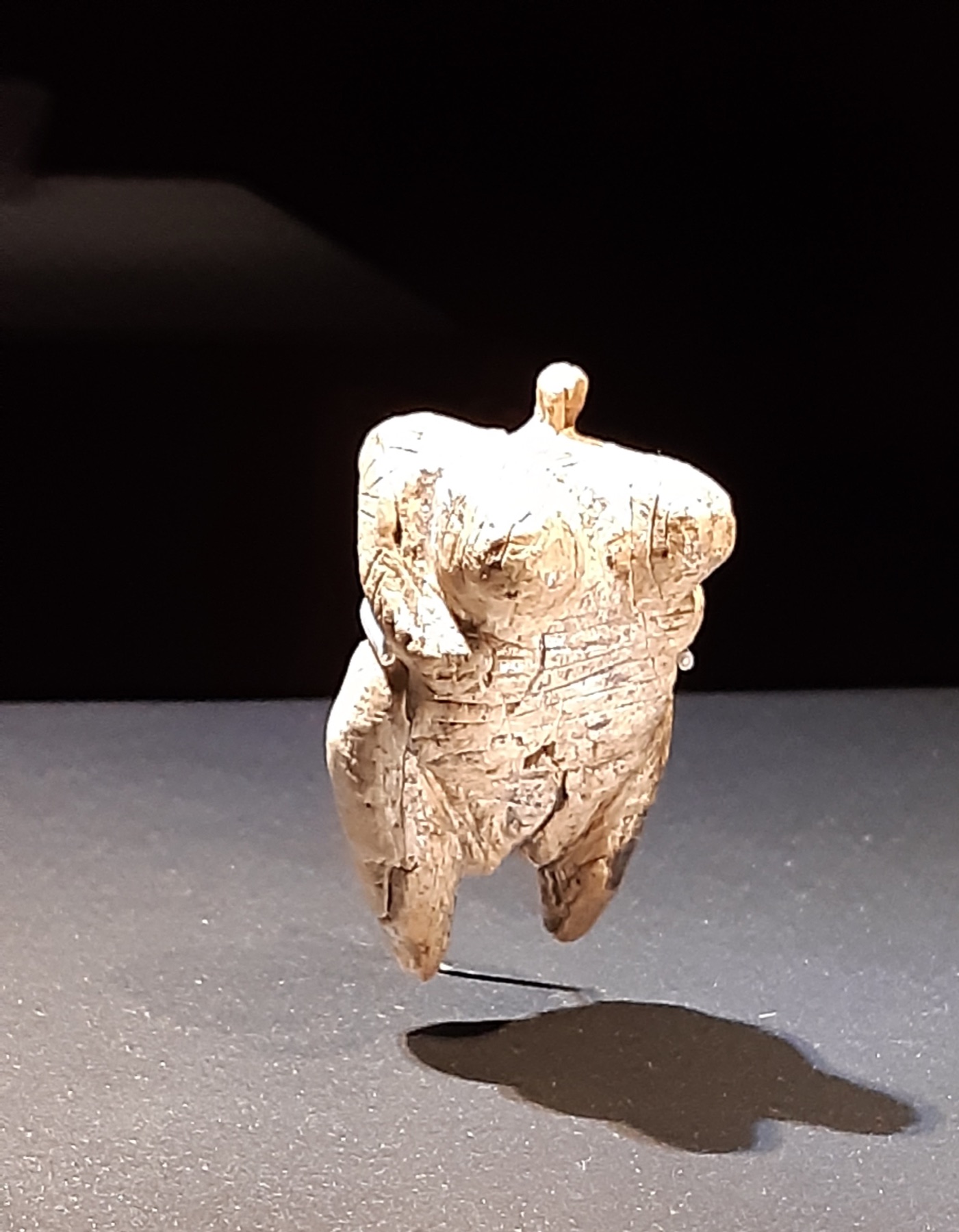
The fired-clay woman of the Pavlovian world, the Central European horizon Michel Dauvois named as the oldest for bullroarers.Photo Miroslav Zachoval, Wikimedia Commons. CC BY 2.0.
Across the Ice Age world
From the Swabian Jura to Lake Baikal, female figures and perforated sound-making forms occupy the great art-making centers of the Upper Paleolithic.
Hohle Fels & Vogelherd
The Hohle Fels Venus, c. 38,000–33,000 BC, is the oldest securely dated human figure. About 38 kilometers away, Vogelherd’s Aurignacian layer yielded a 24-centimeter perforated ivory baton that Gustav Riek published as a Schwirrblatt, a whirring blade. Different caves; one Swabian ivory-art world. Map Vogelherd
The Pavlovian horizon
Dolní Věstonice, Pavlov, and Předmostí made fired clay, ivory ornaments, and some of Europe’s most famous female figures around 25,000–22,000 BC. Dauvois named this Pavlovian world as Europe’s oldest bullroarer horizon, although no individual blade has yet been tied to Dolní Věstonice. Dolní Věstonice on the map
Mal’ta
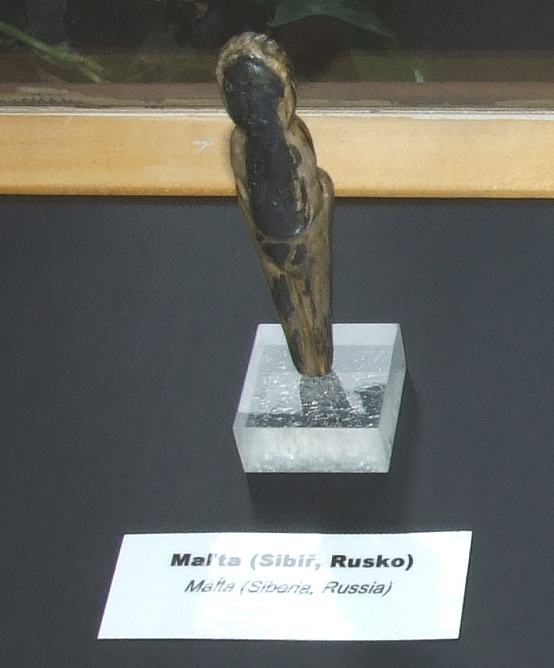
At Mal’ta near Lake Baikal, mammoth-ivory women belonged to the same settlement horizon and domestic context system as a perforated decorated plaque from the 1929 excavations. Its hole runs through the center, making it a rotating plaque or buzzer rather than the classic edge-tethered bullroarer—but it joined female figures and sounding motion inside one inhabited place. Map Mal’ta
Fifteen meetings
Fifteen Paleolithic meetings connect female imagery with pierced blades, from one occupation to a shared cave or regional tradition.
Some belong to one occupation, some to one cave, and some to the same wider art world.
Swipe to see every connection and map link →
| Place | Date | Female image | How they meet | |
|---|---|---|---|---|
| Brassempouy | c. 29,500–26,500 BC | Nine ivory women, including the Dame | Same cave · front zone | Map |
| Laugerie-Basse | c. 15,000–9000 BC | Vénus impudique | Same shelter · Magdalenian span | Map |
| La Roche de Birol, Lalinde | c. 13,000–11,000 BC | Limestone block engraved with eleven women | Same shelter · same occupation | Map |
| Fontalès | c. 12,000–9000 BC | Plaque engraved with two women | Same shelter · successive phases | Map |
| La Vache | c. 13,000 BC | Antler ellipse with two women and three ibex | Same chamber · Salle Monique | Map |
| Lespugue | c. 22,000–17,000 BC | Venus of Lespugue and the later Venus des Harpons | Same gorge · three horizons | Map |
| Mal’ta | c. 22,000–17,000 BC | Ivory female-figure assemblage | Same settlement · same horizon | Map |
| Pavlovian Moravia | c. 22,000 BC | Venus of Dolní Věstonice and Pavlovian figurines | Same cultural horizon | Map |
| Vogelherd | c. 38,000–33,000 BC | Hohle Fels Venus | Same regional art tradition | Map |
| El Pendo | c. 15,000–9000 BC | “Venus de El Pendo” antler figure | Same cave · earlier Ice Age phase | Map |
| Isturitz | c. 15,000–12,000 BC | Aurignacian talc-stone female pendant | Same cave · earlier phase | Map |
| Saint-Marcel / La Garenne | c. 17,000–14,500 BC | Dancing-women pendant and a female-form reading of the blade | Same site · Magdalenian imagery | Map |
| Le Placard | c. 24,000–9000 BC | Antler figures combining female and male traits | Same cave collections | Map |
| Altamira | c. 22,000–17,000 BC | Possible schematic painted woman | Same cave · Magdalenian art | Map |
| La Paloma | c. 15,000–12,000 BC | Female reliefs at nearby Las Caldas | Same regional Magdalenian network | Map |
One world of women and whirring blades
What appears once at Lalinde appears again across caves, gorges and entire art provinces.
Ice Age Venus figures and bullroarers belong to the same makers, the same shelters, and the same imaginative world.
At Brassempouy and Laugerie-Basse, female figures and perforated blades come from the same celebrated caves. Lalinde draws them closer still: the roarer and the eleven-woman block belong to one homogeneous Final Magdalenian shelter occupation. Fontalès, La Vache, and Saint-Marcel show the same bundle in late Paleolithic shorthand: the female body reduced to signs at exactly the sites where pierced blades were engraved, suspended, deposited, and perhaps sent roaring through the air.
The Swabian Jura, Pavlovian Moravia and Mal’ta show the same pattern on a larger stage. In each, female images and whirring or perforated sound-makers enter the same cultural world. The woman and the blade do not meet once. They keep meeting wherever Ice Age people made the body, the ornament, and the sounding object part of one imaginative repertoire.
Key sources
Musée d’Archéologie nationale, MAN 47137 A, Brassempouy perforated ivory; Aurélien Simonet, the Middle Gravettian ivory-working context at Brassempouy.
Musée de l’Homme, Vénus dite impudique; Iain Morley, The Evolutionary Origins and Archaeology of Music, 2003, pp. 34–36.
Musée national de Préhistoire, the engraved women of Lalinde; Denis Peyrony, Sur quelques pièces intéressantes de la grotte de La Roche, 1930.
Anne-Catherine Welte, the Fontalès fish-shaped pendant; Gerhard Bosinski, schematic female representations of the Upper Paleolithic.
Musée d’Archéologie nationale, La Vache, Salle Monique collections; Muséum national d’Histoire naturelle, Venus of Lespugue.
Liudmila Lbova, personal ornaments and social identity at Mal’ta; Mikhail M. Gerasimov, “The Palaeolithic site of Mal’ta” (1958), on the excavations and finds.
Nicholas Conard, the female figurine from Hohle Fels; UNESCO, Caves and Ice Age Art in the Swabian Jura nomination dossier.
Michel Dauvois, “Néandertal et Cro-Magnon, le renne et le son”, 2018; Ignacio Barandiarán Maestu, the Magdalenian bullroarer corpus.