No. PEUR2026-003
Isturitz cave Magdalenian bramaderas
France · Pyrenees-Atlantiques · Isturitz level II; Middle Magdalenian · Europe
Function not recorded
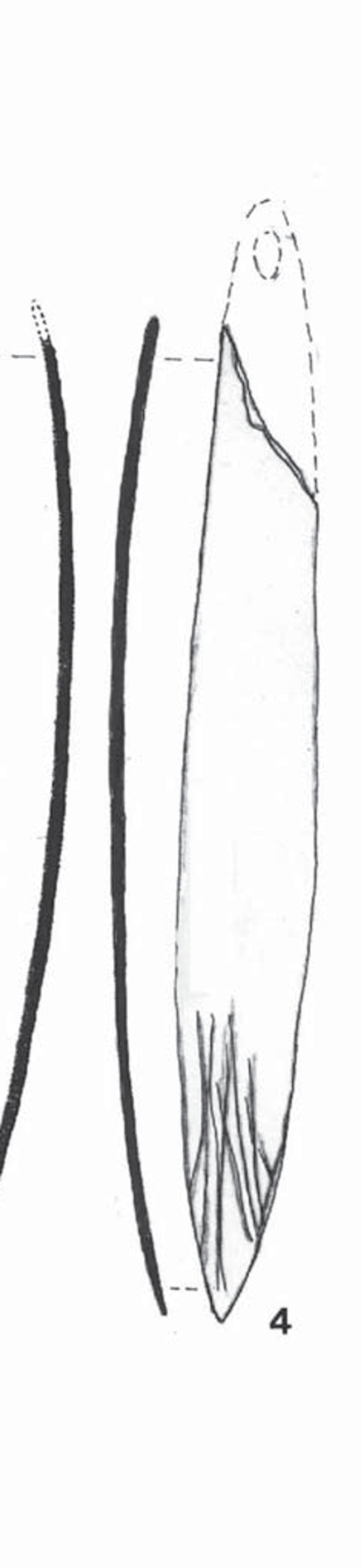
bramadera / rhombe
Source term: bramadera
Spanish for bullroarer, from bramar, "to bellow/roar"; rhombe is the French term for the same whirled instrument.
Etymology. Standard Spanish term for bullroarer, from bramar, to bellow or roar; used by Barandiaran for Paleolithic bone specimens.
In level II of the Isturitz cave, in the French Basque country, excavators recovered two fragments of bone bramaderas — bullroarers — dated to the Middle Magdalenian. One is decorated and was published by the Comte de Saint-Périer in his 1936 study of the cave's Grande Salle; the other is plain and went unrecorded until Ignacio Barandiarán found it in 1966 while reviewing the Musée Basque collections in Bayonne, where it sat labeled "R. de Saint-Périer 1937/Ist.II." Barandiarán places Isturitz within a corpus of these objects strung along the northern Pyrenees — Bourrouilla, Lortet, La Vache — each a long, narrow, very thin blade of polished bone, lenticular in plan, the proximal end swelling into a constricted head flanked by a small lug on either side, the whole pierced and looped with cord so the blade could be whirled to roar.
dos fragmentarias (decorada y lisa) en el nivel II de Isturitz (Pyrénées Atlantiques) reconocido como del Magdaleniense medio
two fragmentary ones (one decorated and one plain) in level II of Isturitz (Pyrénées-Atlantiques), recognized as Middle Magdalenian
Barandiarán Maestu 2015, Kobie BAI 6:154
Particulars
- Object
- Two fragmentary bone bramaderas from level II, one decorated and one plain, Middle Magdalenian.
- Function
- Whirled-cord aerophone.
Source
Ignacio Barandiarán Maestu, 'La bramadera de hueso: análisis y discusión cronocultural,' Kobie BAI 6 (2015), pp. 149-158