No. EA-XINGLONGWA-001
Xinglongwa type-site jade bi-shaped blades (匕形器)
China · Aohan Banner, Chifeng, Inner Mongolia; Xinglongwa site, type-site of the Xinglongwa culture (c. 6250–5450 BC) · East Asia
Function not recorded Candidate only
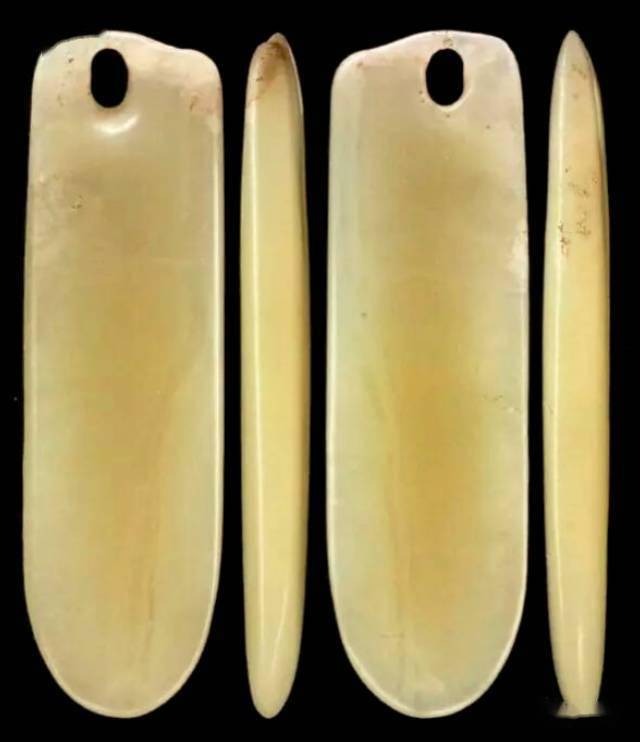
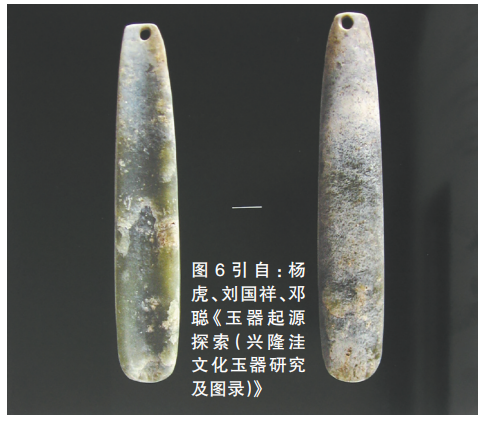
玉匕形器
Source term: yu bixingqi (jade bi-shaped object)
匕形器 (bǐxíngqì): 'bi-shaped object' — an elongated spoon- or tongue-shaped blade named after the ancient Chinese bi eating-spoon; in the Xinglongwa culture, thin nephrite blades pierced at one end.
Xinglongwa, in the dry hills of Aohan Banner in southeastern Inner Mongolia, is the moated village that gave its name to one of the oldest jade-working cultures on earth: eight thousand years ago its people lived in more than a hundred and seventy pit-houses ringed by an oval ditch, and buried some of their dead beneath the house floors with worked nephrite. Among those jades, beside the famous slit earrings, is a plainer thing — a long, thin, tongue-shaped blade, one face gently hollowed and the other curved, ground to a slender lens and pierced at one end by a single small hole. Chinese archaeologists call it a bi-shaped object, 匕形器, and read it as a pendant or a dress ornament, because it is found lying along the neck, chest and belly of the buried. It is the same blade that recurs across the whole Xinglongwa world — most richly at Chahai, a sister village to the east, where thirteen were found, among them three graded pairs — large, medium and small — laid in a single house burial.
Particulars
- Object
- Elongated tongue-shaped nephrite blades from the Xinglongwa type-site — the moated Neolithic village that gives the culture its name, with 170+ semi-subterranean houses inside an oval ditch. The bi-shaped jades are one of the site's standard jade forms alongside slit rings (jue): a long strip with one face slightly concave and the other convex, ground to a thin lens section and pierced near one end by a small perforation. Museum specimens attributed to houses 201, 125 and 128 show clean, symmetrical blades a few centimetres long with a single biconical end hole. Most excavated examples lay on the neck, chest or abdomen of the dead and are read as pendants or garment ornaments. Date: Xinglongwa culture, c. 6250–5450 BC.
- Function
- Catalogued as pendants or dress ornaments.
Source
Yang Hu, Liu Guoxiang & Tang Chung (邓聪), 《玉器起源探索——兴隆洼文化玉器研究及图录》 (Chinese University of Hong Kong Press, 2007); Kumbani, Bradfield, Rusch & Wurz, 'A functional investigation of southern Cape Later Stone Age artefacts resembling aerophones,' Journal of Archaeological Science: Reports 24 (2019)