No. PEUR2026-006
Fontalès engraved bone blade
Tarn-et-Garonne · Aveyron valley; Magdalenian V · Europe · Southwest France
Function not recorded Candidate only
pendeloque / rhombe
Source term: pendeloque de Fontalès
pendeloque — French for a hanging ornament or pendant; the neutral term French prehistorians use for a perforated blade whose function is undecided.
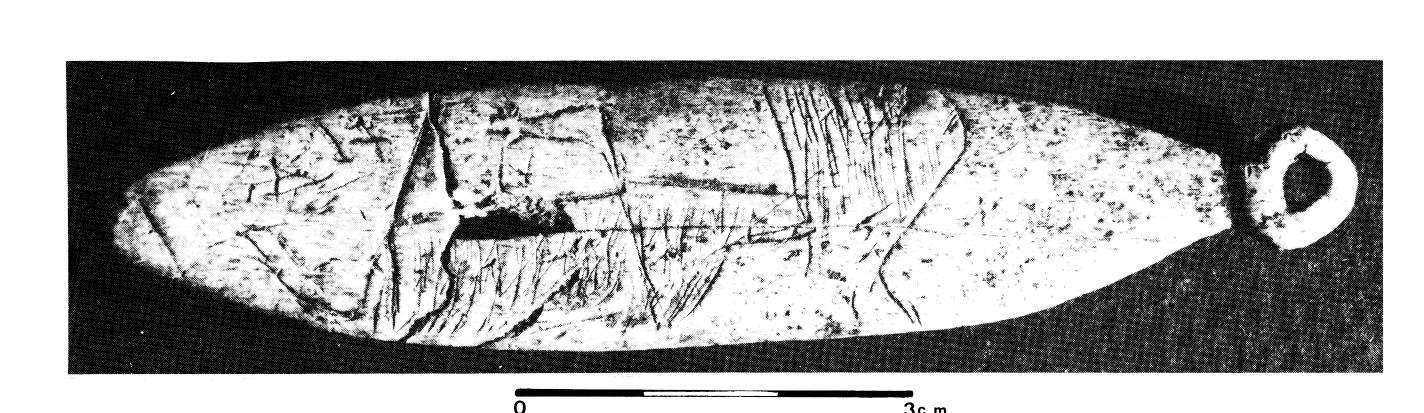
A thin blade of rib bone, 91 mm long and under 3 mm thick, was laid in a small basin cut into the floor beneath the occupation layer of the Fontalès rock-shelter on the Aveyron, packed round with flint tools and roofed over with three large pebbles propped one against another. Paul Darasse, who dug it out, was certain this was no accident of slippage: someone had buried it deliberately. The blade is cut to the outline of a fish, and a whole salmon runs down its length in engraving - muzzle, triangular eye, hooked operculum, a deep lateral line and four bands of chevron hatching for scales - while the pierced ring at the end reads as its tail. Engraved over the fish, upside-down, is the head of a bull. Anne-Catherine Welte, who published the piece in 1985, would not choose between the two functions she could see in it, and named them both as a question: fish-shaped spatula, or pendant. Others have heard it. Nougier and Robert gathered it in 1978 with thirteen other slender Pyrenean pendants sharing a length five times their width and proposed that some of the group had been whirled for sound, without saying which; it appears again in Michael Praxmarer's 2019 inventory of possible Palaeolithic bull-roarers. Ignacio Barandiaran, who has catalogued the Magdalenian bone bull-roarers more closely than anyone, twice refused it - filing it among the mere pendants, and reading the polish worn into its neck and tip as the rub of a cord and a garment rather than the wear of spinning.
Pudiendo traer al recuerdo ejemplos de piezas óseas alargadas preparadas para ser suspendidas con tal aro destacado como la bramadera del Pendo (Cantabria), el 'trofeo de caza' (pienso que es otra bramadera) de Raymonden-Chancelade (Dordogne) o el mero 'colgante' de Fontalès (Tarn-et-Garonne).
One may recall examples of elongated bone pieces prepared to be suspended by such a distinct ring, such as the bullroarer of El Pendo (Cantabria), the 'hunting trophy' (I think it is another bullroarer) of Raymonden-Chancelade (Dordogne), or the mere 'pendant' of Fontalès (Tarn-et-Garonne).
Barandiaran Maestu 2015, “La bramadera de hueso,” Kobie BAI 6:156 n.22
Particulars
- Object
- Thin rib-bone blade, 91.4 x 19.6 x 2.9 mm, concavo-convex and longitudinally curved, cut to a fish silhouette and engraved with a salmonid, an inverted bovid head and a rectangular sign; single terminal perforation through a discrete ring set off by a 5.6 mm waist.
- Function
- Not recorded.
Sources
- Anne-Catherine Welté, 'Propositions pour une nouvelle lecture d’une pendeloque de l’abri Fontalès (Tarn-et-Garonne),' Bulletin de la Société préhistorique française 82(9) (1985): 273-283, pp. 274-276, fig. 1 View · archived
- Nougier and Robert, Préhistoire Ariégeoise 33 (1978): 67-75
- Michel Dauvois, 'Homo musicus palaeolithicus et paléoacoustica,' Munibe 57 (2005/06): 225-241, pp. 232-233, fig. 3 no. 2
- Michael Praxmarer, 'Blasinstrumente aus dem europäischen Jungpaläolithikum,' Archaeologia Austriaca 103 (2019), p. 89, table 1 no. 9
- Ignacio Barandiarán Maestu, 'Forma vs. función en tipología prehistórica,' Veleia 29 (2012): 307-334, p. 322 n. 38, pp. 327-328, fig. 5.1
- Ignacio Barandiarán Maestu, "La bramadera de hueso," Kobie BAI 6 (2015): 149-158, p. 156 n. 22
- Edmée Ladier and Anne-Catherine Welté, "Les objets de parure de la vallée de l’Aveyron," Paléo 5 (1993): 281-317, fig. 4, accession MHNT 1970.Dar.7
- Darasse and Guffroy, L’Anthropologie 64 (1960), fig. 13.6
- Iain Morley, The Evolutionary Origins and Archaeology of Music (2003), Fontalès discussion