No. AIKENS1970-001
Hogup Cave bull-roarer, Stratum 3
United States · Hogup Mountains, Box Elder County, Utah (eastern Great Basin) · North America
Function not recorded
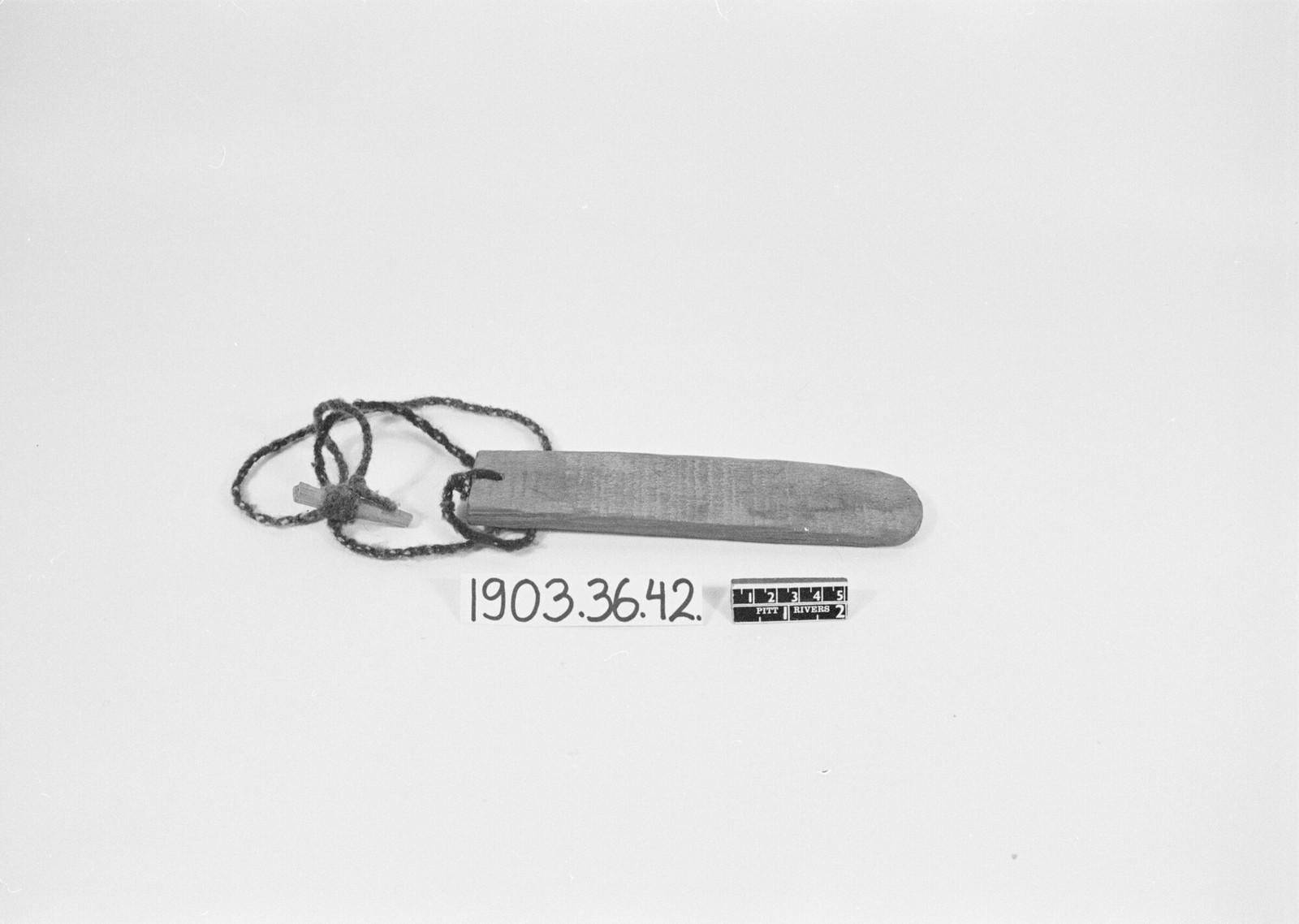
Source term: Bull-roarer
Seven thousand years ago somebody in the Hogup Mountains, on the old shoreline west of the Great Salt Lake, shaped a cottonwood blade, thinned it to a lens in section, gave it a gentle bow along its length, and hung it from a cord through a small knot-hole near one end. It lay in Stratum 3 of the cave until 1967. When C. Melvin Aikens published the excavation he did the one thing archaeologists almost never do with an object like this: he spun it. It "speaks," he wrote, with a satisfying if subdued voice. Nothing else like it had come out of the dry caves of the Great Basin, and he was careful to say the identification was not beyond doubt - the cord hole sits off to one side rather than centred, which is not how the California cave specimens are strung. What the Northern Paiute did with theirs is on record, from Isabel Kelly and Julian Steward both: children played with them, and a man whirled one to call up a warm wind.
Because of the antiquity and widespread distribution of such artifacts, an early appearance in the Basin would not be particularly surprising.
Aikens, Hogup Cave (1970), section BULL-ROARER.
Particulars
- Object
- Populus blade 19.0 cm long, 3.6 cm wide at the centre and 1.2 cm thick; slightly crescentic in outline, roughly lenticular in cross-section, tapered toward both ends and bowed along its length, with a 3 mm hole 2.5 cm from the narrow end whose edge is constricted and worn where a cord was tied.
- Function
- Not recorded. The excavator tested the specimen and found that it sounded.
Source
C. Melvin Aikens, Hogup Cave, University of Utah Anthropological Papers No. 93 (1970), p. 173 (section 'BULL-ROARER'), specimen illustrated as Fig. 123 on p. 175