Atlas Essay — 2026-09-13
The European Roots of the Primordial Matriarchy
Across Australia, Melanesia, and the Americas, stories remember women as the first owners of sacred powers now held by men. The power may be a bullroarer, a flute, a mask, or knowledge hidden behind initiation. In each version, present authority carries a memory of transfer. The resemblance is too specific, and too widely spread, to be coincidence. These communities inherited a shared mythic complex.
Yuri Berezkin maps the distribution of such narrative motifs across the world. Julien d’Huy uses methods adapted from evolutionary biology to reconstruct relationships among myths and infer features of their ancestors. Their studies establish the historical claim: these stories are descendants of a common tradition, altered as it moved among peoples.
Berezkin calls the pattern F38, “Women and Sacred Knowledge.” His catalogue includes women’s former possession of ritual objects, sanctuaries, and knowledge later forbidden to them, as well as stories of women trying to recover it. His separate motif F39, “The Epoch of Women,” concerns women’s dominance over men. Here, “primordial matriarchy” means a myth of women’s original custody of sacred things. For the bullroarer’s place in this larger ritual world, see the Vectors of Mind survey and the Atlas essay What Travels When the Bullroarer Doesn’t?1
The shared myths of women’s former sacred authority are more convincingly rooted in Ice Age Europe than in Africa.
In brief
- The shared myths of women’s former sacred authority are more convincingly rooted in Ice Age Europe than in Africa.
- The same reversal recurs across continents: women possessed the sacred power first, and men now guard it.
- Europe preserves female imagery across distinct Ice Age periods, from Hohle Fels at least 35,000 years ago to Lalinde around 15,000 years ago; at Lalinde, a block engraved with women and the first Palaeolithic bullroarer ever announced came out of the same cave.
- Berezkin and d’Huy place the complex in a larger human prehistory, but a species’ migration out of Africa does not date every story its descendants later told.
How Africa became the root
Berezkin proposes that a broad complex of male rites and institutionalized opposition between the sexes began in Africa. In his account, early human migrations carried it into Australia and New Guinea, with later movement through East Asia and into the Americas. F38 belongs inside this larger ritual history. What travels is a whole tradition: guarded knowledge, initiation, sacred objects, and the story of women’s former authority.1
D’Huy’s 2017 study, Matriarchy and Prehistory, is a separate, solo-authored work using Berezkin’s catalogue. He roots its main tree in East Africa and concludes that the story of women’s former power was already set in the mythic past sixty-five thousand years ago, before the dispersal. But the root is placed there on the strength of the near-consensus about modern human origins, and on the assumption that some mythology travelled Out of Africa with the people. It was imported on those grounds. The stories did not put it there.2
The stories point somewhere else, and d’Huy prints it in a footnote to the same paper. He reconstructs the proto-folklore at the Balkan node of his own tree in order to estimate the content of European Palaeolithic myth, and F38 — women as the first owners — is in that reconstruction. His main text treats the Balkans as a place where the African inheritance was lost, thinned out by falling population after the glacial maximum. The footnote says the opposite about this motif: at that node, in Ice Age Europe, the myth is there to be reconstructed.2
D’Huy uses the same reconstruction to rule out a matriarchal society behind the Palaeolithic Venuses; the inheritance traced here is the story of women as first owners and men as present keepers, which is exactly what his footnote finds. Population history and myth history answer different questions. A story can form, travel, and recombine long after the migration of the people who tell it. The question is where this one took shape.
D’Huy returned to the Palaeolithic comparison in a separate 2025 paper on the Lalinde rhombe. That work brings phylomythological reconstruction into conversation with an archaeological object from the same broad period as Europe’s late Ice Age female engravings.8
Women in Ice Age Europe
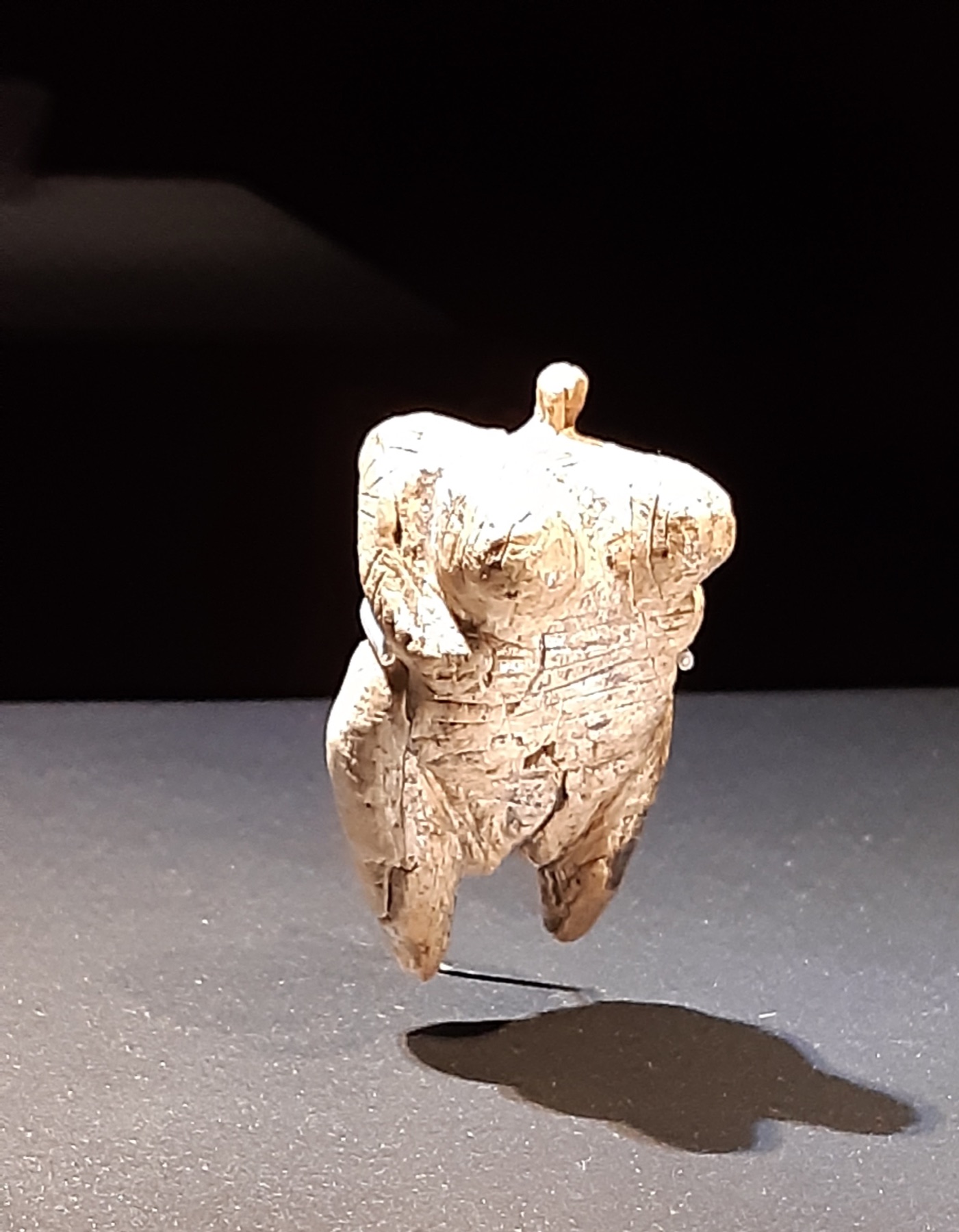
The female figure from Hohle Fels, carved from mammoth ivory, belongs to the Aurignacian deposits of southwestern Germany. Its archaeological context dates to at least 35,000 calendar years ago and may approach 40,000. The body is unmistakably female; a suspension loop takes the place of a head. Long before the end of the Ice Age, people in Europe had made the female form an object of attention, handling, and memory.4
Later Gravettian artists made female figures across a wide arc of Europe, in ivory, stone, and fired clay. The figures from Lespugue and Dolní Věstonice are not copies of one design. They share a subject across distance while changing its proportions and materials. Female imagery had a life that could travel; each community could give it a local form.5
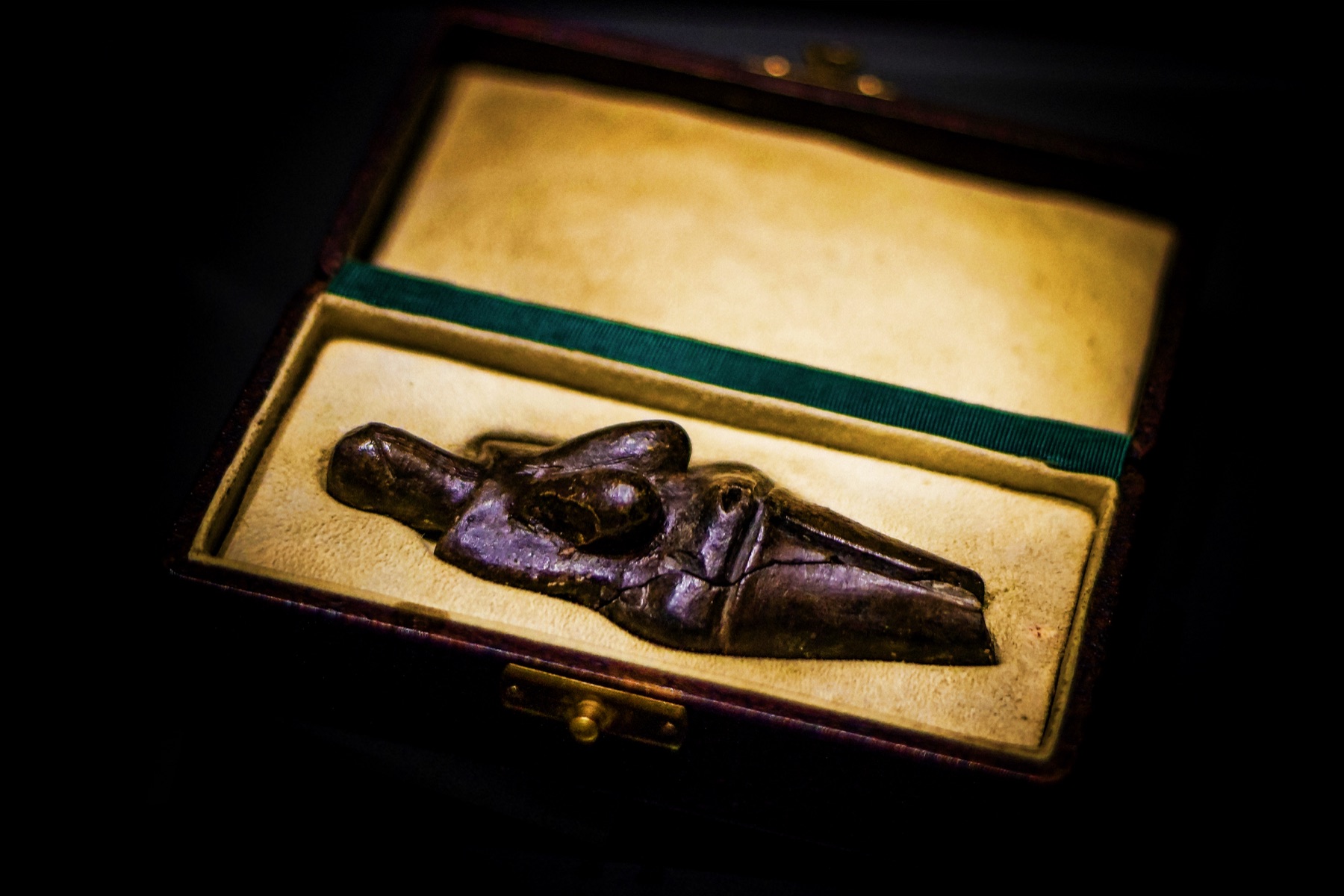
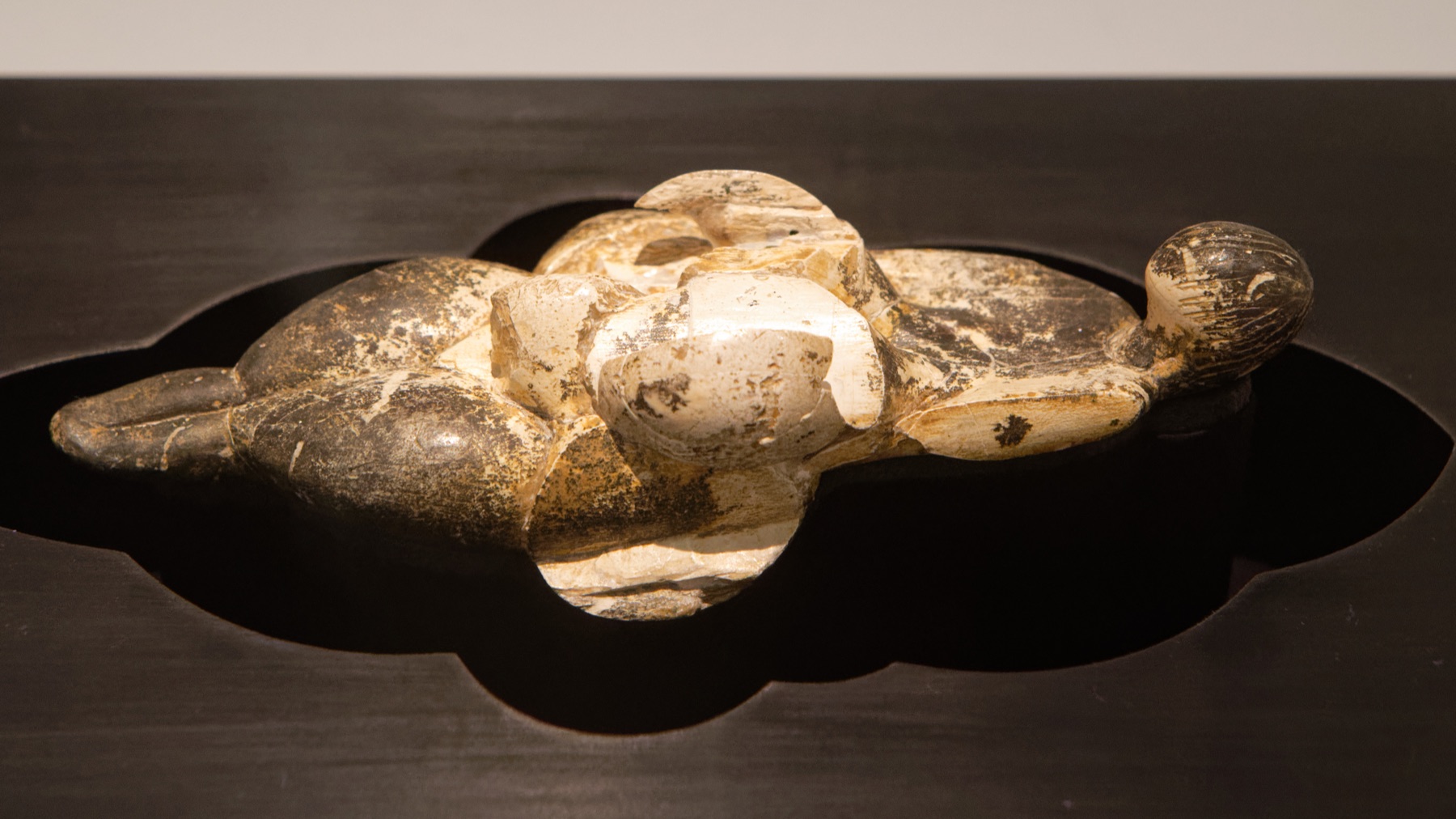
Near the end of the Ice Age, female images appear in a different visual language. At Lalinde in southwestern France, engraved limestone bears eleven schematic women: repeated headless profiles reduced to spare lines. Related Gönnersdorf–Lalinde figures occur across several parts of Europe, showing that even this economical form circulated well beyond one shelter.6, 12
These works do not preserve one unchanging image or tell us the words of a myth. Female figures recur in distinct periods and across major changes in style. That recurrence is what a cultural inheritance looks like in the archaeological record: one relation held steady while its forms were remade.
The Lalinde evidence
At La Roche de Birol near Lalinde, the two halves of this argument came out of the same cave. One is a limestone block engraved with eleven women: narrow waists, swelling hips, the body cut down to a sign and then repeated until it reads as a rhythm. The other is a blade of reindeer antler, rubbed with ochre and pierced at one end, which Peyrony announced in 1930 as the first bullroarer yet found in the Palaeolithic. Denis Peyrony, publishing it, set it beside an Australian churinga and concluded that it must have served the same purpose. Nowhere else in the Ice Age record do a frieze of women and the roaring blade come out of the same cave.6, 7, 13
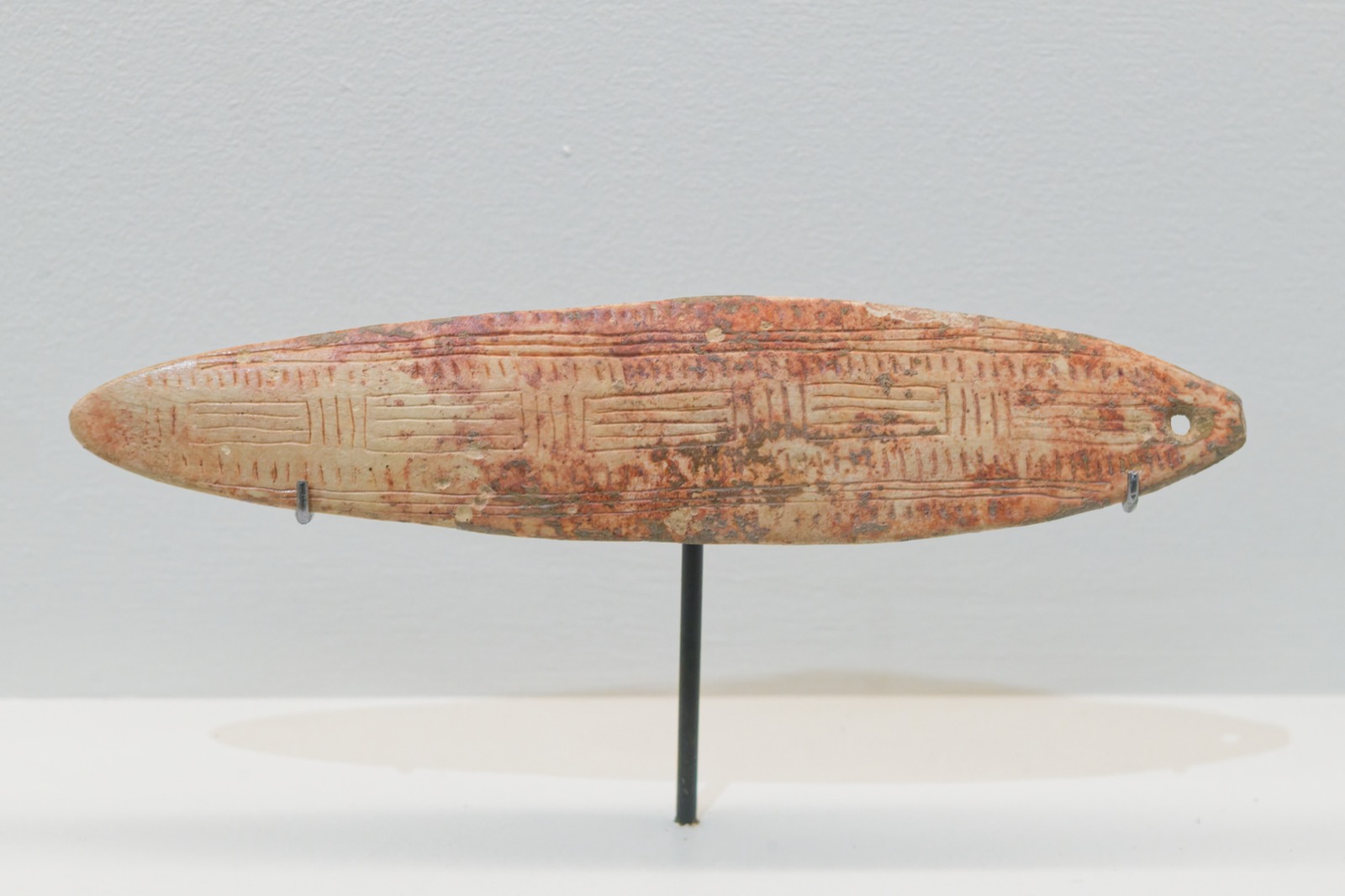
This is the closest archaeological meeting the argument has: a repeated female image and an instrument of sacred sound, in one cave, in the period when the European record is thickest with women. It is also the pairing the myth itself describes. Wherever the story survives today — Arnhem Land, the Sepik, the Xingu — the same two things are bound together: the women who owned the voice, and the voice men now keep from them.
Lalinde does not stand alone. It belongs to a family of elongated, pierced bone and antler blades that Barandiarán gathered into a single western European class — Isturitz, Aitzbitarte, El Pendo, Bourrouilla. The form is consistent enough across five hundred kilometres of Magdalenian country to be a type rather than a coincidence. Lalinde is the one site in that family that also gave up engraved women.7, 13
What the African record shows
Africa’s symbolic record is older. Blombos Cave preserves geometric engravings around 77,000 years old, and Apollo 11 Cave in Namibia has portable figurative plaques around 30,000 years old.9, 10
Age is not the test here. The surviving finds from Blombos and Apollo 11 do not provide the material pairing at issue here: repeated female imagery beside an object classed as a bullroarer or rotating sound-maker. A notable African sound-object find is Matjes River MR40, a bone artifact whose wear experiments support rotation. Its archaeological layer dates to roughly 9,580–5,400 radiocarbon years BP—later than the European Magdalenian contexts at issue.11
The European case rests on something more specific than antiquity: a long record of female representation, Ice Age women engraved in stone, and a rhombe from the same cave. Africa offers no such pairing. A deeper symbolic record is not the same as the one we are looking for, and on the pairing that matters, Europe is the only place it occurs.
The inheritance can change its form
A shared myth does not need to keep the object that first carried it. A bullroarer may disappear while its story remains; a flute, mask, or sanctuary may take its place in a later version. The inheritance at issue is the relation among women’s former sacred ownership, the transfer of that power, and its guarded use by men. Communities can retell that relation in the objects and institutions they know.
This is how long-range cultural descent can leave local histories intact. Ilahita’s Mimi’unemb belongs to Ilahita, with its own spirit, ceremony, and account of male authority. Yirrkala, Karadjeri, Buka, and Upper Xingu traditions belong to their own worlds. These later versions descend from an Ice Age European inheritance, reshaped within the histories of the communities that carried it.
Europe offers an extended female-image record and, at Lalinde, engraved women and the first Ice Age bullroarer ever announced, from the same cave. Berezkin’s African root rides on the first human dispersal; d’Huy’s own tree puts F38 at a Balkan node. The imagery and the Lalinde cave give the shared stories the one material setting that fits their central relation: women’s former possession of sacred power.
The shared myths of women’s former sacred authority are more convincingly rooted in Ice Age Europe than in Africa.
Key sources
- Yuri Berezkin, Африка, миграции, мифология (2013), pp. 141–148, especially Fig. 44 and pp. 147–148; Berezkin’s analytical catalogue, F38 and F39.
- Julien d’Huy, “Matriarchy and Prehistory: A Statistical Method for Testing an Old Theory,” Les Cahiers de l’AARS 19 (2016–17; published 2017), pp. 159–170: East African root, p. 161; reconstructed core, p. 163; Balkan F38, p. 167 n. 7.
- Donald Tuzin, Unity in Duality (1973), Appendix E, no. 4, p. 358; The Voice of the Tambaran (1980), “Lefin,” pp. 55–78; see the Atlas Mimi’unemb account.
- Nicholas J. Conard, “A female figurine from the basal Aurignacian of Hohle Fels Cave in southwestern Germany,” Nature 459 (2009), pp. 248–252.
- Patrick Paillet and Éric Robert, “Vénus de Lespugue,” Muséum national d’Histoire naturelle; Gravettian female imagery and comparative conventions.
- Musée national de Préhistoire, “Bloc gravé de Lalinde.” Eleven female figures, archaeological context, and wider style.
- Ignacio Barandiarán Maestu, “Forma vs. función en tipología prehistórica: el caso de las bramaderas óseas magdalenienses,” Veleia 29 (2012), pp. 307–334.
- Julien d’Huy, “Le rhombe de la grotte de La Roche à Lalinde: l’apport de l’approche phylomythologique,” Bulletin de la Société historique et archéologique du Périgord 152 (2025), pp. 155–162; SHAP listing.
- Christopher S. Henshilwood et al., “Emergence of Modern Human Behavior: Middle Stone Age Engravings from South Africa,” Science 295 (2002), pp. 1278–1280.
- Rifkin et al., “Characterising pigments on 30 000-year-old portable art from Apollo 11 Cave, Karas Region, southern Namibia,” Journal of Archaeological Science: Reports 5 (2016), pp. 336–347.
- Kumbani et al., “A functional investigation of southern Cape Later Stone Age artefacts resembling aerophones,” Journal of Archaeological Science: Reports 24 (2019), pp. 693–711.
- Joseba Rios-Garaizar et al., “The Venuses Block from Arlanpe Cave (Northern Iberian Peninsula): Implications for the Origins and Dispersion of Gönnersdorf-Lalinde Style Depictions Throughout the European Magdalenian,” Oxford Journal of Archaeology 34.4 (2015).
- Brigitte and Gilles Delluc & Francis Guichard, “Les fouilles de la grotte de la Roche à Lalinde (Dordogne),” Préhistoire du Sud-Ouest 16, no. 2 (2008), pp. 185–205.