Atlas Essay —
Recognised
Saint-Marcel · Lalinde · Aitzbitarte · Sare · Central Australia · Gippsland
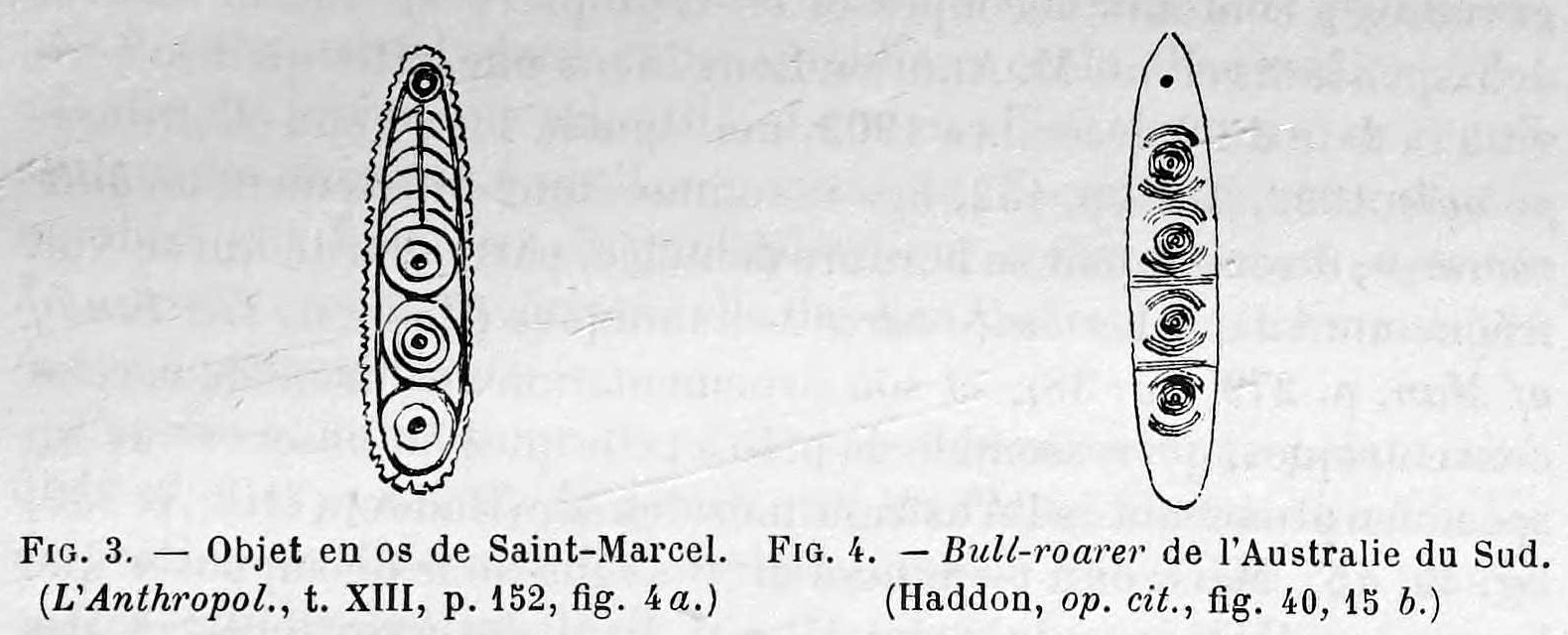
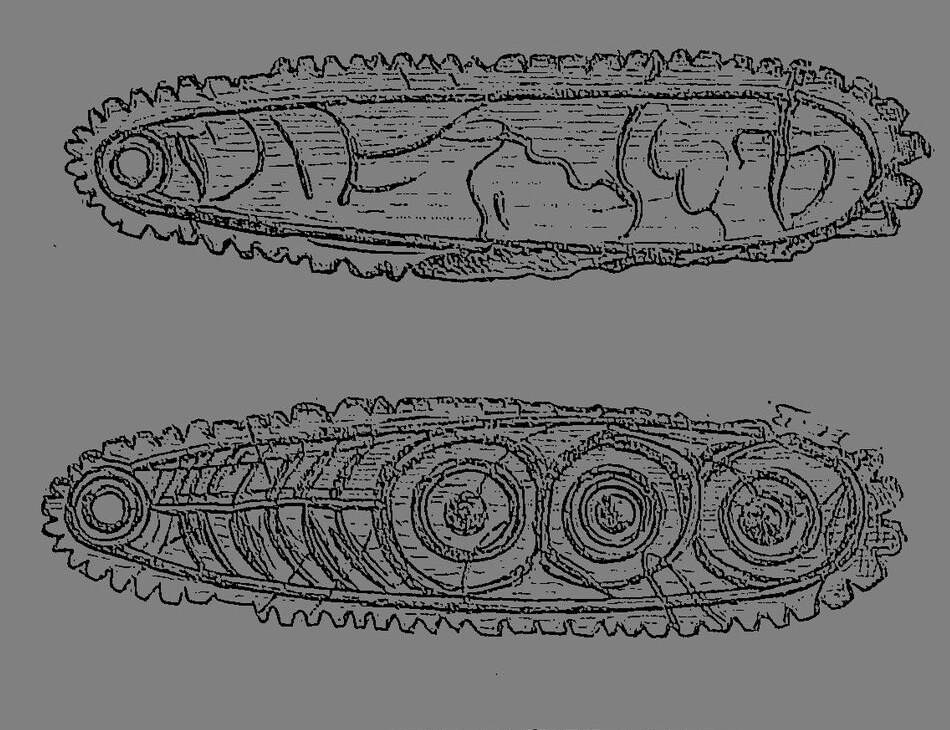
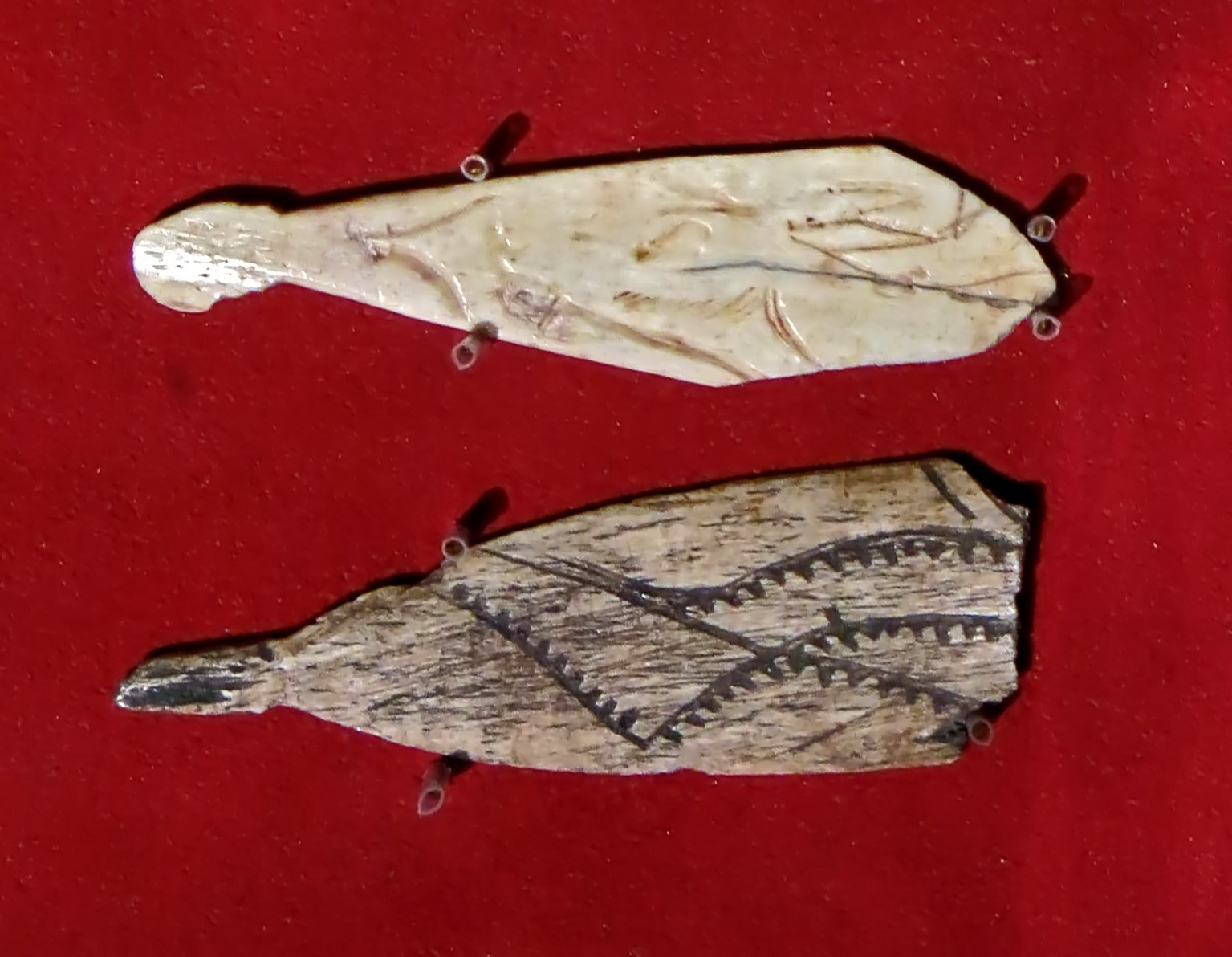
In the spring of 1902 the Abbé Henri Breuil published a small bone pendant from the rock shelter of Saint-Marcel, on the Creuse in central France: an elongated oval with toothed edges, three concentric circles cut down one face, a hole at the tip. He called it an amulet. That December Andrew Lang looked at Breuil's drawing and wrote to the Cambridge classicist Arthur Bernard Cook that it was clearly a bull-roarer — “nettement un bull-roarer,” as Cook reported the letter. Lang knew it because he had seen it before: the toothed edge on the boys' buzzers of the British Isles, the concentric circles on a bull-roarer from South Australia. Every Ice Age bullroarer since has entered science the same way.
In brief
- The first recognition was the Saint-Marcel pendant. Lang named it a bull-roarer in a letter of 9 December 1902, and Cook printed it beside a South Australian bull-roarer in L'Anthropologie in 1903, twenty-seven years before Peyrony's Lalinde plate.
- For a century the verdict came back in stronger words: “exactly akin” (Lang, 1904), “resembling very closely” (MacCurdy, 1932), “indistinguishable in general form and decoration” (Levy, 1948), “a remarkable resemblance” (Graziosi, 1960), impérieusement (Camps, 1994). Even the sceptic Étienne Patte conceded the likeness and argued only over which Australian object it matched.
- In the Basque Country the recognition ran through the village toy. José Miguel de Barandiarán catalogued his Aitzbitarte blades as bramaderas, the Spanish boys' toy, and the Bolinkoba fragment is a furrunfarra in Basque. In 1947 that same abbé owned a Sare burruna whose animal engravings Marie-Barbara Le Gonidec, writing up its recordings, found “astonishingly close to the Palaeolithic engravings.”
- The Magdalenians recognised it too. At Lortet, Le Morin and Fontalès they engraved bison on the blade, an animal whose low bellow, Michel Dauvois observed, is like the roarer's own voice.
The Ice Age bullroarer was never discovered; it was recognised. Every Palaeolithic roarer in Europe entered science because someone held it beside a living one, Australian or Basque, and saw the same object. That recognition, repeated for a century by scholars who agreed on nothing else, is the evidence: one form has survived from the Magdalenian blade to the Arunta churinga and the Basque village burruna.
Every Ice Age blade on this page is in the atlas — browse the dated archaeological records, or start from the Lalinde blade on the map.
Lang reads a pendant
The object came out of the deepest layer at Saint-Marcel, the level of cut-out and champlevé engravings, dug by a M. Benoist and published by Breuil in L'Anthropologie for 1902. Breuil described it with care: an elongated oval “with toothed edges,” an engraved cartouche running parallel to the border, three circles each centred on a deeply drilled point, a smaller circle cut round the suspension hole on both faces. Then he gave his reading. The pendant from Saint-Marcel, he wrote, “semble bien être une amulette”, does indeed seem to be an amulet.
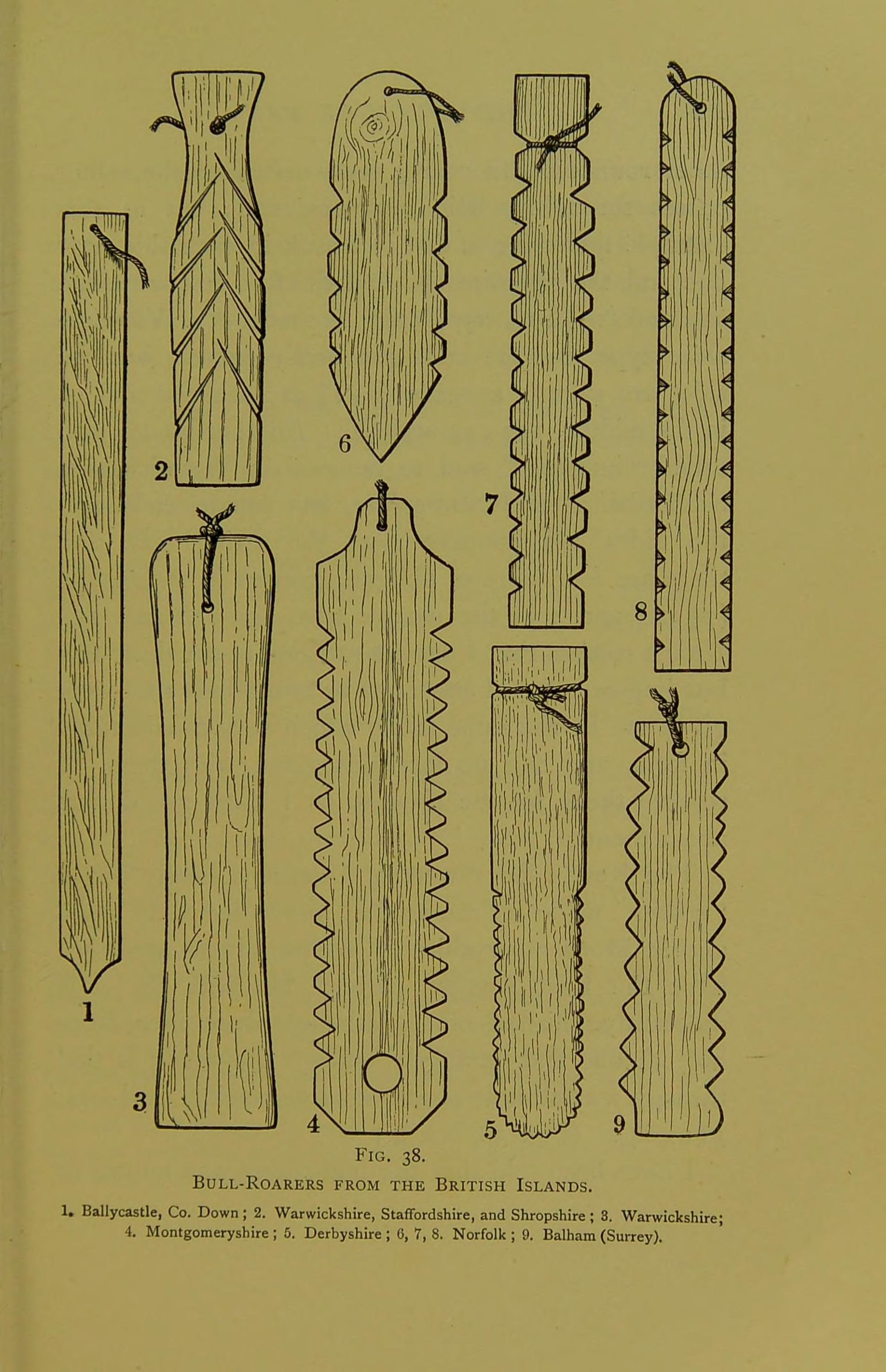
Nobody in France had yet thought of a bullroarer, because nobody in France had one in mind. Lang did. Eighteen years earlier he had written the essay that made the bull-roarer a subject, tracing the whirled slat of the Greek mysteries to the turndun of the Kurnai of Gippsland. He knew the toy as it survived in British villages, and Alfred Haddon had just printed both halves of what he would see, in The Study of Man (1898): the bull-roarers of the British Isles in figure 38, and the comparative series of the world in figure 40. When Breuil's drawing reached him, he saw both in it at once. Cook reported the letter in his own paper the next year:
Mr Andrew Lang, in a letter he wrote me dated 9 December 1902, pointed one of them out to me … as being “clearly a bull-roarer.” He remarked its toothed border, a peculiarity seen frequently on British bull-roarers (Haddon, The Study of Man, p. 279, fig. 38), and its ornament in the form of concentric circles, which closely resembles that seen on a specimen from South Australia (Haddon, ibid., p. 309, fig. 40, 15).
— A. B. Cook, L'Anthropologie 14 (1903), p. 658, reporting Lang's letter (original: “nettement un bull-roarer”)
Both of Lang's witnesses were living objects. The serrated edge came from the boys of Ballycastle and Norfolk and Balham, who sawed teeth into the edges of their buzzers. The circles came from Australia. The bone from the Creuse had never been seen by anyone who whirled a roarer, and it took a man who had handled the living toy to see that it was one.
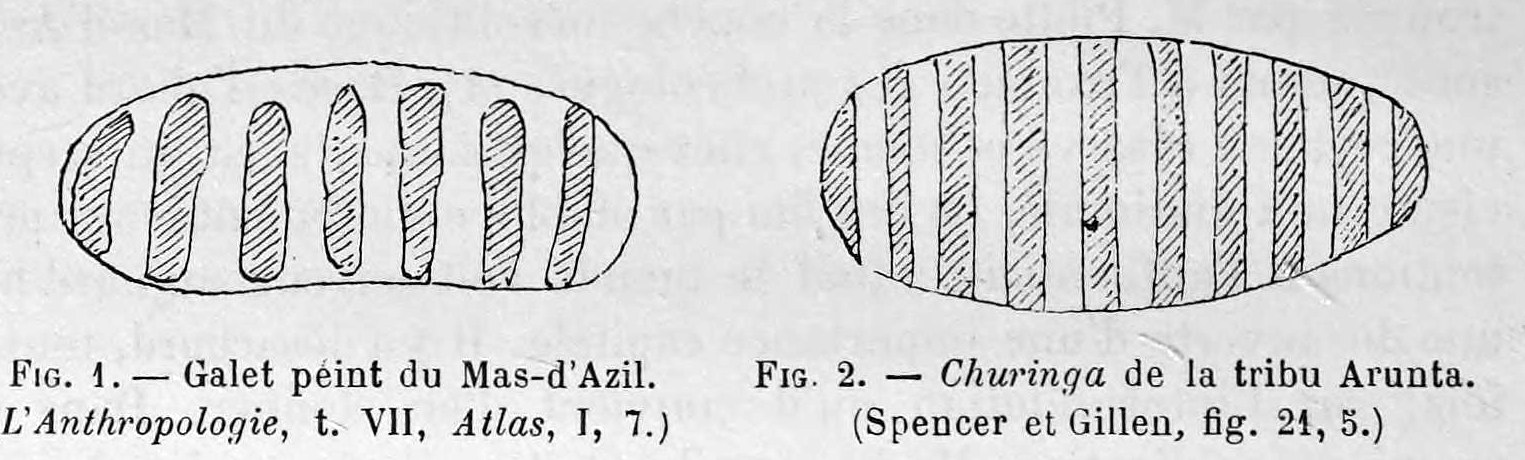
Cook made Lang's eye the keystone of his argument. He had come to the Ice Age through the painted pebbles of the Mas d'Azil, the striped and dotted stones that Édouard Piette had read as an alphabet, and in a lecture at Bedford College in November 1902 he had set them beside the stone churinga of the Arunta of Central Australia, the sacred ancestor-boards that Baldwin Spencer and Frank Gillen had just published. Spencer and Gillen had shown him that the churinga and the bull-roarer were the same object in Arunta hands; wooden churinga, Cook noted, “ne peuvent être distingués du bull-roarer”, cannot be distinguished from the bull-roarer. If the Magdalenians had a bull-roarer, they had a churinga. Lang had just handed him one.
Now the bull-roarer, which still survives among us as a toy or at most as a charm against thunder, was traced by Mr Andrew Lang in ancient Greece, where it seems to have been a sacred instrument used in the Dionysiac mysteries. No traces of it further back had been found on the soil of Europe when, in the spring of last year, the Abbé Breuil published the discoveries made by M. Benoist at Saint-Marcel. … Given the striking analogy between the Palaeolithic and Mesolithic remains of the French caves on the one hand and the living customs of the Australian aborigines on the other, we may provisionally accept that the stones of Saint-Marcel and of the Mas d'Azil are truly churinga, bearing witness to a belief in spirits that survived the death of the body, and that perhaps could even make their voices heard by means of a bull-roarer. We have thus found what has long been sought: the proof that Palaeolithic man himself was not entirely without a certain belief in spirits and in another life.
— A. B. Cook, L'Anthropologie 14 (1903), pp. 658–659
He printed the evidence as pictures. On page 656 a painted pebble from the Mas d'Azil sits beside an Arunta stone churinga; on page 657 the Saint-Marcel pendant sits beside Haddon's South Australian bull-roarer. That pairing, Palaeolithic object on the left and living Australian object on the right, is the format of every recognition that followed.
Agreed on nothing else
Lang answered Cook in Man the following year, and the answer was a disagreement. The pebbles, he argued, were probably counters in a game, like the coloured stones of the Mexican patolli; the Mas d'Azil was a dwelling, not a sacred storehouse; the brochs of Caithness had painted pebbles too, and nobody thought the Picts kept churinga. On everything Cook had built, Lang dissented. On the one object Lang had seen first, he went further than Cook:
He shows that there is an example of a French palaeolithic pendeloque in bone or ivory, which in shape, serrated edges, and decoration (concentric circles) is exactly akin to some Australian bullroarers. Another, from a Moravian site, is figured in Hoernes's Der Diluviale Mensch, p. 138 (1903). Dr. Hœrnes does not remark on the thoroughly Australian appearance of this object. It may be inferred from these examples and from others in amber from the Baltic coasts, published by Klebs, that palaeolithic and neolithic men had bullroarers, and probably had such religious ideas as among savages are attached to bullroarers, as uttering the Voice (or “Word”) of some supernormal being.
— Andrew Lang, Man 4 (1904), no. 22, pp. 37–38
That is the pattern of the next thirty years. The scholars of the new prehistory quarrelled about the pebbles, about totemism, about whether the Tasmanians were the Magdalenians' cousins or their opposite, about whether religion could be read off stone at all. They did not quarrel about the pendant. William Sollas, in Ancient Hunters (1911), captioned it plainly, “a churinga or bull-roarer, in ivory, from Saint Marcel,” and wrote that it “has been interpreted as a bull-roarer, an instrument of magic … still widely disseminated among primitive races, including the Australians, Bushmen, and the Eskimo.” Salomon Reinach, cataloguing every piece of Ice Age art he could find in 1913, entered it as “Amulette en os (analogue à un churinga australien)”, bone amulet, analogous to an Australian churinga. George Grant MacCurdy's gazetteer of 1924 lists at Saint-Marcel an “engraved bone amulet similar to Australian churinga.”
Hugo Obermaier, the great excavator of the Spanish caves, took up Cook's pebbles in Fossil Man in Spain (1924) and found the Australian stones “exceedingly similar to the Azilian pebbles, both in shape and design.” Miles Burkitt, writing the first English textbook of prehistory in 1921, set down the comparison and declared in the same breath that “we know nothing, as yet, about their significance.” Lang himself, looking back over his career in 1907, mocked his own enthusiasm and kept the likeness intact:
There was a time when I was apt to see churinga nanja everywhere; and my sole excuse is that the European neolithic and palaeolithic things were exactly like churinga nanja.
— Andrew Lang, “Edward Burnett Tylor,” in Anthropological Essays presented to Edward Burnett Tylor (1907), p. 10
A recantation that rests its defence on “exactly like” is no recantation of what the eye saw. Lang withdrew the theory and kept the object.
The European neolithic and palaeolithic things were exactly like churinga nanja.— Andrew Lang (1907)
Lalinde, the first whole one
In 1930 Denis Peyrony published the piece that settled the type: a slender blade of reindeer antler from the cave of La Roche de Birol, near Lalinde in the Dordogne, coated with red ochre, engraved after the ochre in ranked lines, pierced near one end, shaped, he said, like a fish without a tail. Its story is told in full in Identical Forms. What matters here is how Peyrony knew what he had. He did what Cook had done. He set an Australian churinga on the left of his figure 3 and the Lalinde blade on the right, and he named the instrument by its living names: the word churinga, he explained, had passed into common use for “l'instrument de musique que les Anglais dénomment « bull roarer », les Allemands « schwirrholz » et les Français « planche ronflante » ou « diable »”, the musical instrument the English call the bull-roarer, the Germans the Schwirrholz, and the French the snoring board or the devil. Two of those four names belong to a toy.
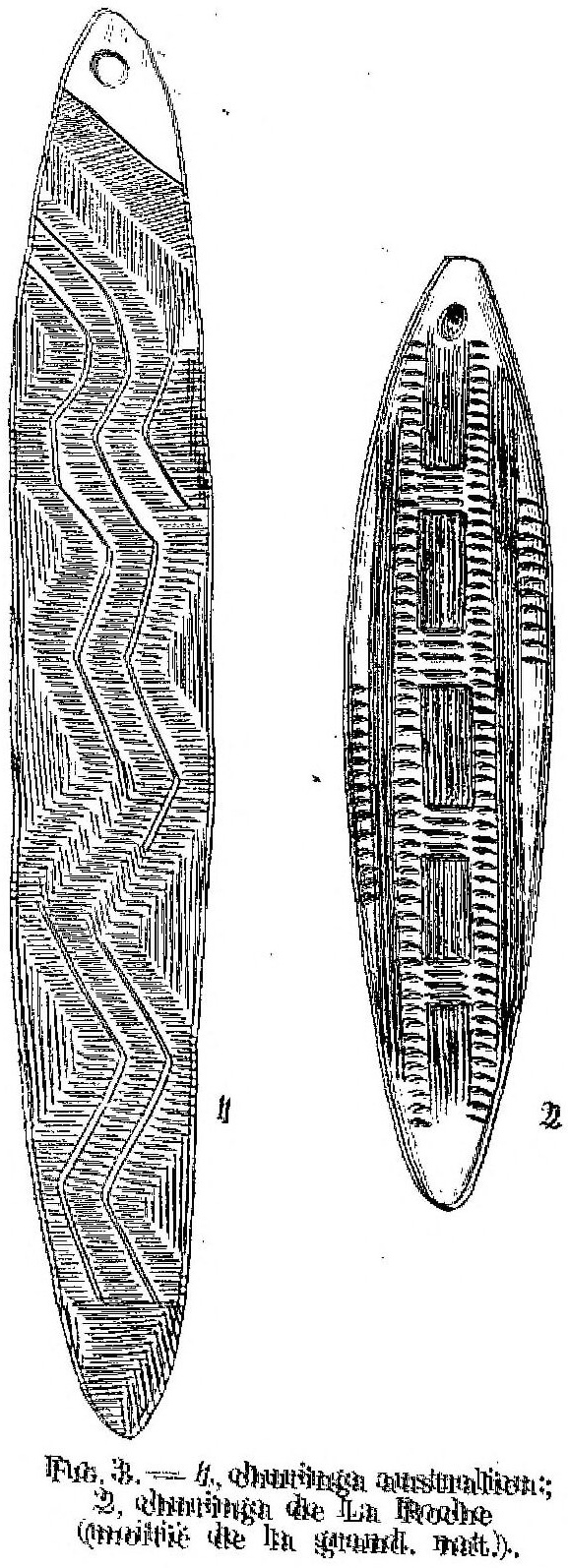
Henry Field, who bought the blade and gave it to France, reported that the Abbé Breuil hailed it as the first complete Magdalenian churinga ever found. MacCurdy, two years after Peyrony, put it into The Coming of Man as “an object resembling very closely an Australian churinga,” adding that “it bears a close resemblance to the churinga of the Arunta tribe and must in its time have served a purpose similar to that served by the esoteric and sacred churinga.” In the same pages he gathered a decorated bone pendant from La Roche-Plate at Saint-Mihiel, on the Meuse, “closely resembling the churinga,” and an incised slate from the cave of Pekárna in Moravia, and drew his conclusion: “These specimens resembling the churinga all serve to throw light on the significance of cave art.” R. R. Marett, the Oxford anthropologist of religion, gave the received view in 1933: the bull-roarer “is usually held to go back to Palaeolithic times, since certain ivory pendants of Magdalenian age look very like miniature bull-roarers that have become amulets.”
The sceptic's concession
The recognition had one serious opponent in these years, and his objection proves it. Étienne Patte, writing in the Revue anthropologique in 1934 on the engraved bones of Le Placard in the Charente and Předmostí in Moravia, refused the word churinga. It smuggled in totemism, he said, and totemism in Ice Age Europe was “far from proven.” He wanted a neutral term. And then he went looking for a better comparison, and found it in the same continent:
Moreover, the comparison of certain fairly similar engraved bones is sometimes as easy with the “message-sticks” of the Australians and Melanesians as with the churinga. … M. Peyrony recently compared a churinga and an engraving from the Dordogne. The comparison would be just as easy with message-sticks.
— Étienne Patte, Revue anthropologique 44 (1934), p. 54 (original: “La comparaison serait aussi facile avec des bâtons-messages”)
The sceptic's alternative to an Australian sacred board was another Australian board. And on the Australian side the two were not always two: Patte himself noted, after Durkheim, that a churinga could serve as the message-stick a messenger carried to summon distant groups to ceremony. He quoted Breuil too, who had looked at the shattered decorated ribs of Předmostí in 1925 and thought that the reading “d'objet sacré ou « churinga »”, of sacred object or churinga, would better explain why they were so highly ornamented. The opposition, when it came, conceded the likeness and fought over the label.
A century of the same words
After the war the recognition hardened into a sentence that every handbook carried. Gertrude Rachel Levy, in The Gate of Horn (1948), gave it its strongest English form, and printed it as Cook had: on page 32 the Lalinde blade and the Saint-Marcel pendant flank a churinga of the Arunta Wild-Cat totem, and her fifth plate, “Palaeolithic and modern comparisons,” sets a Kurnai bull-roarer beside a Palaeolithic one.
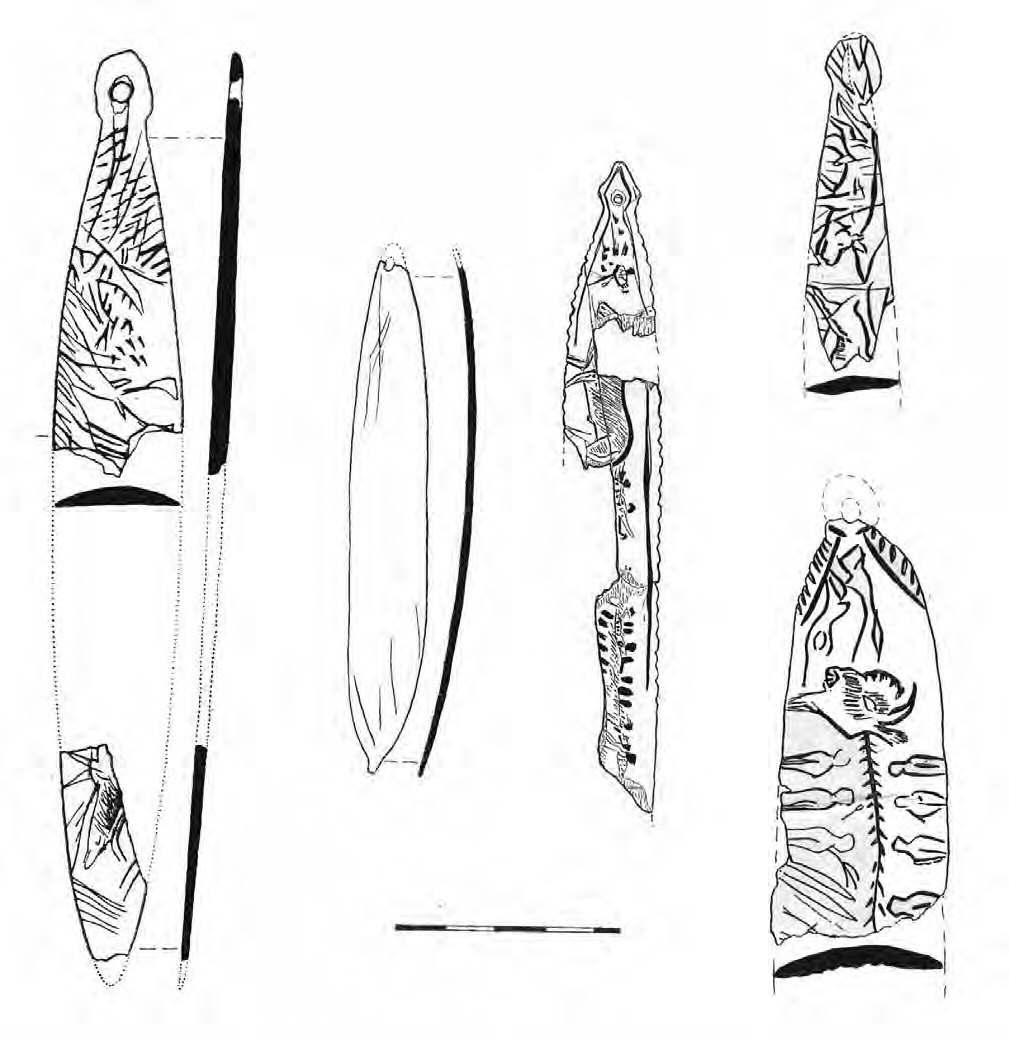
A special implement of the churinga type is the Bull-Roarer, which produced the voice of divinity to terrify the candidate and the distant women and children during the earlier ordeals of initiation. This was generally made of wood and pierced for whirling. Several similar objects appear among the Magdalenian finds … They are indistinguishable in general form and decoration from Australian specimens, but their purpose is of course unknown. The bull-roarer, however, was used in the mysteries of the succeeding civilisations of Europe, sometimes retaining its Magdalenian pattern.
— G. R. Levy, The Gate of Horn (1948), p. 48
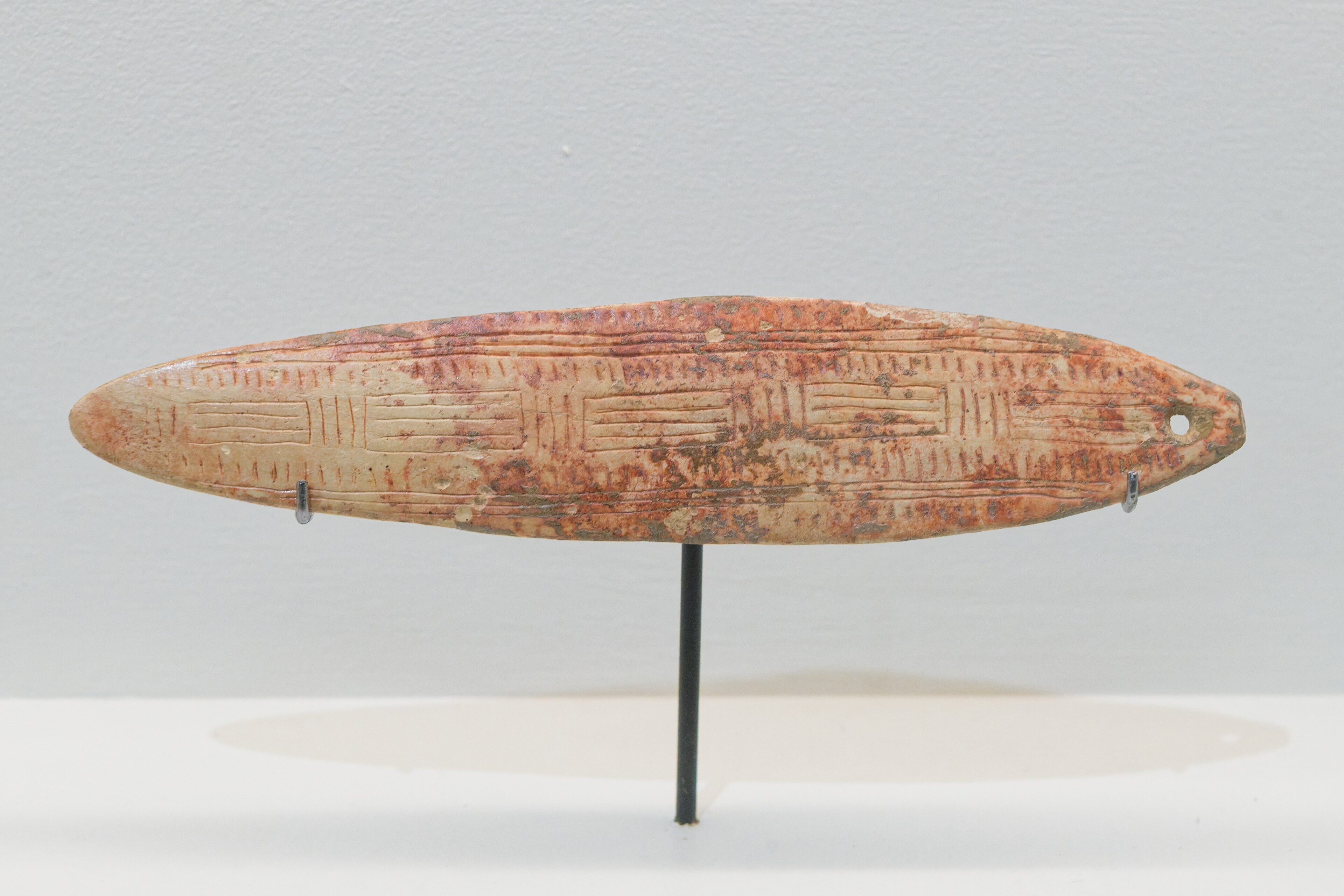
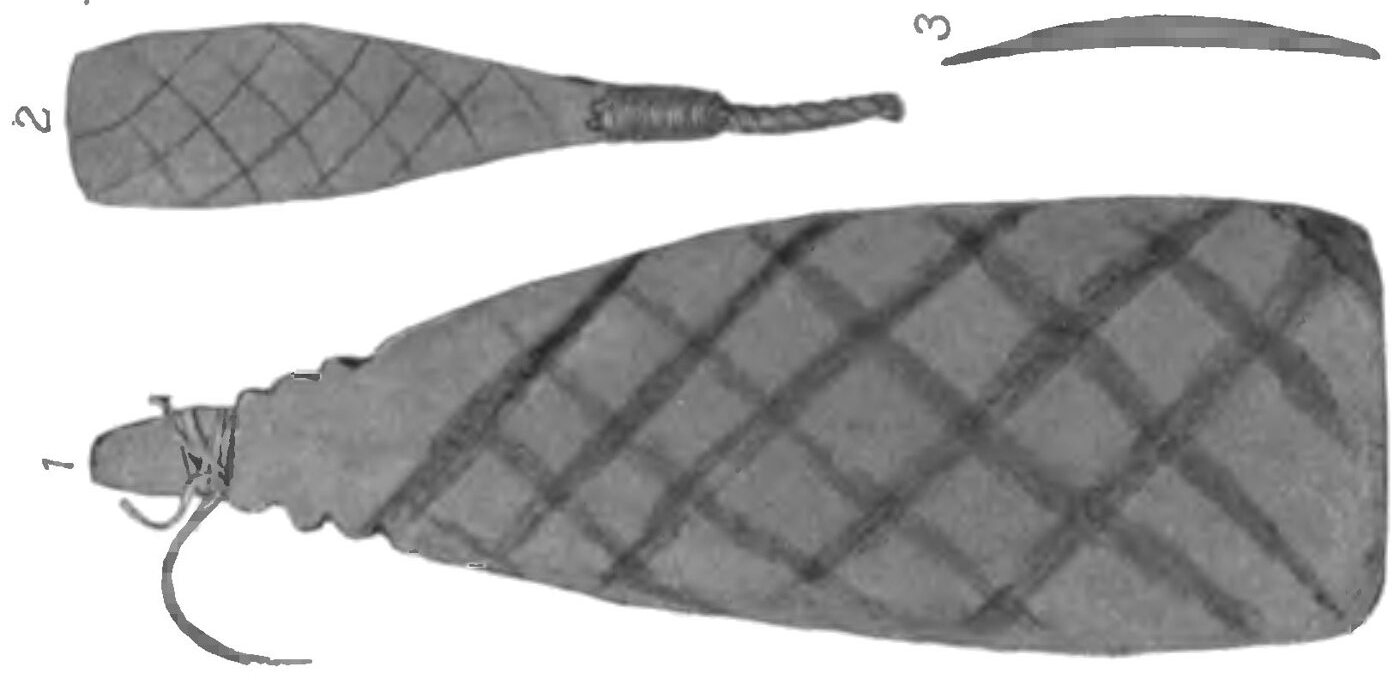
Johannes Maringer, in The Gods of Prehistoric Man (1956; English 1960), came to the reindeer-bone blade that Alfred Rust had dug from the glacial lake at Stellmoor near Hamburg, which, as Maringer told it, “sounded a not very high-pitched note when swung on a band.” Maringer recognised it at once: “We have already met the same type of object excavated from Magdalenian deposits at La Roche — a decorated bone strongly resembling the bull-roarer of the Australian aborigines.” Paolo Graziosi, in Palaeolithic Art (1960), wrote of the Lalinde plaque that it “bears a remarkable resemblance to such instruments.” When Ignacio Barandiarán Maestu surveyed the literature in 2012 he found the sentence everywhere: André Leroi-Gourhan taking Lalinde as the type of “un rombo, el instrumento del que los australianos, especialmente, sacan un sonido ronco”, a rhombe, the instrument from which the Australians especially draw a hoarse sound; Denise de Sonneville-Bordes calling it the churinga, “the sounding rhombe of Australia.” Gabriel Camps, in his Introduction à la préhistoire of 1994, set the Lalinde blade beside “les « churinga » ou rhombes des sorciers australiens”, the churinga or bullroarers of the Australian sorcerers, with the strongest word in the series: impérieusement, imperiously. “Un exemplaire analogue d'Isturitz renforce cette interprétation,” he added: an analogous piece from Isturitz reinforces the reading.
| Year | Who | Ice Age object | Held beside | Words |
|---|---|---|---|---|
| 1902 | Andrew Lang (letter, via Cook) | Saint-Marcel | British and South Australian bull-roarers | “nettement un bull-roarer” — clearly a bull-roarer |
| 1904 | Andrew Lang | Saint-Marcel; a Moravian pendant | Australian bullroarers | “exactly akin”; “thoroughly Australian appearance” |
| 1911 | W. J. Sollas | Saint-Marcel | Australian, San and Inuit bull-roarers | “a churinga or bull-roarer” |
| 1913 | Salomon Reinach | Saint-Marcel | Australian churinga | “analogue à un churinga australien” |
| 1930 | Denis Peyrony | Lalinde | Australian churinga | “un instrument identique” — an identical instrument |
| 1932 | G. G. MacCurdy | Lalinde; Saint-Mihiel | Arunta churinga | “resembling very closely” |
| 1934 | Étienne Patte | Lalinde | Australian message-sticks | “aussi facile” — just as easy |
| 1948 | G. R. Levy | Lalinde; Saint-Marcel | Arunta churinga; Kurnai bull-roarer | “indistinguishable in general form and decoration” |
| 1954 | Henry Field | Lalinde | Australian churinga and shields | “resembles that on Australian churinga” |
| 1956 | Johannes Maringer | Lalinde; Stellmoor | Australian bull-roarer | “strongly resembling” |
| 1959 | László Vértes | Tata, Hungary | Australian churinga | “nous font penser aux churinga” — make us think of churinga |
| 1960 | Paolo Graziosi | Lalinde | Australian bull-roarers | “a remarkable resemblance” |
| 1966 | J. M. de Barandiarán | Aitzbitarte IV | the Spanish boys' toy | bramaderas |
| 1973 | J. R. Harding | Saint-Marcel | Australian churinga | “exactly imitating the blade of the instrument” |
| 1994 | Gabriel Camps | Lalinde; Isturitz | Australian churinga | “impérieusement” — imperiously |
| 2015 | Ignacio Barandiarán Maestu | Bolinkoba | the Basque village toy | furrunfarra |
| 2020 | Joshua Kumbani | Matjes River, South Africa | the Magdalenian blades | “resembles that of other known bullroarers from the European Upper Palaeolithic” |
The verbs barely change in a hundred years, and neither does the method. The object comes out of the ground as a pendant, an amulet, a spatula, a pendeloque. It becomes a bullroarer the day somebody lays it beside a roarer that is still in use. Breuil's amulet from Saint-Marcel became one in Lang's letter. The bison-engraved sliver from Le Morin in the Gironde was catalogued as a pendant in 1975, until Michel Dauvois read its proportions as a rhombe's. In South Africa a pear-shaped bone from the burial layer of the Matjes River rock shelter, “previously described as a pendant,” was reread as a bullroarer by Joshua Kumbani and his colleagues, who spun replicas of it; its “oval- to pear-shaped form,” Kumbani wrote in 2020, “resembles that of other known bullroarers from the European Upper Palaeolithic.” By then the Magdalenian blade had itself become the living reference, the thing a new find is held beside.
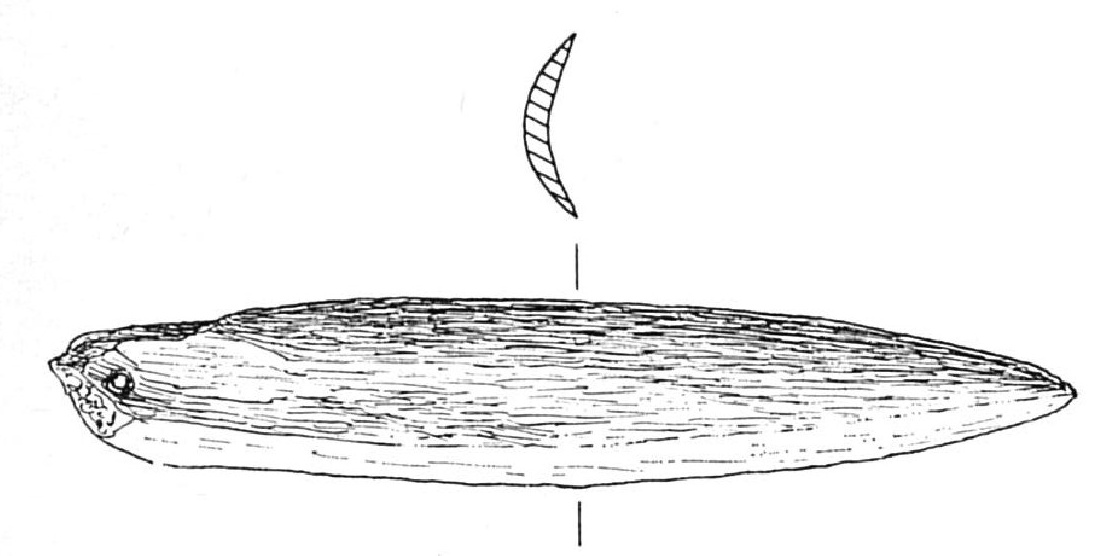
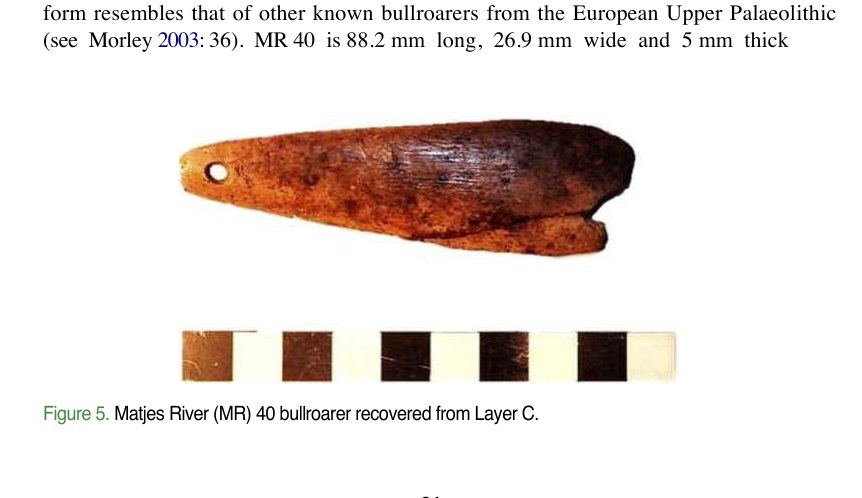
They are indistinguishable in general form and decoration from Australian specimens.— G. R. Levy, The Gate of Horn (1948), p. 48
The village toy
Cook had already said where else to look. The bull-roarer, he wrote in 1903, “still survives among us as a toy.” South of the Pyrenees that is exactly where the archaeologists found their word. The Spanish name for the Ice Age blade is bramadera, and the Real Academia's dictionary defines the bramadera not as a relic but as a plaything: a thin piece of board with a hole and a cord, “which boys use as a toy,” whirled in a circle round the hand until it “makes a noise like the bellowing of the wind.” Barandiarán Maestu, quoting that definition, lists the names the literature gave the Magdalenian type — churinga, bull-roarer, Schwirrholz, rhombe, planche ronflante, diable — and in Spanish “los equivalentes al juguete infantil ‘bramadera’, bramador, zumbador, zumbadera, zumba, zurrumbera o rombo”, the equivalents of the children's toy.
The man who fixed that name to Ice Age bone was the Basque priest and prehistorian José Miguel de Barandiarán. Excavating the cave of Aitzbitarte IV near Errenteria in Gipuzkoa in 1963 and 1964, he recognised among the Magdalenian bone three flat pierced blades, and in his report of the 1964 season he catalogued them as bramaderas. His namesake and successor in the field, Ignacio Barandiarán Maestu, reports the choice with an exclamation mark of his own: the excavator catalogued them as bramaderas “—¡con esta precisa referencia nominal!—”, with exactly that name. The great recorder of Basque custom looked at Magdalenian bone and saw the village toy.
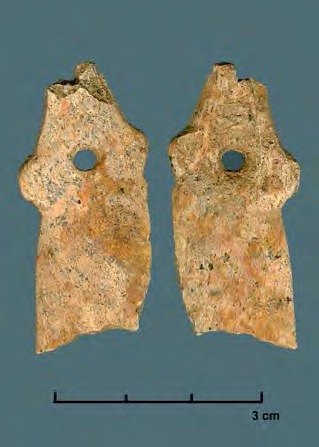
The naming did not stop in Spanish. When a fragment of one of these blades turned up in 2010 in the cave of Bolinkoba at Abadiño in Bizkaia, Barandiarán Maestu's Basque summary called it, without comment, a furrunfarra: “Bolinkobako indusketan zehar furrunfarra fragmentu bat berreskuratu da”, a furrunfarra fragment was recovered during the Bolinkoba excavation. Furrunfarra is what children in Lekeitio called the whirring slat they swung at Lent and again at harvest to drive the sparrows off the crops. The same paper states the method that made the identification, in one line: the use of the type had been agreed “atendiendo paralelos etnográficos (las churingas …) y de juegos infantiles (los rombos, las zumbas etc)”, on the strength of ethnographic parallels, the churingas, and of children's games, the rombos and zumbas. Australia and the village green, side by side, are the two hands that hold the Ice Age blade up to the light. Barandiarán Maestu also records, from Louis-René Nougier and Romain Robert, who dug the Magdalenian blades of La Vache in the Ariège, that the children of neighbouring Bigorre were still playing with such toys around 1900.
The burruna of Sare
In 1947 two ethnomusicologists from the Musée des Arts et Traditions Populaires in Paris, Claudie Marcel-Dubois and Maguy Pichonnet-Andral, came to Sare, a village in the French Basque hills near Espelette. They stayed with the abbé José Miguel de Barandiarán, then in exile on the French side of the border, and twice they recorded the rhombe there under the names burruna and furrunfurra. Marie-Barbara Le Gonidec, who has written up the recordings, hears in them “le vrombissement tout à fait caractéristique de l'instrument”, the entirely characteristic whirr of the instrument, and finds its name onomatopoeic. They also photographed the board. In 1958 Marcel-Dubois showed the photograph to a Basque improvising poet in Paris; he had never seen a burruna. Le Gonidec, publishing the photograph, saw in it what the poet had not:
This print, whose negative has deteriorated as the white spots on it show, lets one see the object well and appreciate its animal décor, astonishingly close to the Palaeolithic engravings of the painted caves… Should we see in it the fruit of chance, or rather think that the abbé knew of the more-than-millennial existence of the rhombe?
— Marie-Barbara Le Gonidec, “Le rhombe,” Les Réveillées (EHESS / Mucem) (original: “le décor animalier étonnamment proche des gravures paléolithiques des grottes ornées”)
The board in her photograph is a flat wooden blade with a rounded, pierced head, and down it walk incised quadrupeds in file, the way the bison and horses walk along the Magdalenian blades. A drawing of a Sare furrunfarra from the same 1947 mission, sent out by the Paris museum, shows a board decorated the same way on both faces: small four-legged animals stepping down beneath the cord-hole, and on one a figure above them. Le Gonidec leaves her question open. It answers itself. The abbé of Sare was the prehistorian who would catalogue the Aitzbitarte blades as bramaderas in the 1960s. He had dug Ice Age caves since the 1910s. He did not need to guess at the rhombe's antiquity; he was one of the people who established it. On his burruna the two halves of the recognition meet in a single object: a living Basque roarer, carrying Ice Age animals, in the hands of the man who named the Ice Age roarer after it.
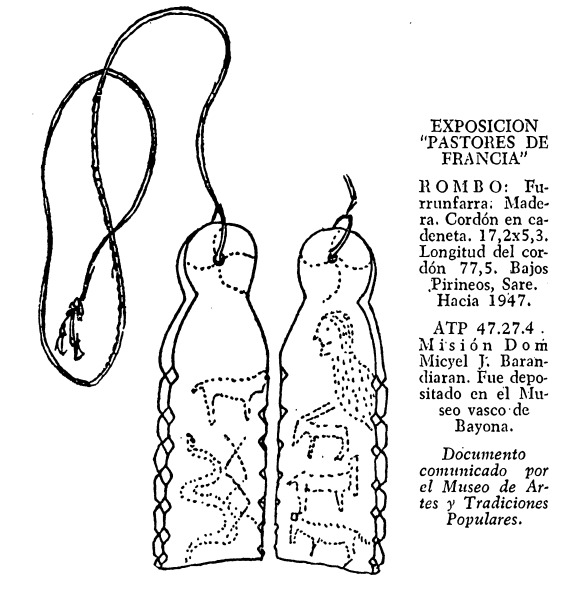
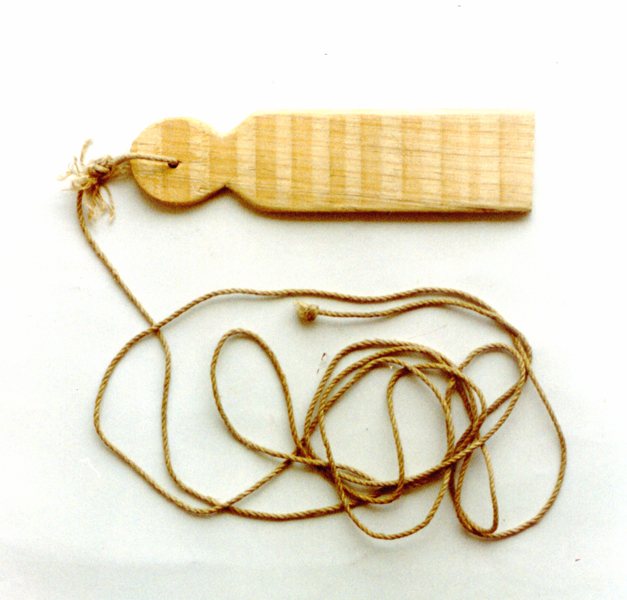
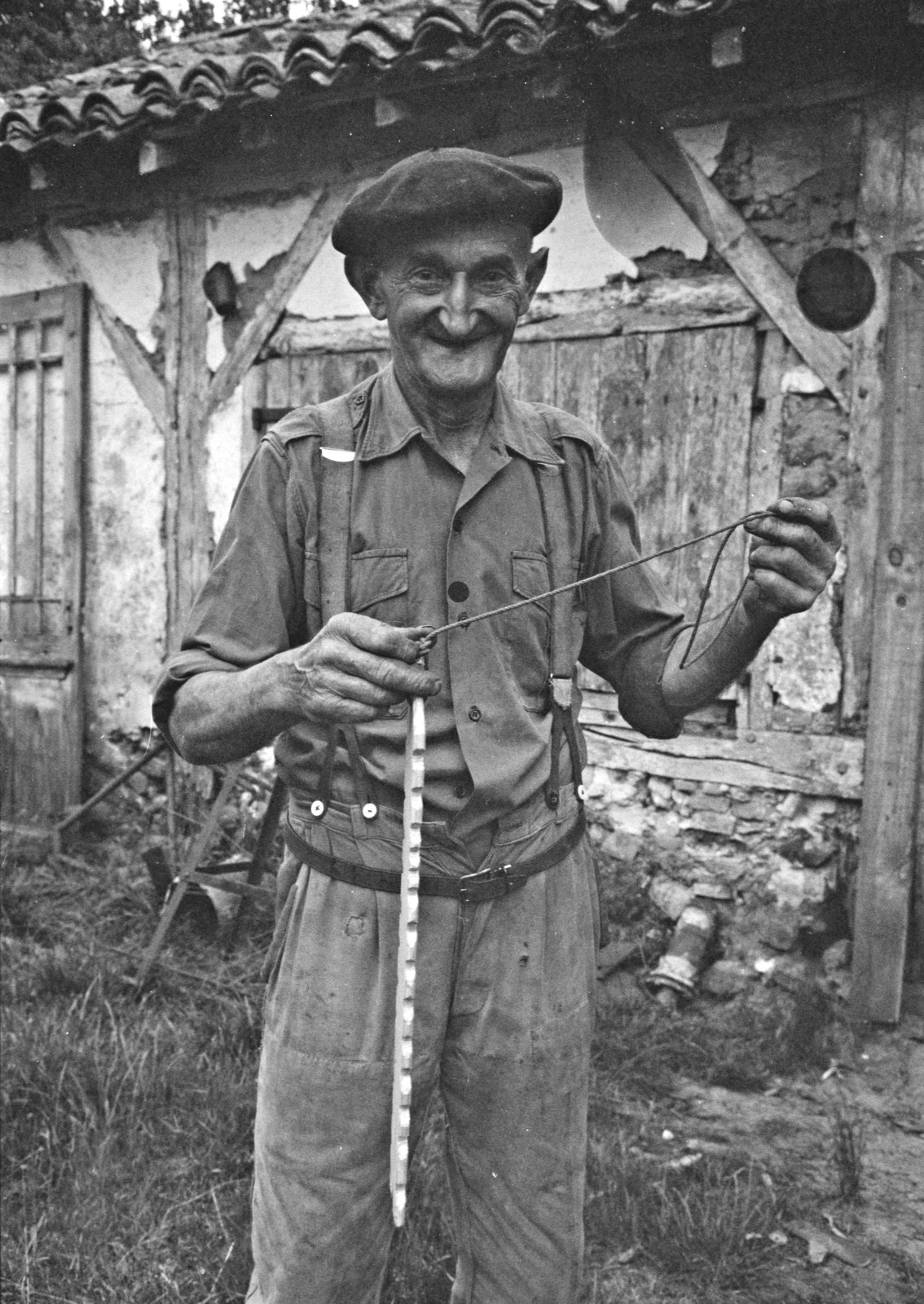
Le Gonidec saw the same continuity in the instrument as a whole. On the same page she writes that “en Dordogne, des sites du paléolithique supérieur ont livré des objets en tous points similaires à ceux que l'on trouve encore de nos jours dans certaines régions du monde”, that in the Dordogne Upper Palaeolithic sites have yielded objects similar in every point to those still found today in certain regions of the world. The two researchers found that living object again in 1965 in the pine country of the Landes, where Léonce Mano carved them a notched burrumbe at his bench in Commensacq and whirled it outside his door to show how it drove the wild boar from the maize. Marcel-Dubois, writing up a lifetime of such recordings in 1975, called these sounding toys witnesses of “traditions non dépourvues de profondeur historique”, traditions not without historical depth.
Bison that bellow
The last recognition is the oldest. Michel Dauvois spent his career listening to Ice Age instruments. He whirled an exact replica of the Lalinde blade, cut in reindeer antler and ochred like the original; its voice swept from 35 to 205 hertz with every circuit, a sound, he noted, still more impressive in the absolute dark of a cave. Then he looked at what the Magdalenians had engraved on the blades that make that sound:
At Lortet (Hautes-Pyrénées), at the abri Morin (Gironde), or again at Fontalès (Tarn-et-Garonne), these pieces carry engravings representing bison. These animals, like the aurochs, give out lowing of very low frequency, somewhat analogous to the whirr of the rhombe. … This instrument has had a long career from the Upper Palaeolithic until today.
— Michel Dauvois, “Néandertal et Cro-Magnon, le renne et le son,” Revue de Paléobiologie 37(2) (2018), p. 460 (original: “Cet instrument a connu une longue carrière depuis le Paléolithique supérieur jusqu'à aujourd'hui”)
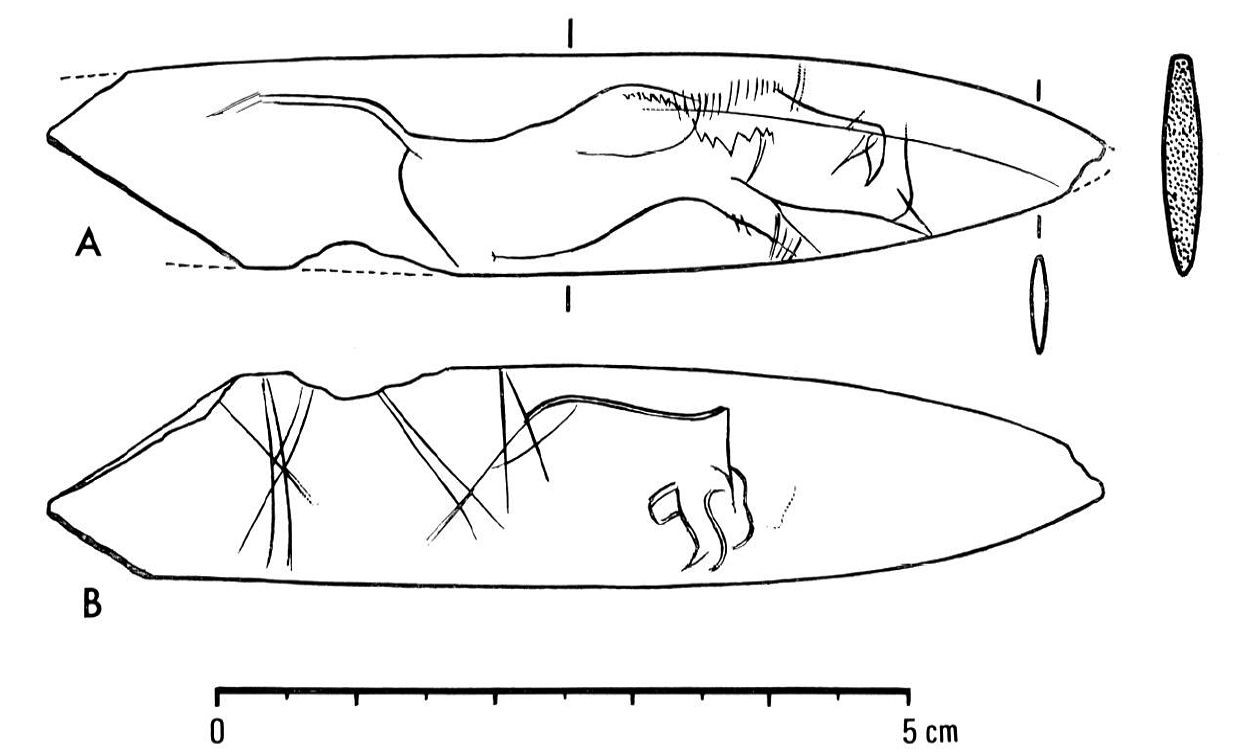
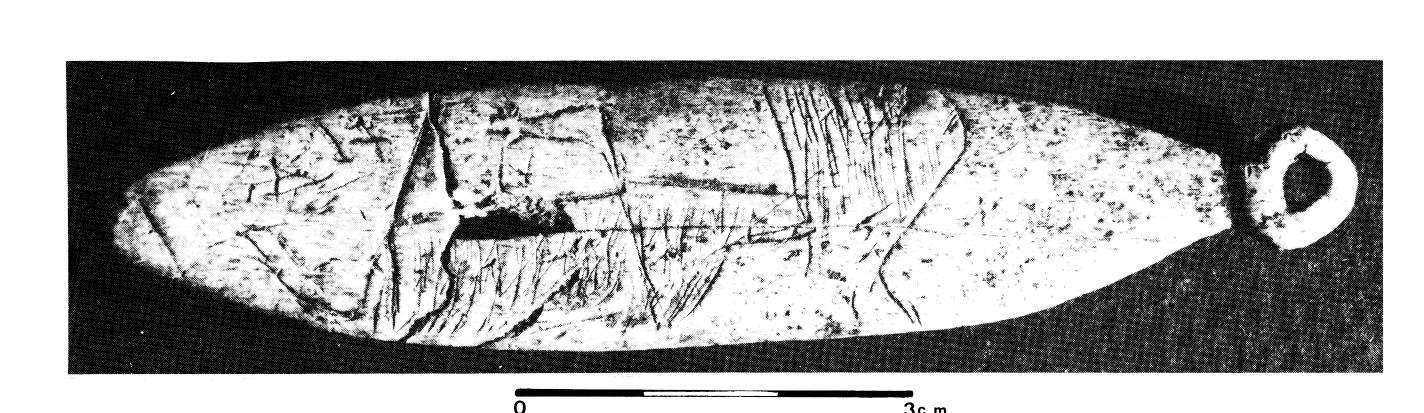
The Magdalenian engraver did what Lang and Barandiarán did. He held the instrument up beside a living thing that made the same sound, and he cut that animal onto the blade. The bull-roarer's English name records the same hearing, and so does the Spanish: bramadera comes from bramar, to bellow, the verb of the bull and the stag. Dauvois added the Australian side: among the Aborigines, he wrote, the rhombe is called tjuringa, a word that also renders the sound. At Lortet in the Hautes-Pyrénées, where Piette dug six of these blades and five were engraved, the same workshop was cutting vipers in series on its companion rods. Whatever the Magdalenians heard in the roar, they heard it as a voice, and they gave it a body.
One object, seen twice
Recognition is evidence. A tool that answers a common need can be invented again and again, and when it is, its shapes scatter: every inventor solves the problem his own way. Recognition works only where the shapes did not scatter. Lang could name the Saint-Marcel bone in a letter because its edge and its circles were already on two living toys at opposite ends of the earth. Peyrony could name Lalinde because an Australian board lay ready to be drawn beside it at the same scale. A Basque abbé could name his cave blades after the boys' toy because the boys' toy had kept their form. Had the form drifted in fifteen thousand years, no one would have known the Magdalenian blade when it came out of the ground. It was known at sight, by Lang, by Peyrony, by Barandiarán, by Levy, by Maringer, because the living instrument had not changed.
And the people who saw it agreed on nothing else. Lang thought Cook's pebbles were gaming counters. Patte thought totemism was unproven and wanted the word churinga struck from prehistory. Burkitt thought nothing could yet be known. Obermaier, MacCurdy, Levy and Camps belonged to different countries, different decades and different schools. Every one of them, set before the blade, reached for a living roarer or its Australian kin and said that it was the same. Their quarrels show that this was no school doctrine handed from master to pupil. It was the object itself, speaking to each of them separately.
The Ice Age bullroarer was never discovered; it was recognised. Every Palaeolithic roarer in Europe entered science because someone held it beside a living one, Australian or Basque, and saw the same object. That recognition, repeated for a century by scholars who agreed on nothing else, is the evidence: one form has survived from the Magdalenian blade to the Arunta churinga and the Basque village burruna. The bison on the Le Morin blade, the circles on the Saint-Marcel pendant, the animals walking down the board in the abbé's house at Sare are the same instrument in three ages, and each time it reached a new pair of hands, it was known.
Key sources
- Breuil, Henri. 1902. “Station de l'âge du Renne de Saint-Marcel (Indre),” L'Anthropologie 13: 145–165 — the pendant, fig. 4, p. 152; description and “semble bien être une amulette,” p. 154.
- Cook, Arthur Bernard. 1903. “Les galets peints du Mas-d'Azil,” L'Anthropologie 14: 655–660 — figs 1–2 (Mas d'Azil pebble and Arunta churinga), p. 656; figs 3–4 (Saint-Marcel and South Australian bull-roarer) and churinga “ne peuvent être distingués du bull-roarer,” p. 657; Lang's letter of 9 December 1902 and the bull-roarer that “still survives among us as a toy,” p. 658; the conclusion, pp. 658–659.
- Lang, Andrew. 1904. Note on Cook's painted pebbles, Man 4, no. 22, pp. 37–38 — “exactly akin,” the Moravian pendant, and the inference that Palaeolithic men had bullroarers. 1907. “Edward Burnett Tylor,” in Anthropological Essays presented to Edward Burnett Tylor, p. 10.
- Haddon, Alfred C. 1898. The Study of Man — British bull-roarers, fig. 38, p. 279; comparative series with the South Australian specimen, fig. 40 no. 15, p. 309.
- Sollas, W. J. 1911. Ancient Hunters and their Modern Representatives, fig. 213.5 and pp. 346–347 (2nd ed. 1915, fig. 272.5 and pp. 482–483). Reinach, Salomon. 1913. Répertoire de l'art quaternaire, Saint-Marcel entry. Burkitt, M. C. 1921. Prehistory, pp. 143, 316. Obermaier, Hugo. 1924. Fossil Man in Spain, p. 331. MacCurdy, G. G. 1924. Human Origins, vol. 2, p. 440; 1932. The Coming of Man, pp. 113–115. Marett, R. R. 1933. Head, Heart and Hands in Human Evolution, p. 291.
- Peyrony, Denis. 1930. “Sur quelques pièces intéressantes de la grotte de La Roche, près de Lalinde (Dordogne),” L'Anthropologie 40: 19–29 — fig. 3, p. 22; the identification and the instrument's names, p. 24.
- Patte, Étienne. 1934. “Remarques sur quelques figurations préhistoriques du bassin de la Charente et de l'Europe centrale,” Revue anthropologique 44 — Breuil 1925 on Předmostí, p. 53; message-sticks and Peyrony, pp. 53–54.
- Levy, G. Rachel. 1948. The Gate of Horn, p. 48; figs 37–39, p. 32; pl. V. Field, Henry. 1954. “A Magdalenian 'Churinga',” Man 54, no. 162. Maringer, Johannes. 1960. The Gods of Prehistoric Man (German original 1956), Stellmoor section. Vértes, László. 1959. “Churinga de Tata (Hongrie),” BSPF 56: 604. Graziosi, Paolo. 1960. Palaeolithic Art, p. 250. Camps, Gabriel. 1994. Introduction à la préhistoire, p. 395. Harding, J. R. 1973. “The Bull-Roarer in History and in Antiquity,” African Music 5(3): 40.
- Barandiarán Maestu, Ignacio. 2012. “Forma vs. función en tipología prehistórica: el caso de las bramaderas óseas magdalenienses,” Veleia 29: 307–334 — Graziosi and the citation chain incl. Leroi-Gourhan 1965 and de Sonneville-Bordes 1967, pp. 308–309; J. M. de Barandiarán's Aitzbitarte bramaderas, p. 309; the toy names, the DRAE definition and Bigorre after Nougier & Robert 1978, p. 323 and nn. 42, 44. 2015. “La bramadera de hueso,” Kobie BAI 6: 149–158 — the Basque furrunfarra abstract; use by ethnographic parallels and children's games, p. 152; the Isturitz fragment in the Musée Basque, n. 9.
- Le Gonidec, Marie-Barbara. “Le rhombe,” Les Réveillées (EHESS / Mucem), on the 1947 Sare recordings (MUS1947.006.117.004–005), photograph phw-47-6-3, and Marcel-Dubois 1975. Servier, Jean. 1970. El hombre y lo invisible, plate of ATP 47.27.4.
- Dauvois, Michel. 2018. “Néandertal et Cro-Magnon, le renne et le son,” Revue de Paléobiologie 37(2): 457–468 — §7 “Rhombes,” p. 460; the Lalinde replica, pl. IV. Kumbani, Joshua. 2020. PhD thesis, University of the Witwatersrand, p. 31 (Matjes River MR 40).
- As far as we know, two points are original to this page: that the comparison begins with Lang's letter and Cook's paired figures of 1902–03, and that the owner of the decorated Sare burruna was the excavator who named the Aitzbitarte blades bramaderas.
Read on: Identical Forms, on the shape the recognisers saw; The First Mystery, on the Ice Age rite; and The European Roots of the Primordial Matriarchy.