KOCH1992-002 - archaeological find
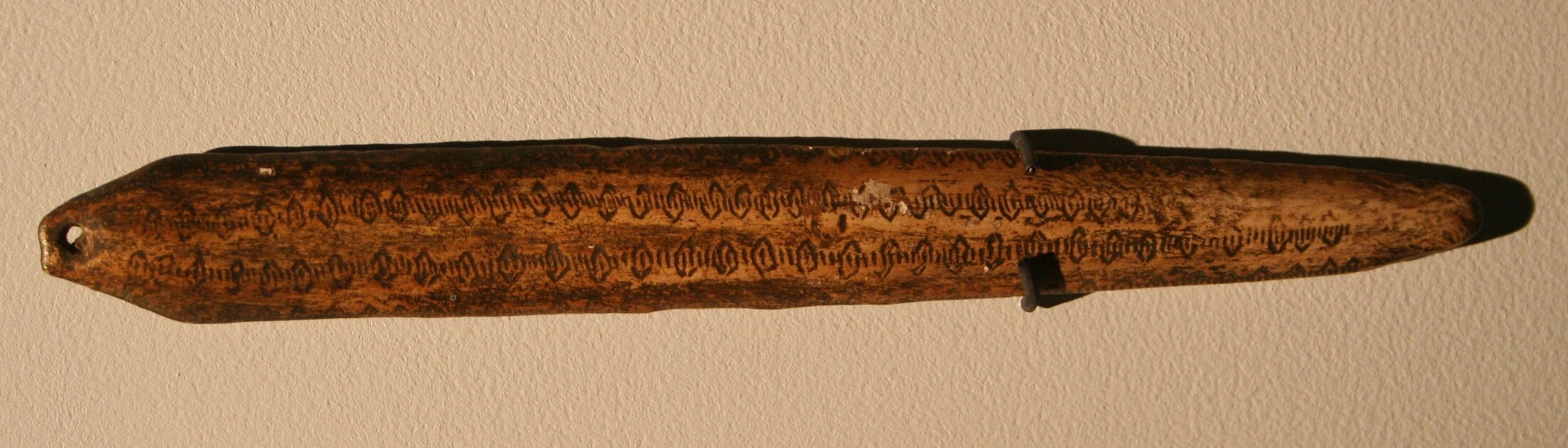
Fernewerder decorated whirring blade
Germany - Brandenburg - former Kreis Nauen - Europe
Function not recorded
Source term: Schwirrplättchen / Schwirrblatt
Schwirrplättchen / Schwirrblatt: small whirring plate or whirring blade; archaeological German terms for a bullroarer
A long bone blade tapers to a single perforation at its broader end, with four rows of V-shaped nicks cut down its faces. That ornament is why Koch singled it out among the eight Mesolithic whirring blades of his eastern German survey, and why Berlin's prehistory museum displays it as a decorated Schwirrblatt from the Havelland hunters' gear, somewhere in the millennia between 9600 and 4000 BC. But the blade in the case is a copy: the original went east as war booty and sits in Russia, out of reach for anyone wanting to check its thickness, its wear, or the hand that cut the Vs.
Das Objekt aus Fernewerder, Kr. Nauen, hat vier Reihen aus V-Motiven.
The object from Fernewerder, Kreis Nauen, has four rows of V motifs.
Koch 1992:120
- Object
- Long tapered bone blade with one perforation at the broader end and four longitudinal rows of engraved V motifs; the Berlin display shows a replica because the original is held in Russia.
- Function
- Not recorded.
- Source
- Klaus-Peter Koch, Musikarchäologische Quellen aus dem östlichen Deutschland: Zwischenbericht, Jahresschrift für mitteldeutsche Vorgeschichte 75 (1992), pp. 119-120, Fundliste 7; Berlin Museum für Vor- und Frühgeschichte display and label
- Source location
Page references
printed pp. 119–120; Fundliste 7; Berlin museum display
- Source confidence
- medium Fernewerder locality anchor from public OSM/GeoNames data; the exact archaeological findspot is not recovered.