No. KOCH1992-007Europe
Satzkorn whirring blade
Germany · Brandenburg · former Kreis Potsdam · Europe
Function not recorded
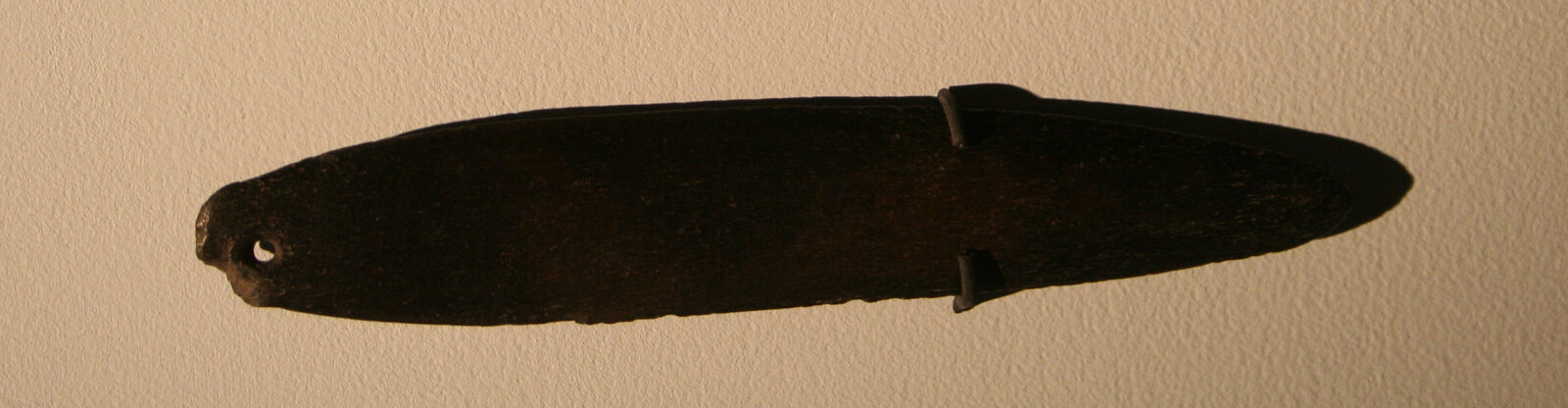
Source term: Schwirrer / Wirbelaerophon
Schwirrer / Wirbelaerophon: German, "whirrer" and "whirled aerophone" - the archaeological terms for a bullroarer.
Satzkorn is a village swallowed by the northern edge of Potsdam, and somewhere in it a Mesolithic bone whirring blade surfaced. Klaus-Peter Koch counts it among the whirled aerophones of eastern Germany: blades of flat bone, long ovals 13 to 21 centimetres long, pierced at the broader end for the cord. Where the Satzkorn blade rests today is unknown.
Fundliste 7: Aerophone. Wirbelaerophone (Schwirrer) […] Mesolithikum: […] Satzkorn, Kr. Potsdam […]
Find list 7: Aerophones. Whirled aerophones (bullroarers) […] Mesolithic: […] Satzkorn, district of Potsdam […]
Koch 1992:132
Particulars
- Object
- One of the Mesolithic bone whirring blades of eastern Germany, which Koch describes as long ovals tending to a streamlined form, pierced at the broader end, 13 to 21 cm long, 2 to 2.5 cm wide and under 0.7 cm thick.
- Function
- Not recorded.
Source
Klaus-Peter Koch, 'Musikarchäologische Quellen aus dem östlichen Deutschland: Zwischenbericht,' Jahresschrift für mitteldeutsche Vorgeschichte 75 (1992): 101-136, at pp. 119 and 132 (Fundliste 7)