No. SAFR-002
Matjes River pear-shaped bone bullroarer
South Africa · Southern Cape · Matjes River mouth near Keurboomstrand (Plettenberg Bay) · Southern Africa
Function not recorded
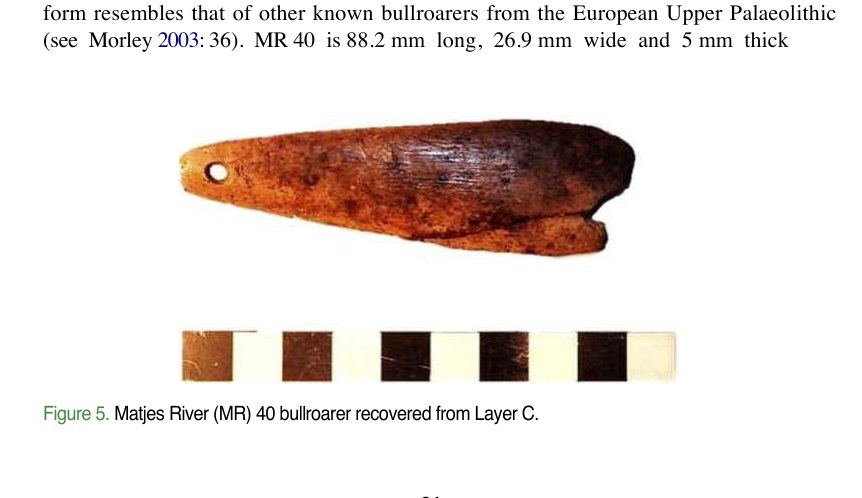
MR 40
Source term: bone pendant / bullroarer
Catalogue number for a single-perforated bone object from the Matjes River rock shelter, long classed as a pendant and reinterpreted as a spun aerophone.
For decades MR 40 sat in the Matjes River collection as a decorated bone pendant, recovered from Layer C of the Matjes River rock shelter near Plettenberg Bay, a deposit so dense with graves that the site yielded the remains of some 120 people across several thousand years. Joshua Kumbani and colleagues, examining the southern Cape Later Stone Age material in 2019, spun replicas and compared their wear with the originals. Spinning, they found, abrades the left side of the perforation, while wearing an object as a hanging pendant abrades the upper edge; on the pear-shaped MR 40, roughly 88 mm long and still carrying traces of ochre and a fatty substance around its single hole, the wear matched the spun replicas. The replicated pendants produced a sustained, pulsing whir between about 55 and 250 Hz, in the range of bullroarers elsewhere. The one implement that failed to produce that whirring sound when spun was the object the collection had labelled the woer woer, after the echoic Afrikaans name for a spinning buzz-toy — and it failed because it is not a bullroarer at all, but an oval blade bored with two holes through its middle instead of one at its end, so lopsided that the team took it for unfinished work. Move the holes on the replica and it whirred.
We conclude that one of the bone artefacts previously thought to be a pendant, MR 40, most likely functioned as an instrument to produce sound.
Kumbani, Bradfield, Rusch & Wurz 2019, Journal of Archaeological Science: Reports 24:693
Particulars
- Object
- Pear-shaped bone blade, 88.2 x 26.9 x 5 mm, pierced with a single hole; long catalogued as a pendant.
- Function
- Spun to make a whirring, pulsed sound.
Sources
- Kumbani, Rusch, Bradfield and Wurz, “Sound producing objects from Middle Stone Age layers at Klasies River,” Journal of Archaeological Science: Reports 24 (2019), pp. 693-711, at pp. 693-694, 697 (Table 3), 699 (fig. 5), 706-709 View
- Joshua Kumbani, Sound and musical instruments in the Holocene archaeological record of South Africa, PhD thesis, University of the Witwatersrand (2020), article facsimile View
- Louw (1960), via Kumbani et al. 2019
- Ludwig (2005), via Kumbani et al. 2019