No. EUROPE-002
Bourrouilla (Arancou) cave
France · Magdalenian middle to final, Pyrenees-Atlantiques · Europe
Sacred / spirit
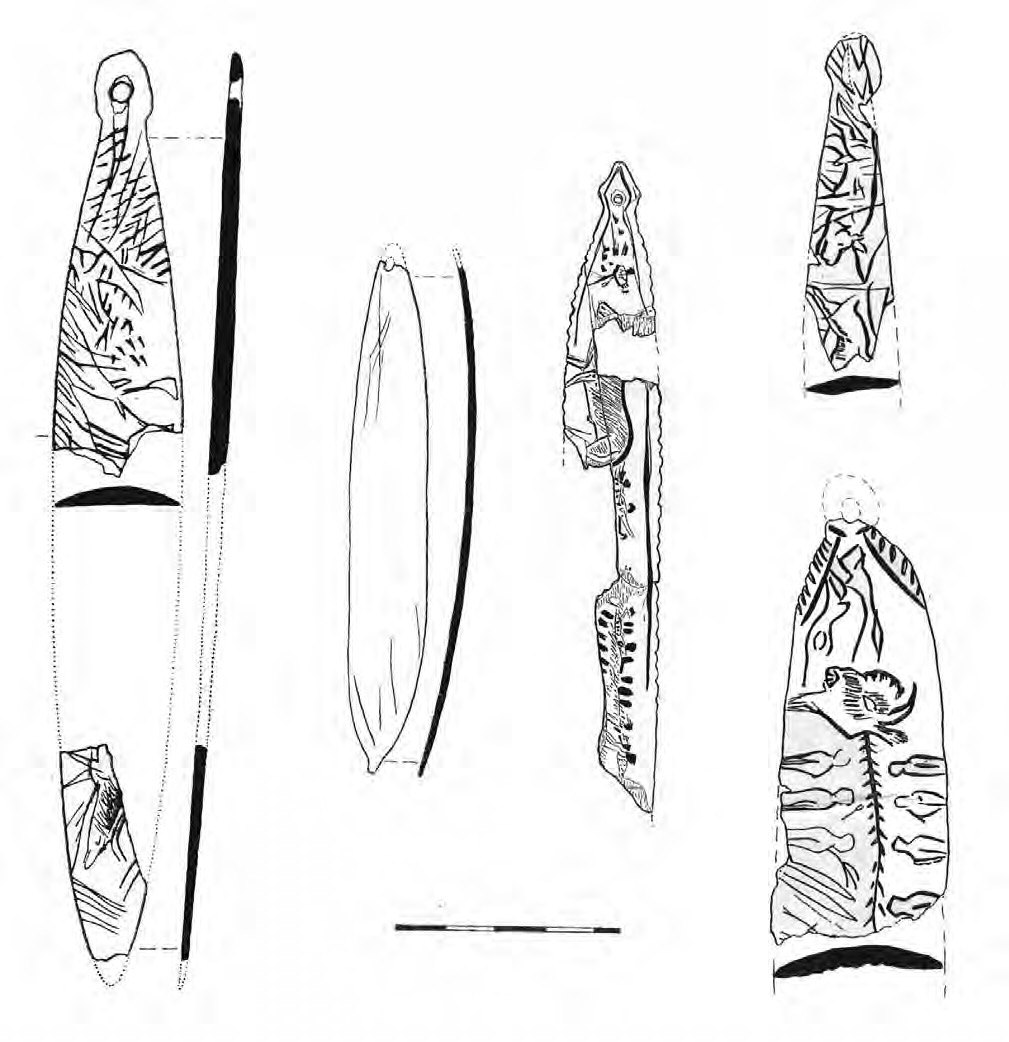
rhombe
French for bullroarer: a thin blade whirled on a cord to produce a roaring hum; here the Magdalenian bone type, Spanish bramadera.
Etymology. From Greek rhombos, the whirled bullroarer.
Ten bone bullroarers came out of the cave of Bourrouilla at Arancou, in the French Basque foothills of the western Pyrenees: one complete, nine in fragments, all of them decorated. Cut from the polished rib-blades of large animals into a long, narrow, very thin fusiform shape, each was pierced at one end so it could be tied to a cord and whirled to make the humming, roaring sound that gives the type its name. Most of the pieces are simply perforated, but two from Bourrouilla carry the rarer arrangement of a subcircular perforated "head," a raised ring notched out at the sides to grip the cord. The objects came not from controlled excavation but from clandestine digging, and were assigned to the Middle through final Magdalenian. They are the largest single assemblage of their kind: across the whole corner of southwest Europe — Cantabrian Spain, the northern Pyrenees, the Dordogne and its neighbors — barely more than thirty Paleolithic bullroarers are known, and Bourrouilla alone accounts for ten of them. Why so few survive is an old question; as Peyrony suggested in 1930, the ordinary ones may simply have been made of wood and rotted away.
En la banda septentrional del Pirineo son: diez (una completa y nueve fragmentarias) decoradas de Bourrouilla/Arancou (Pyrénées Atlantiques) que proceden de excavación clandestina y se adscriben al "Magdaleniense medio y superior a final".
On the northern flank of the Pyrenees there are: ten (one complete and nine fragmentary) decorated ones from Bourrouilla/Arancou (Pyrénées-Atlantiques), which come from clandestine excavation and are assigned to the "Middle and Upper to final Magdalenian."
Barandiarán Maestu 2015:154 (citing Chauchat et al. 1999:2), Kobie BAI 6
Particulars
- Object
- Ten decorated bone bramaderas (one complete, nine fragmentary).
- Function
- Whirled-cord aerophone.
Source
Chauchat et al. 1999, in Barandiaran Maestu (2015)