MUS2026-240 - archaeological find
Tito Bustillo rib spatula
Spain - Asturias - Ribadesella - Ardines - Europe
Function not recorded Candidate only
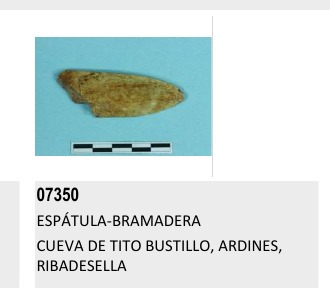
Source term: espatula-bramadera (museum label); espatula decorada en proceso de fabricacion (original excavation reading)
bramadera: Spanish bullroarer; espatula: spatula, a flat bone tool typically read as a hide-working or decorative implement; the museum's compound label espatula-bramadera keeps both readings in one term.
From the base of Tito Bustillo's upper Magdalenian layer, square XII-C, came a worked rib 139 millimetres long, blade-shaped at one end and pointed at the other. Alfonso Moure published it in 1982 as a spatula caught mid-manufacture. Decades later, the Museo Arqueológico de Asturias displays the same accession, 07350, under a different name: espátula-bramadera, spatula-bullroarer. Ignacio Barandiarán's 2012 survey, the standard account of Cantabrian bone bullroarers, does not count it among his accepted examples. The layer around it dates to roughly 17,800 to 17,400 years ago.
La espatula decorada es claramente un ejemplar en proceso de fabricacion... Procede de la capa 1c, la mas baja del complejo superior.
The decorated spatula is clearly a specimen in process of manufacture... It comes from layer 1c, the lowest part of the upper complex.
Alfonso Moure Romanillo, La cueva de Tito Bustillo (Ribadesella, Asturias): El yacimiento paleolitico, p. 120
- Object
- Proximal section of a rib, 139 mm long and about 20 mm wide, shaped at one end into a rounded, blade-like spatula and worked to a point at the other; no perforation is visible in the museum photograph.
- Function
- Not recorded.
- Source
- Museo Arqueologico de Asturias, Relacion de piezas de la exposicion permanente; I. Los tiempos prehistoricos, PDF p. 29, accession 07350, labelled "ESPATULA-BRAMADERA, CUEVA DE TITO BUSTILLO, ARDINES, RIBADESELLA." Original identification: Alfonso Moure Romanillo, "Espatula decorada procedente del Magdaleniense de la cueva de Tito Bustillo," Boletin del…
- Source location
Page references
Moure 1982:668-669; Moure (RIA site report), fig. 10 no. 3, pp. 119-121; Barandiaran 2012:210-213; museum exhibition PDF p. 29
- Source confidence
- high Cueva de Tito Bustillo site coordinate, Ardines, Ribadesella, Asturias.