No. LANGLEY2018-001Europe
Le Placard antler ovaloid
France · Charente · Vilhonneur · Europe
Function not recorded Candidate only
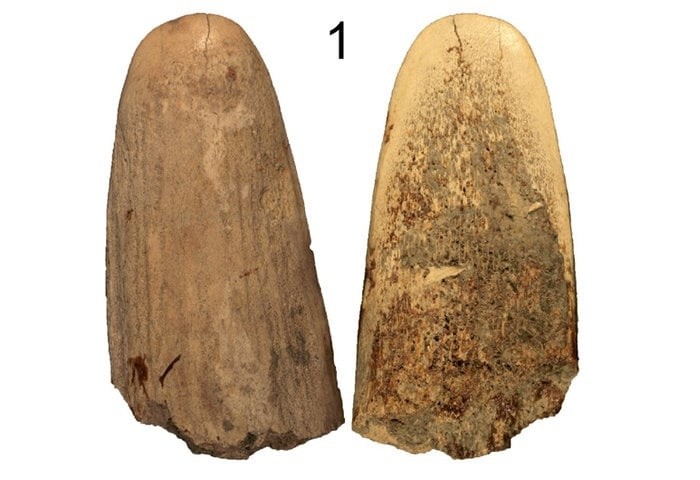
Source term: bull roarer / spatule / pendentif
Among the long-dispersed collections from the Grotte du Placard in Charente sits an antler piece shaped into a slim oval, about the length of a hand, broken at one end before it was ever buried and never drilled through on the end that survives. Cataloguing the site's antler technology, Michelle Langley and Christophe Delage weighed three identities for it: a spatula, unlikely since it lacks the scoop-shaped working end such tools need; a pendant, for which no attachment wear survives; and a bull roarer, favoured for its long curved outline and narrowing profile. The missing end, they note, could once have carried a lashing point that broke away.
A Bull Roarer, a Spatula, or a Pendant?
Langley and Delage 2018, p. 116
Particulars
- Object
- A carefully shaped antler ovaloid about 11 cm long, almost 2 cm wide, and more than 1 cm thick through much of its body. The published photograph shows two views of a narrow, gently curved, pointed piece with one end broken off before it was buried; no perforation survives anywhere on the object.
- Function
- Not recorded.
Source
Michelle C. Langley and Christophe Delage, “New antler, shell, and tooth technology from La Grotte du Placard (Commune de Vilhonneur, Charente),” in The Grotte du Placard at 150 (Archaeopress, 2018):112–123, pp. 116–117, fig. 7 no. 2