KOCH1992-003 - archaeological find
Wustermark plain whirring blade
Germany - Brandenburg - Havelland - Europe
Function not recorded
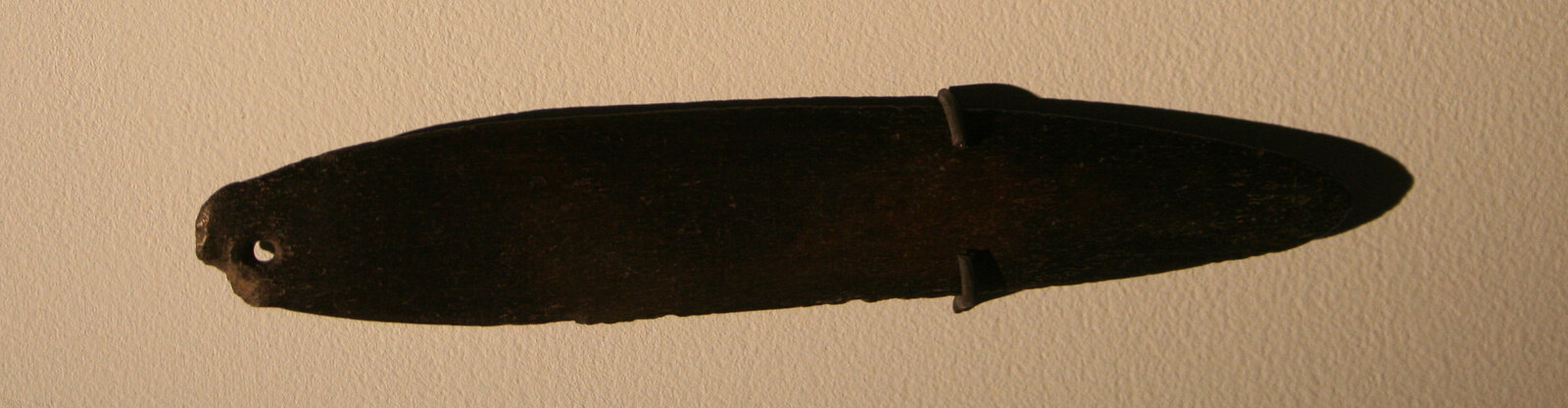
Source term: Schwirrplättchen / Schwirrblatt
Schwirrplättchen / Schwirrblatt: small whirring plate or whirring blade; archaeological German terms for a bullroarer
Dark, slightly curved, tapering, with one hole through the wide end and not a mark of decoration on it: the bone blade from Wustermark is the plain sibling of the ornamented Fernewerder piece, and unlike that one the object in the Berlin case is the original. Koch counted it among the Mesolithic whirring blades of eastern Germany; the museum dates it only to the long forager span between 9600 and 4000 BC. Where in Wustermark it came out of the ground nobody now records.
Die Durchbohrung befindet sich an dem einen (breiteren) Ende.
The perforation is located at one, broader end.
Koch 1992:119
- Object
- Long, dark, slightly curved and tapered bone blade with a single perforation at its broader end; the Berlin display identifies it as an undecorated Mesolithic whirring blade.
- Function
- Not recorded.
- Source
- Klaus-Peter Koch, Musikarchäologische Quellen aus dem östlichen Deutschland: Zwischenbericht, Jahresschrift für mitteldeutsche Vorgeschichte 75 (1992), pp. 119-120, Fundliste 7; Berlin Museum für Vor- und Frühgeschichte display and label
- Source location
Page references
printed pp. 119–120; Fundliste 7; Berlin museum display
- Source confidence
- medium Wustermark town anchor; no site number or exact findspot is recovered, and the object is not assigned to Wustermark 22.