No. PEUR2026-005
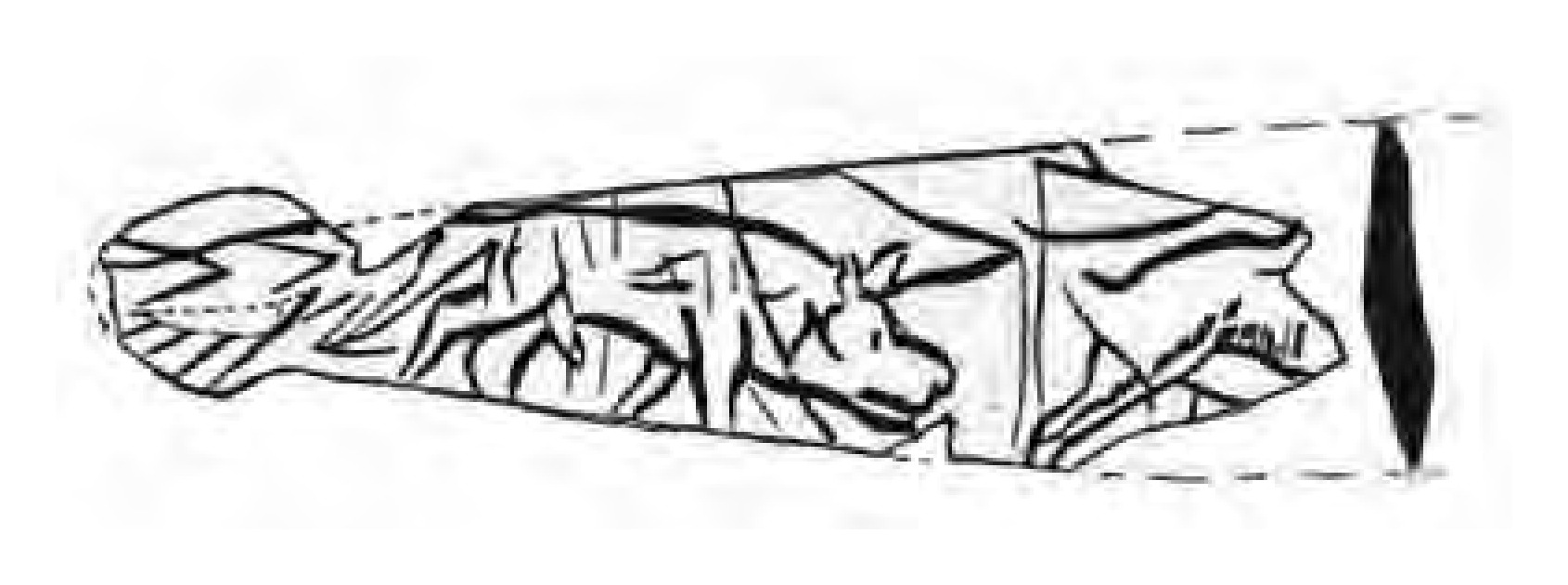
Grotte des Eyzies animal-scene bramadera
Dordogne · Les Eyzies; Magdalenian final attribution · Europe · Southwest France
Function not recorded
bramadera / rhombe
Source term: bramadera fragmentaria
Spanish bramadera (also rombo; French rhombe, English bull-roarer): the name for a Paleolithic whirled bull-roarer.
Etymology. From Spanish bramar, to bellow or roar.
Only the top third of this bone blade survives, and it is the end that held the cord: just below the tip the maker narrowed the bone from both sides, waisting it into a small round head for a cord to be tied around. Below the waist, animals crowd the face in a single composed scene. Complete, the blade would have run to about fifteen centimetres, long and narrow like the other bone bramaderas of Magdalenian France and Spain. It came from the grotte des Eyzies, a small cave inside the village whose deposits were being dug out and sold to collectors even before Lartet and Christy began work there in the 1860s.
sendos trozos de ‘colgantes’ decorados (me parecen bramaderas fragmentarias) de Raymonden/Chancelade y de ‘grotte des Eyzies’ se recuperaron en excavaciones no bien controladas del XIX y, atendiendo al estilo de sus figuras, se han adscrito respectivamente al Magdaleniense superior y al Magdaleniense final
two decorated “pendant” fragments (which appear to me to be fragmentary bull-roarers) from Raymonden/Chancelade and from the “grotte des Eyzies” were recovered in poorly controlled nineteenth-century excavations and, by the style of their figures, have been assigned respectively to the upper Magdalenian and the final Magdalenian
Barandiarán Maestu 2015, “La bramadera de hueso,” Kobie BAI 6:152
Particulars
- Object
- Upper third of a thin bone blade, 80 mm long and 20 mm wide, broken across the body; complete, it would have run to about 150 mm. The top end is waisted into a small knob-head for the cord, and animals are engraved across the face as a scene.
- Function
- Not recorded.
Source
Ignacio Barandiarán Maestu 2012, Forma vs. función en tipología prehistórica: el caso de las bramaderas óseas magdalenienses, Veleia 29:311-334, at p. 321 and fig. 2.5; Barandiarán Maestu 2015, La bramadera de hueso, Kobie BAI 6:149-158, p. 152 and n. 12, fig. 4; Henri Breuil 1937, IPEK 1936/1937:1-16, p. 6 fig. 6