No. EUROPE-004
Lortet cave
France · Magdalenian IV-VI (Hautes-Pyrenees) · Europe
Sacred / spirit
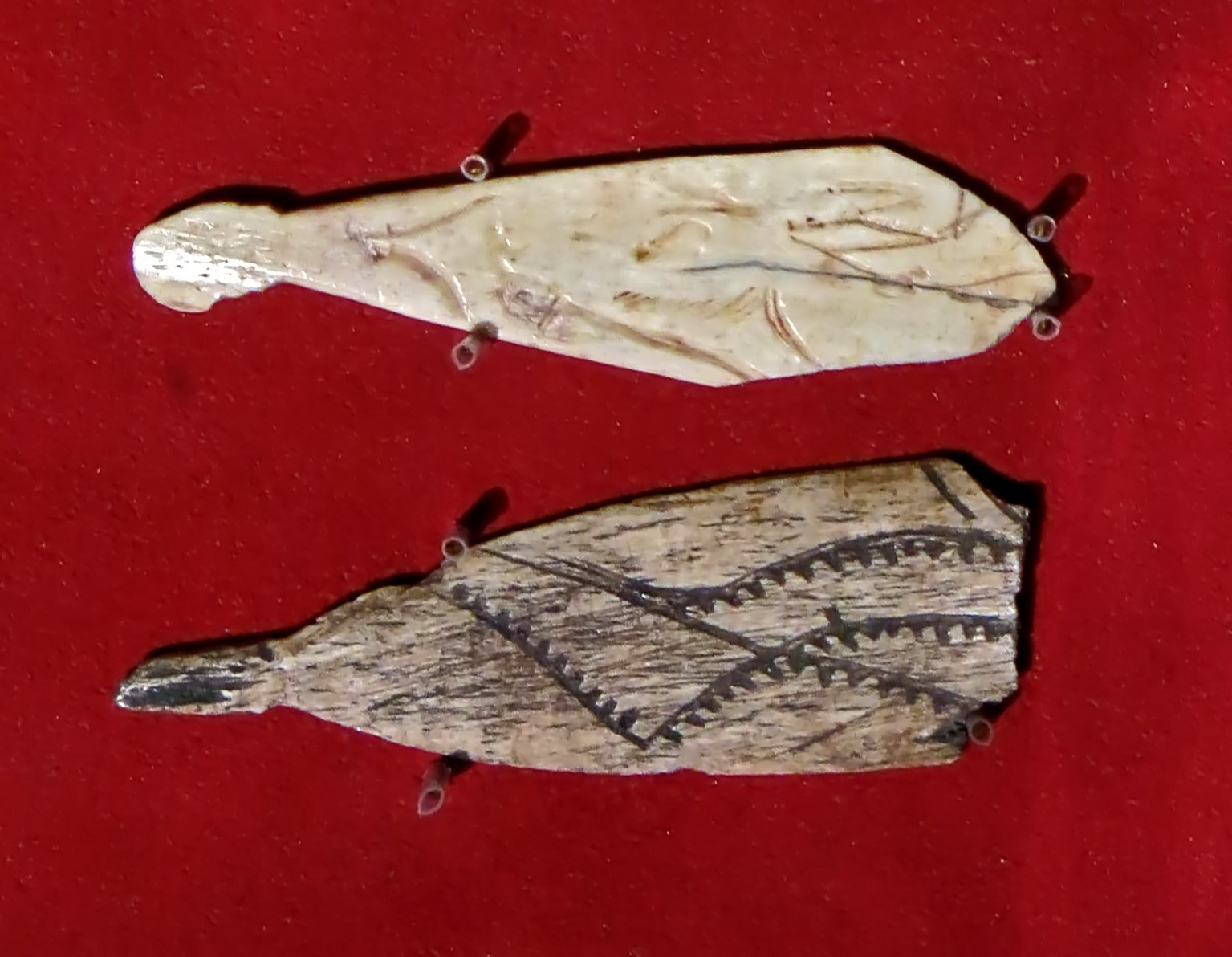
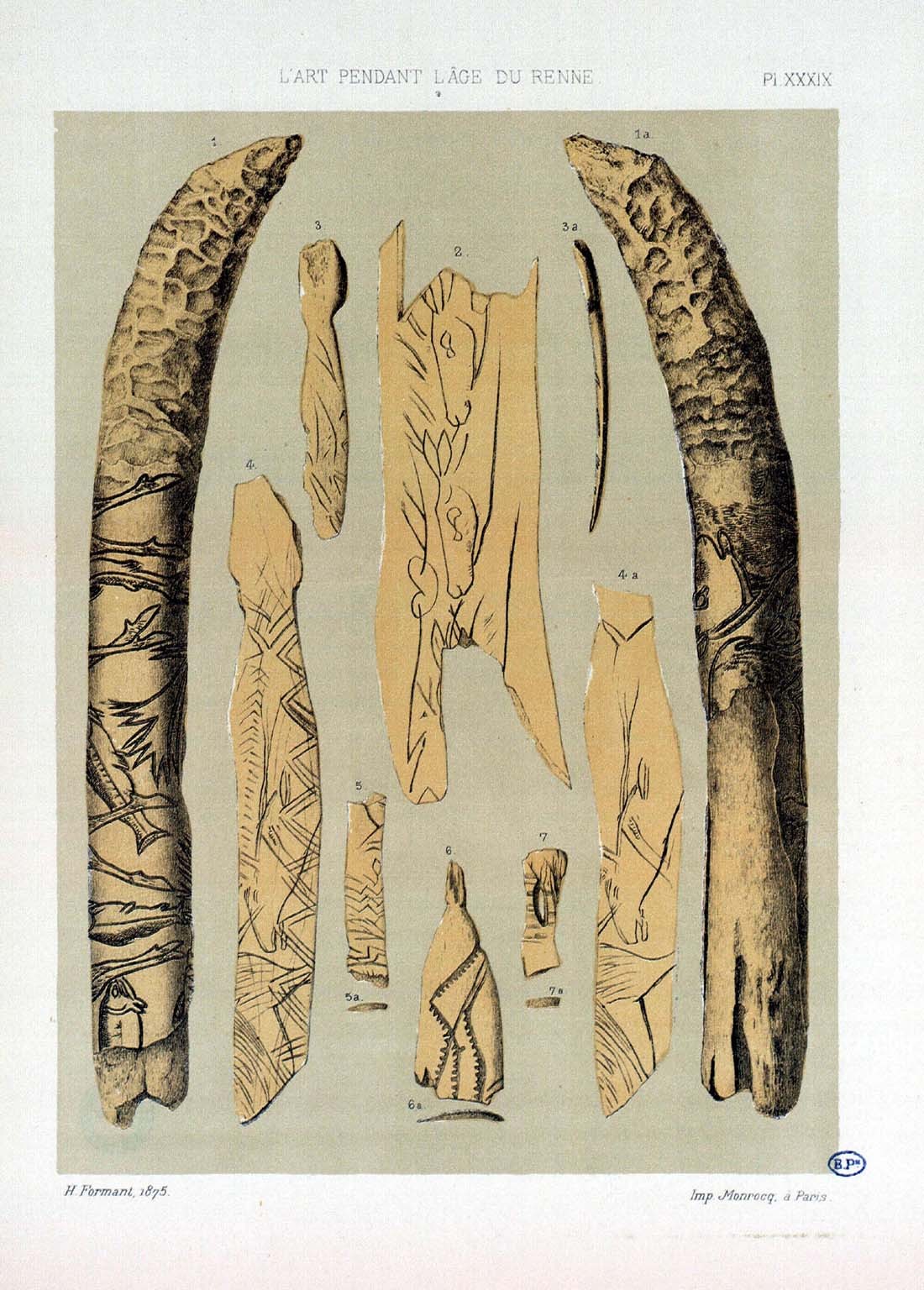
rhombe
rhombe — French for the whirled-cord aerophone known in English as a bull-roarer.
Etymology. From Greek rhombos, a spinning, whirring thing.
Six fragmentary bone bullroarers were recovered from the Grotte de Lortet in the Hautes-Pyrénées by Édouard Piette in the late nineteenth century: five carry engraved decoration, the sixth is plain. They belong to a thin, elongated, fusiform type cut from rib bone, pierced at one end for a cord and whirled rapidly to produce a roar. Marthe Chollot's 1964 catalogue of the Piette Collection, in what is now the Musée d'Archéologie nationale, placed them in the Magdalenian, one in stage IV–V and the other five in V–VI. The first piece of this kind recognized by archaeology was the Lalinde holotype, which D. Peyrony in 1930 proposed had been whirled to make sound in the manner of the Australian churinga. Reviewing the whole corpus, Barandiarán cited the ethnographic interpretation his predecessors leaned on: that among some Australian groups the whirled roar was held to be the voice of the ancestors, a voice the Magdalenian hunters were said to have expected to hear resound through their own ceremonies. Piette's Lortet material also holds a second, closely related family of objects, which Barandiarán calls ellipses: slender reindeer-antler rods about as long as the bull-roarers but much thicker in section, hung by a constriction pinched into the end rather than by a hole, and too thick to buzz when whirled. Four of them survive. The finest, MAN 47418, is complete at 138 mm: a viper engraved at the centre of the piece, its head clearly drawn, its body carried in ranks of aligned transverse cuts — and the rod itself cut to the shape of a viper's body, with the head sculpted, and the eye, and the mouth. Two more were never finished. On one, the museum record reads a raised median rib as possibly stylising a viper's body, one end thinned into a suspension button that may be the animal's head; the next is a blank in preparation, like it. The fourth is a broken piece carrying chevrons. Whatever the ellipses were for, the workshop at Lortet was making serpents in series.
seis fragmentarias (cinco decoradas y una lisa) de Lortet (Hautes-Pyrénées) recuperadas por E.Piette a fines del XIX y atribuidas (Chollot 1964, 143-145) una al Magdaleniense IV o V y las otras cinco al Magdaleniense V o VI
six fragmentary [bullroarers] (five decorated and one plain) from Lortet (Hautes-Pyrénées), recovered by E. Piette at the end of the nineteenth century and attributed (Chollot 1964, 143-145) one to Magdalenian IV or V and the other five to Magdalenian V or VI
Barandiarán Maestu, "La bramadera de hueso: análisis y discusión cronocultural," Kobie BAI 6 (2015): 154
Particulars
- Object
- Six fragmentary bone bramaderas (five decorated, one plain), Piette excavations, now in the Musée d'Archéologie nationale: MAN 47299 (158 x 20 x 5 mm), 47349 (59 x 16 x 2 mm), 48213 (73 x 10 mm), 48244 (75 x 13 x 3 mm), 48762 (60 x 20 x 2 mm), 47283 (55 x 26 x 2 mm). All six are fragmentary.
- Function
- Whirled-cord aerophone.
Source
I. Barandiarán Maestu, 'Forma vs. función en tipología prehistórica,' Veleia 29 (2012), pp. 318, 324-325; I. Barandiarán Maestu, 'La bramadera de hueso,' Kobie BAI 6 (2015), p. 154, after M. Chollot, Collection Piette (1964), pp. 143-145; Musée d'Archéologie nationale, Piette collection