No. PEUR2026-004
Raymonden bramadera fragment
Dordogne · Chancelade; Magdalenian superior · Europe · Southwest France
Function not recorded
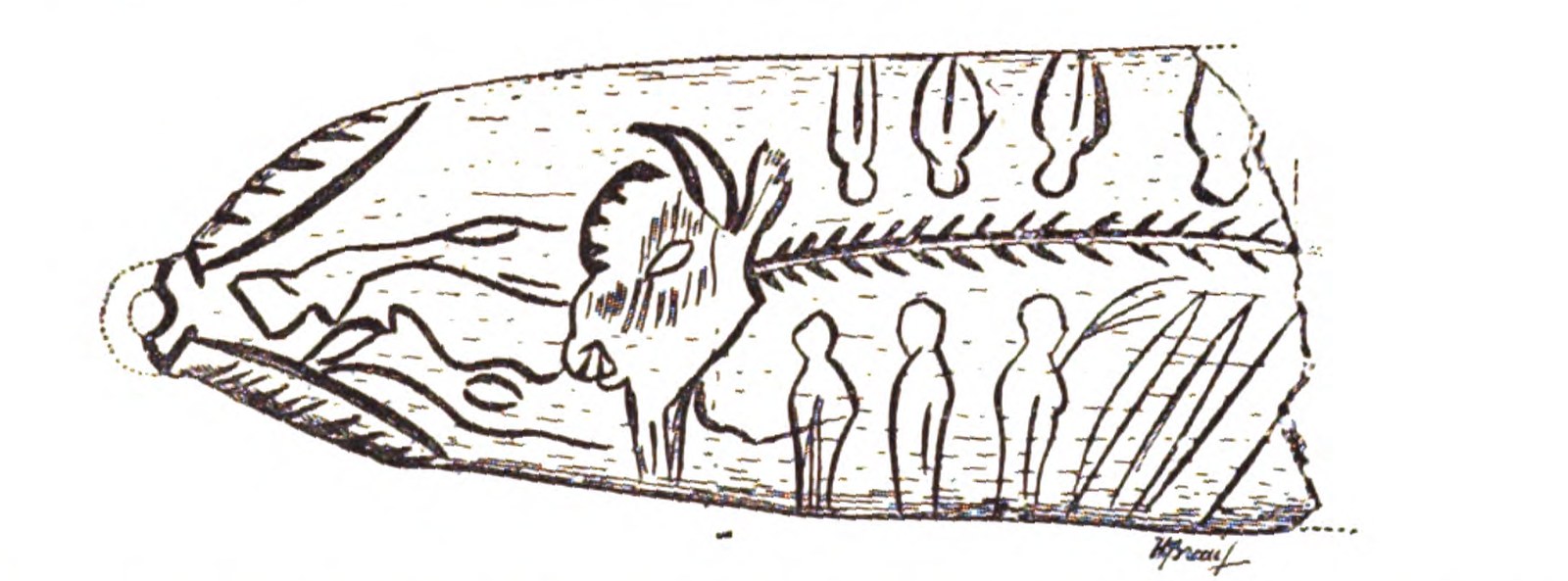

bramadera / rhombe
Source term: bramadera fragmentaria
bramadera (Spanish) / rhombe (French): a bull-roarer.
Etymology. Spanish bramadera (French rhombe), "the roarer," comes from bramar, to bellow or roar.
The famous engraved bone from the Raymonden shelter at Chancelade, in the Dordogne, is usually read as a butchery scene: tiny schematic men ranged along a barred line taken for a bison's spine, with the animal's head, vertebral column and a pair of legs all that remain of it, and a broken suspension hole at one end. Ignacio Barandiarán Maestu sets it instead among the thirty-odd recognized Paleolithic bone bull-roarers of southwest Europe. He counts two decorated “pendant” fragments from poorly controlled nineteenth-century digs — this one and another from the grotte des Eyzies — as bramaderas fragmentarias (fragmentary bull-roarers), the Raymonden piece assigned on the style of its figures to the upper Magdalenian. It shares a rare detail with the bull-roarers of El Pendo and Bourrouilla: rather than a simple hole, its suspension end is worked into a subcircular ring set off by lateral notches. The shelter was dug by M. Hardy and M. Féaux in 1887-88, and the object is now in the museum at Périgueux. Hardy himself, publishing the piece in 1891, classed it simply as an objet de parure — an ornament whose suspension hole shows “clearly recognizable” traces, with an ancient break at the other end — and read the animal not as a bison but as a musk-ox, his pendeloque à l'Ovibos (musk-ox pendant).
sendos trozos de ‘colgantes’ decorados (me parecen bramaderas fragmentarias) de Raymonden/Chancelade y de ‘grotte des Eyzies’ se recuperaron en excavaciones no bien controladas del XIX y, atendiendo al estilo de sus figuras, se han adscrito respectivamente al Magdaleniense superior y al Magdaleniense final
two pieces of decorated ‘pendants’ (to me they look like bull-roarer fragments) from Raymonden/Chancelade and from the ‘grotte des Eyzies’ were recovered in poorly controlled nineteenth-century excavations and, going by the style of their figures, have been assigned respectively to the upper Magdalenian and the final Magdalenian
Barandiarán Maestu 2015, La bramadera de hueso, Kobie BAI 6:152
Particulars
- Object
- A decorated, engraved bone pendant fragment, its suspension end worked into a subcircular ring with lateral notches.
- Function
- Not recorded.
Source
Ignacio Barandiarán Maestu, 'La bramadera de hueso,' Kobie BAI 6 (2015): 149-158, at p. 152 and n. 12; Michel Hardy, La station quaternaire de Raymonden à Chancelade (1891), pp. 37-39 and 42, pl. III fig. 2