No. SAMER-005
Aige, voice of the Bororo dead
Brazil · Mato Grosso · Rio Vermelho · Aldeia Kejara · South America
Restricted
aige
Source term: Rhombe
aige — the Bororo bullroarer, sharing its name with a mythical water-beast; written aidye / aíge in older sources.
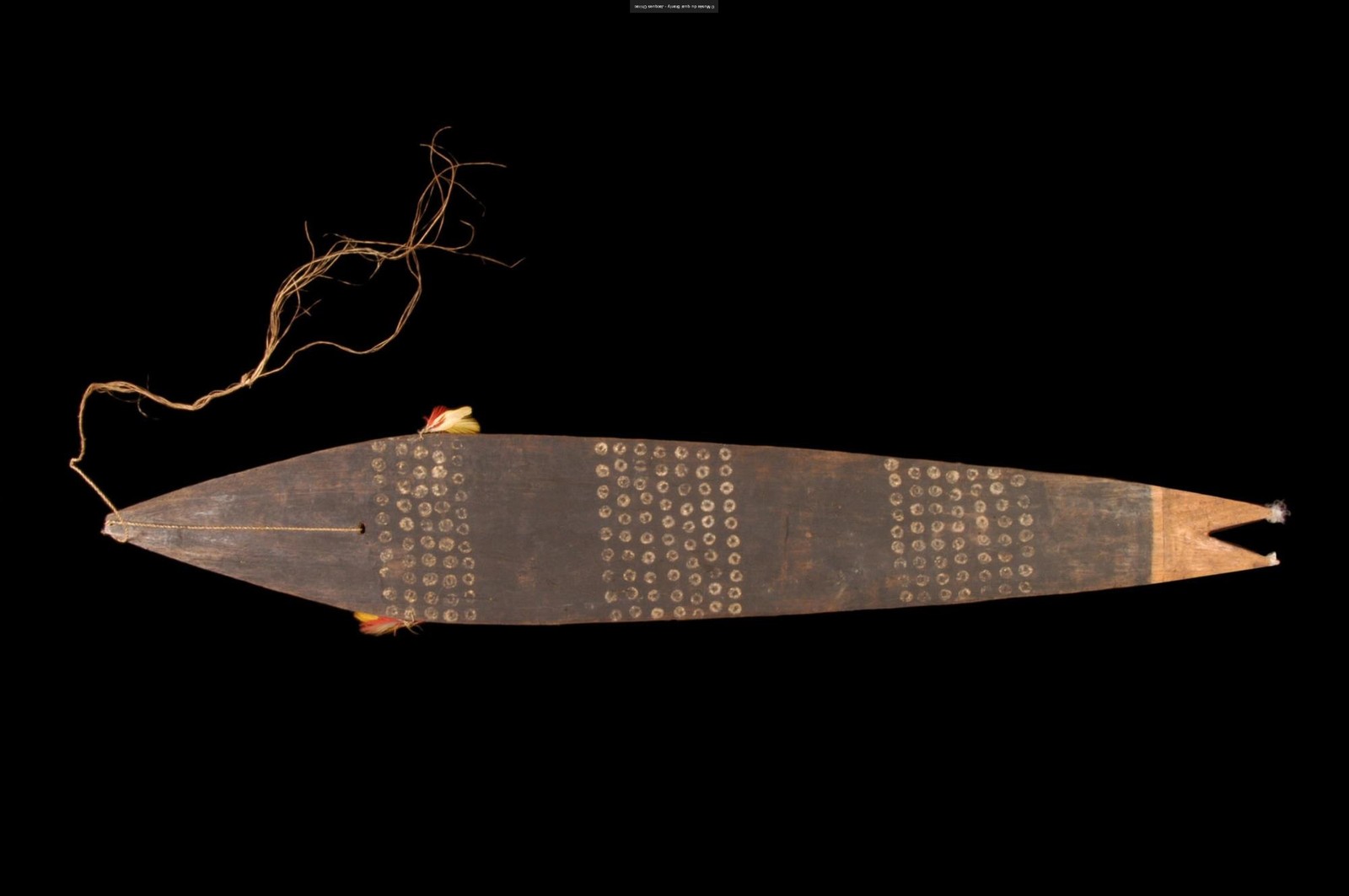
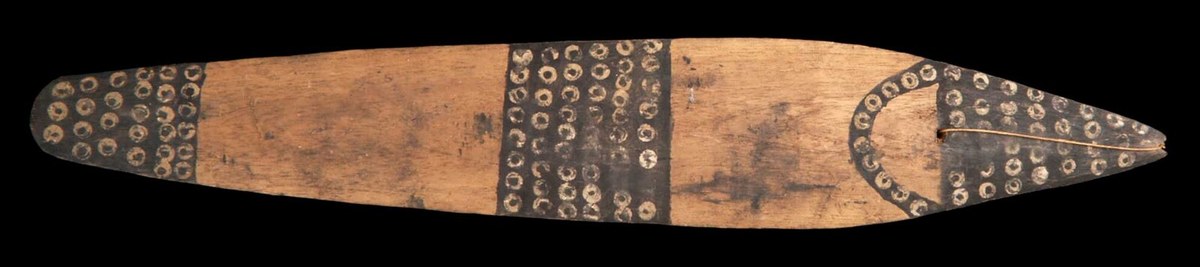
A large Bororo rhombe covered with naturally fluorescent pigments, collected in 1936 by Claude and Dina Lévi-Strauss at Kejara, the Bororo village on the Rio Vermelho in Mato Grosso later described in Tristes Tropiques. The Bororo call the bullroarer aige, which is also the name of a mythical animal likened to a hippopotamus; among the Eastern Bororo of the S. Lourenço and Rio Vermelho the lanceolate boards are swung at funeral rites, where they sound the voice of the dead and where a man smeared head to foot in clay crawls on all fours as the aige. Women are barred from the rite: as soon as the buzzing begins they flee into the forest or hide in the houses, and the old accounts hold that a woman who saw the instrument would die. When the Bororo gave Lévi-Strauss this one, they told him to hide it at the bottom of his locked trunk, out of the women's sight. Even in Paris the aige kept its rules. Its companion blade from the same collection came with its funeral use and its ban on the eyes of women and uninitiated children written down beside it. Being magical, it came with next to nothing technical at all.
le rhombe, de taille importante et couvert de pigments naturellement fluorescents, représente la voix d'un animal mythique
the rhombe, of considerable size and covered with naturally fluorescent pigments, represents the voice of a mythical animal
Les Réveillées (EHESS), "Le rhombe," on the Bororo rhombe collected by Lévi-Strauss (1936)
Particulars
- Object
- A rhombe from Aldeia Kejara on the Rio Vermelho, Mato Grosso, musée du quai Branly 71.1936.48.2. A companion aige from the same collection, 71.1936.48.3, is a painted blade 66 cm long: alternating red urucu and black charcoal paint, rows of white ash circles (kigaduréu) stamped on the black zones, the fine cord still at its pointed head. Two more aige from Kejara are in the same museum: 71.1936.48.1, painted and over a metre long at 109 centimetres, hung with yellow feathers, and 71.1936.48.5, which compresses the same red, black and white into 37.5 centimetres.
Source
Musée du quai Branly – Jacques Chirac, Paris, 71.1936.48.2, with companion aige 71.1936.48.3 (Claude and Dina Lévi-Strauss collection, Kejara, 1936); Karl von den Steinen, Unter den Naturvölkern Zentral-Brasiliens (1894); A. Colbacchini, Bororo ethnography (1925/1942), collated in Otto Zerries, 'The Bull-roarer among South American Indians,' Revista do Museu Paulista n.s. 7 (1953), pp. 276-279