No. DIET2016-004
Nahal Hemar Cave elongated bone plaques
Israel · Judean Desert · Dead Sea region · Near East · Levant
Function not recorded Candidate only
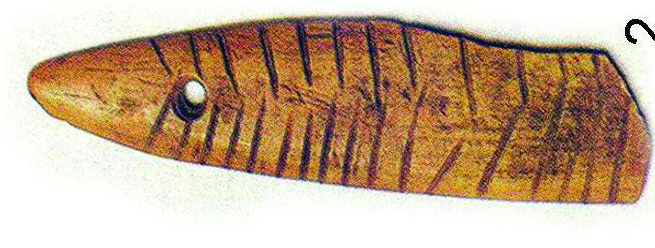
Source term: elongated bone plaques / possible bullroarer comparison
Two small decorated bone objects from a dump layer inside Nahal Hemar Cave, a cave set in a cliff in the Judean Desert near the Dead Sea, are among thirteen elongated, one-perforated-end pieces that Oliver Dietrich and Jens Notroff gather as possible Pre-Pottery Neolithic bullroarers. The first is a trapezoidal plaque tapering to a perforated narrow end, carved with nearly parallel lines running in from both sides toward the centre; the second is a flat fragment incised with chevron-like designs. Both came from the 1983 excavation by Ofer Bar-Yosef and David Alon, which yielded one of the richest ritual assemblages of the Levantine Neolithic: asphalt-decorated human skulls, a carved stone mask, bone figurines, and flax cordage, dated to the later Pre-Pottery Neolithic B in the eighth millennium BC. The narrow perforation would let such an object be tied to a cord and swung, and a hardwood replica built to the proportions of the group produces a deep vibrato sound; but the authors note these pieces differ from the usual bullroarer shape, and their function is left unresolved.
Elongated bone plaque, trapezoidal, tapering towards one end. Single (terminal?) perforation towards smaller end. Simple carved decoration consisting of almost parallel lines running horizontally and slightly downwards from both sides of the bone object towards the centre.
Dietrich and Notroff 2016, Neo-Lithics 1/16:29, Appendix 1 no. 12 (Nahal Hemar Cave)
Particulars
- Object
- Two decorated bone objects from a cave dump layer: a trapezoidal perforated plaque and a flat incised fragment.
- Function
- Not recorded.
Source
Oliver Dietrich and Jens Notroff, Neo-Lithics 1/16 (2016): 22-31, Appendix 1 nos. 12-13 (p. 29); O. Bar-Yosef and D. Alon, 'Nahal Hemar Cave,' 'Atiqot 18 (1988): 1-81, fig. 13:2, 13:10 and pl. III:2