No. EA-HEIWA-HOKKAIDO-001
Heiwa site stone-axe-shaped pendant
Urahoro, Hokkaido, Japan; Heiwa aggregate route · East Asia
Function not recorded Candidate only
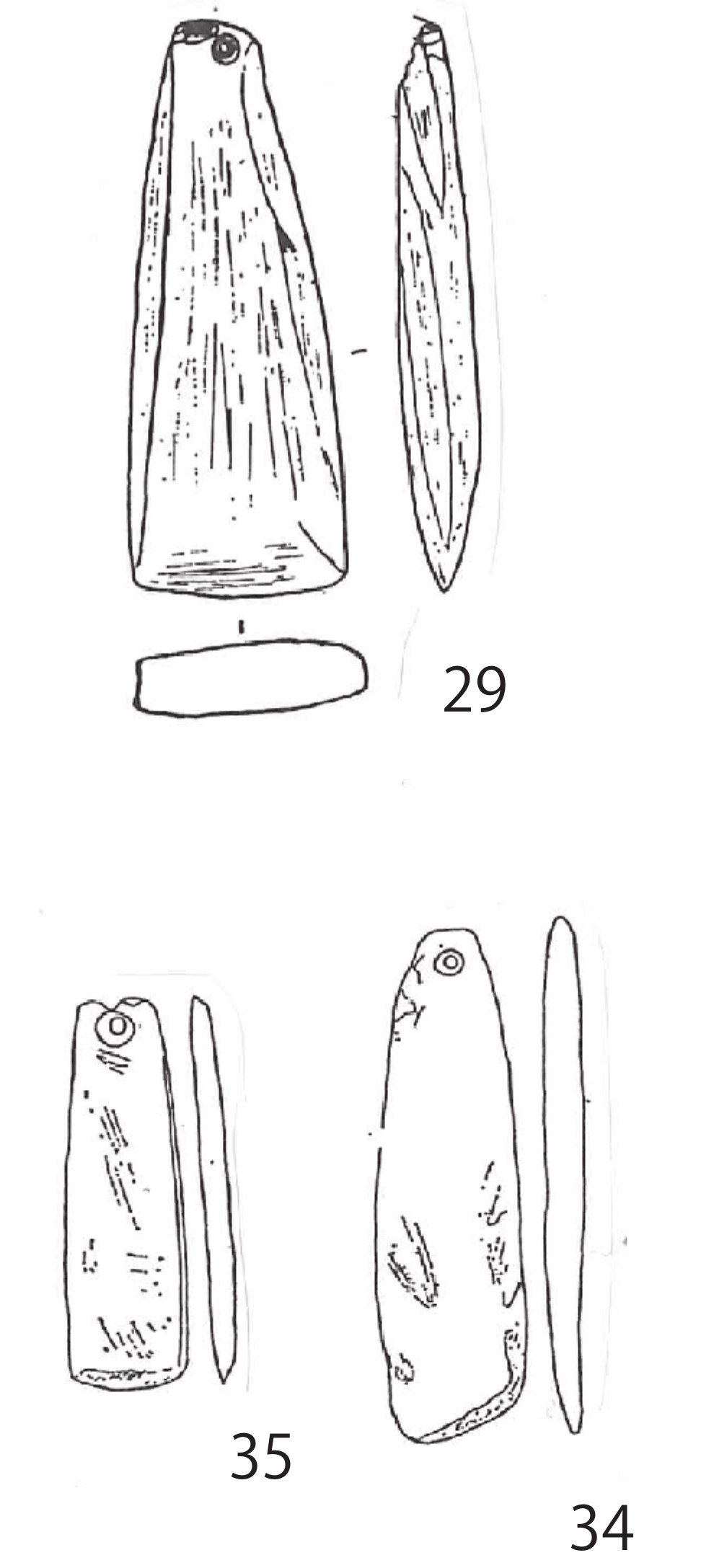
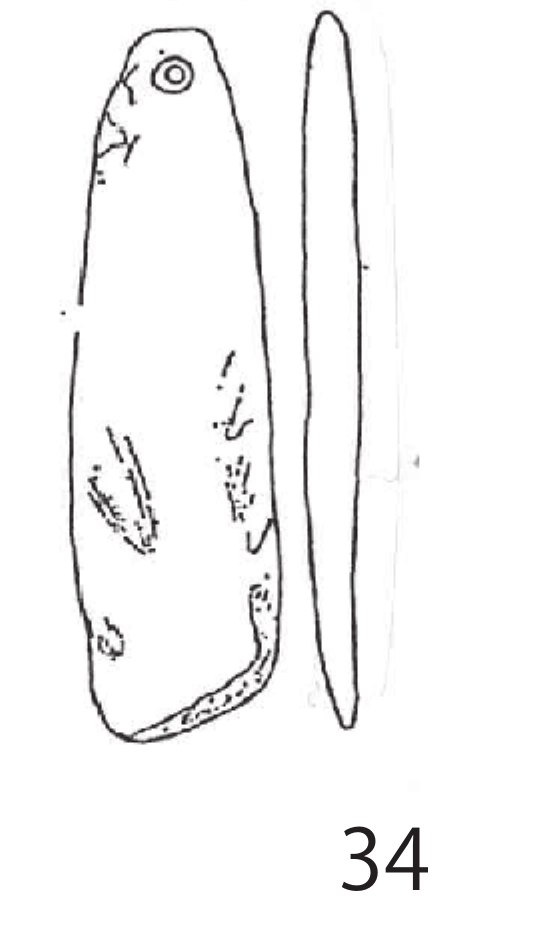
石斧型垂飾
Source term: 石斧型垂飾; 短冊形の垂飾; 軟玉製装飾品; 有孔石斧
石斧型垂飾 (sekifu-gata suishoku): 'stone-axe-shaped pendant'
Urahoro's Heiwa site contributes a whole small corpus to the perforated-slat question: a thick ten-centimetre fragment with a saw-cut hole, slats of 6.8, 6.0 and 4.5 centimetres, some with unfinished drilling — mostly rhyolite, one possibly Hidaka jade, all under the perforated stone axe label. It was one of these that reached the newspapers in 2000 as a 'soft jade' ornament, before geologists pointed out how often Hokkaido's look-alike greenstones fool the eye. One site, one horizon, repeated thin end-holed blades in graded sizes: the pattern of a local tradition of suspended slat objects, whatever those objects did.
Particulars
- Object
- Perforated stone slats and fragments from the Heiwa site. The largest piece is a thick fragment, 10.0 × 4.2 × 2.2 cm as preserved, with a saw-cut hole; three thin slats, each holed at the narrow end, measure 6.8 × 2.4 × 0.9 cm, 6.0 × 1.8 × 0.6 cm and 4.5 × 1.4 × 0.3 cm, and further fragments carry saw-cut grooves or unfinished perforations. Mostly rhyolite; the 6.0 cm slat is possibly Hidaka jade. Initial Jōmon, Shimokorobe-type pottery horizon.
- Function
- Published as a group of perforated stone axes or pendants from one Initial Jōmon site; their ancient use is not recorded.
Source
Tatsuta Osamu, 「有孔石斧について」, Esashi Kenkyu 枝幸研究 11 (2020): 25-32; Hokkaido museum curators' association article; Urahoro town museum publications