Atlas Essay — 2026-10-07
The Bullroarer and the Harvest
The Cameroon Grassfields · the Fly delta · the Sepik · the Sorghum Belt · Walpi · the Upper Xingu · Eleusis · the Upper Tigris
In the middle of November, when the long rains have ended in the Cameroon Grassfields and the young seed is coming up, three old men of the Bali chief walk out of his compound in their finery, through the village and into the farms. Younger men run and leap around them, flinging carved boards out on long cords so that they spin and roar. The women at the dance ground turn their backs and hold their hands up beside their faces like a horse's blinkers. A woman who looked, they said, would bear no more children. Half a world away, on Boigu, an island in Torres Strait off the mouth of the Fly, an old woman named Méte hears a splinter of wood cry bigu-bigu, and that night it tells her in a dream how to make the yams grow.
In brief
- The same instrument, a flat board whirled on a cord until it roars, is sounded over the crops in New Guinea, West and southern Africa, the American Southwest, the Amazon and ancient Greece. It makes the Kiwai yams grow, opens the Bobo sorghum harvest, calls rain to the Hopi corn and comes out for the Wauja pequi festival.
- The details repeat with it: women who must not see it, a spirit whose voice it is, men who keep the secret, and in the Fly delta a story that the instrument began with a woman.
- Farming itself began in at least eleven places in the few millennia after the Ice Age, after hundreds of thousands of years in which people could have farmed and did not. The geneticist David Reich calls this “unbelievable.”
- Two coincidences that large are easier to believe as one trail. The bullroarer travelled the world before farming and travelled again with it, out of the Near East into Africa and quite possibly toward New Guinea, and wherever it arrived it was set to work on the crop.
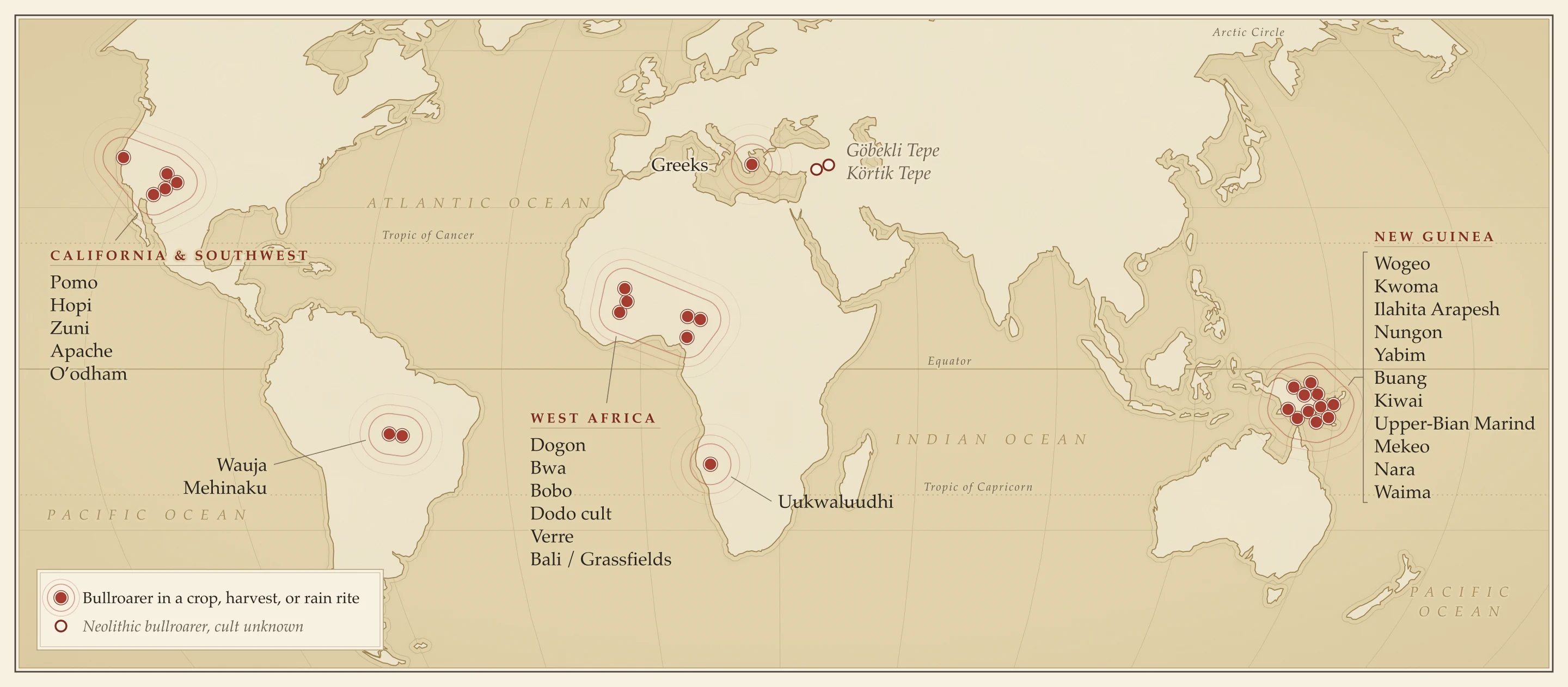
On five continents the same tabooed instrument is sounded over the harvest, and in the few millennia after the Ice Age farming began again and again around the world. Two coincidences that large are easier to believe as one trail. The bullroarer travelled the world before farming and travelled again with it, out of the Near East into Africa and quite possibly toward New Guinea, and wherever it arrived it was set to work on the crop.
A board on a string
The bullroarer is about as simple as an instrument gets. A slat of wood, bone or iron, usually pointed or leaf-shaped, is tied by one end to a cord and whirled around the head. As it flies it spins on its own axis, and the spinning blade gives out a pulsing drone, a roar or a howl, that rises and falls with the speed of the swing. Heard at night from behind a screen it sounds like nothing a person could make. That is the point of it. Almost everywhere it is used in ritual it is said to be the voice of something: a spirit, a monster, a god, the dead, the thunder.
Children make it as a toy, and many peoples have it only as a toy. But in a great many places it is a secret instrument kept by men, which women and boys may hear and must never see. Those secrets cluster around initiation, the dead and the weather. And again and again, in places that never heard of each other, they cluster around the crop.
New Guinea: the mother of the yams
Gunnar Landtman collected the Kiwai story of the first bullroarer at the mouth of the Fly River before the First World War, and printed it in his informants' own Papuan pidgin. An old woman of Boigu named Méte is chopping otoro wood when a chip flies off and cries out, bigu-bigu. That night the splinter comes to her in a dream and tells her what it is:
“That time you plant him umámu (yam), you spit him out medicine along garden. You make medicine along woman belong you, rub me along kasávo (semen) and áe-gadi (secretion from the vulva), you sling me round. I make him that medicine fly all over garden, I make noise too, bigu, bigu. That me make altogether garden move, make him grow. … That me proper thing for umámu, medicine go all over garden, belong banana, taro, sweet potato, too.”
— Gunnar Landtman, The Folk-Tales of the Kiwai Papuans (1917), tale 261, “The First Bull-Roarer,” p. 316
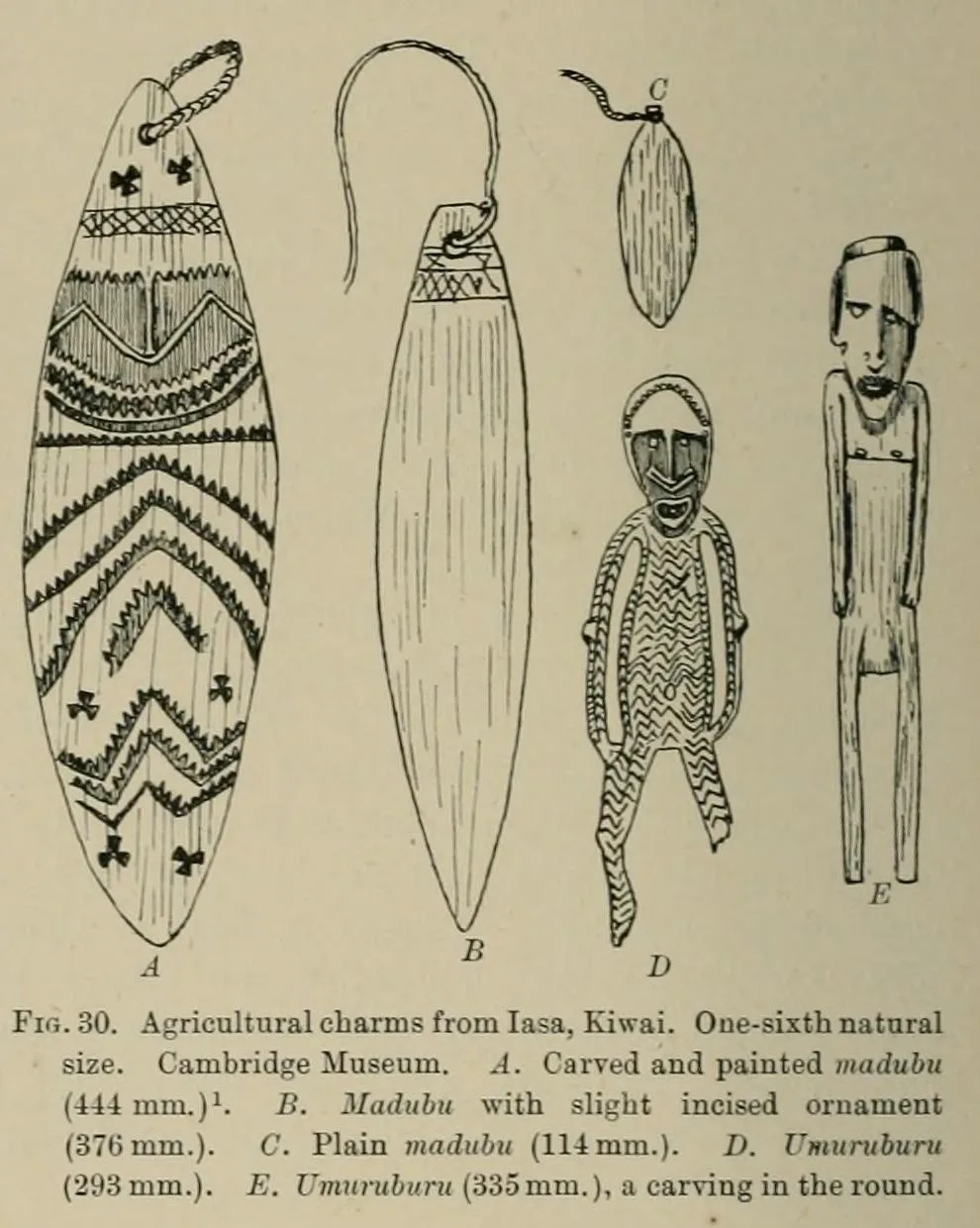
In a variant of the tale the teacher is a snake-man, Máigidúbu, who shows a Budji woman how the roarer is made. Either way the instrument begins in a woman's dream and ends in the men's keeping, and its work is the garden. Alfred Haddon, who had been in the Fly delta a dozen years earlier, wrote it down plainly: “One function of the madubu is to ensure good crops of yams, sweet potatoes, and bananas.” At Iasa, he was told, the bullroarer is shown to each youth at his initiation “in a tabooed and fenced-in portion of the bush, and he is taught how to use it,” and “the whirling of the madubu insures a good crop of yams, sweet potatoes and bananas.” One roarer the missionary James Chalmers sent home from the mouth of the Fly was labelled Buruma-maramu, which Haddon glossed as “the mother of the yams,” and it was shown “when the yams are ready for digging.”
The Kiwai are not alone. Go north to the Huon Gulf and the Yabim use one word, balum, for the bullroarer, the monster of initiation and the souls of the dead. James Frazer summed up their practice in a sentence: “the Yabim of German New Guinea imagine that by twirling bull-roarers while they mention the names of the dead they produce a fine crop of taro.” Up in the Finisterre Range the Nungon planted their yams and taro in silence, and “a bullroarer would be sounded on the occasion of the eating of the first harvest; this was eaten by men and boys in the men's house.” Along the Papuan south coast the Nara “swing the bull-roarer to make their crops grow,” Charles Seligman reported, and call it beriwa, the word their neighbours use for spirits. In the Snake valley some Buang families do not swing it at all but plant it: when the men carry seed yams to the garden in a basket no woman may touch, some put a sky-fallen stone among the yams “to strengthen the vigour of the seed,” and families descended from immigrants out of Bulolo, “where the bullroarer is used, put one in their basket in place of the stone.”
In the Sepik, yam country, the roar belongs to the harvest feasts. At Ilahita, during “the elaborate yam harvest ceremonies,” the Arapesh men sound bullroarers and giant voice pipes behind the screens of the men's house, and the uninitiated outside are told it is the spirits. The Kwoma march in from the forest at dawn singing harvest songs; for the nowkwi yam ceremony they come “to the accompaniment of flutes and bullroarers,” and the women are told the din is Nankwi, the fiercest of the goddesses, coming to the men's house.
Elsewhere on the island the roar closes a crop rather than growing it. On Wogeo, when a headman planned a feast, his men went into the forest whirling mumumu, the voices of the bush monsters, and while the monsters were “present” no one could pick the Tahitian chestnuts; a few days before the feast the ban was lifted and the crop came in. Among the Mekeo masked men swung a slim blade in a bark sheath “when proclaiming a ‘tabu’ on cocoanuts.” At Waima the kaivakuku, men “who alone have the power of pronouncing the most dreaded … form of taboo on vegetable food,” walked the village by day on the sides of their feet so that no one would know their gait, “and at night they would swing bull-roarers.” Whoever broke the taboo had his pigs and dogs killed. And in the far south-west, among the Upper-Bian Marind, the growl of the roarers is the voice of the spirit Ezam and his wife Uzum, and at the end of their rite the semen collected during it “is distributed and taken home, to be drunk or applied to houses, plants or the bodies of children and adults” — the fluid Méte's splinter asked for, put on the plants.
Africa: the sowing festival and the iron voice
Franz Hutter, a German officer, watched the Bali Woma in the 1890s and called it by its right name, a sowing festival:
“The Woma dance is a sowing festival: in mid-November the dry season begins, and with it the seed begins to sprout mightily… The cult acts performed at the Woma aim to keep off and drive away evil, harmful influences from the village and above all from the young seed… Three old men in peace-finery stride from the chief's compound through the whole village and out into the farms… Running and springing ahead of them, then circling round them again, go some younger men with bull-roarers, carved pieces of wood on long threads, which they fling out like tops and make dance… Not content with dancing turned away from them, [the women] also hold their hands like blinkers toward the dangerous spot… ‘If they did that, they would have no more children!’”
— Franz Hutter, Wanderungen und Forschungen im Nord-Hinterland von Kamerun (1902), pp. 429–431, translated from the German
Leo Frobenius, compiling a few years before, put the same Bali men in the harvest: “At harvest time the trusted men of the Bali chief run with a piece of wood on a long cord, the bull-roarer, whizzing it through the air, from homestead to homestead, from plantation to plantation, to bar evil spirits from entering. These men may be seen by no woman.” Sowing or harvest, the roar walks the fields.
Frobenius found the instrument again in 1908 among the sorghum farmers of what is now Burkina Faso, the peoples he called Bobo, made of iron and kept by a hereditary priest:
“The Lo-tigi's office begins with the ripening of the grain. He then roams through the sorghum fields and watches the fruit ripen. He fixes the harvest, and it begins with the whirring of the iron roarer that he is first to swing. As soon as it sounds, the women are chased away. They may see the iron roarers as such, but they may not look on them while they are being swung… before, the separate lineages may lie in fierce feud with one another; as soon as the iron whirs, peace sets in. The grain is cut with sacrifices. Beer is brewed… Finally the Lo-tigi also sets iron roarers, stuck in wooden forked sticks, into the fields.”
— Leo Frobenius, Und Afrika sprach… III (1913), p. 306, translated from the German
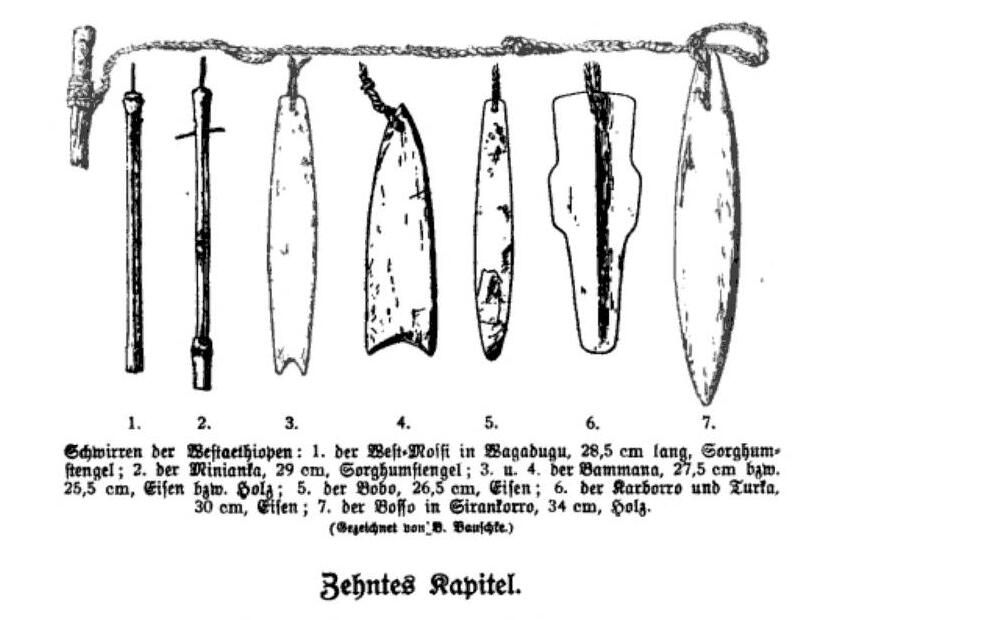
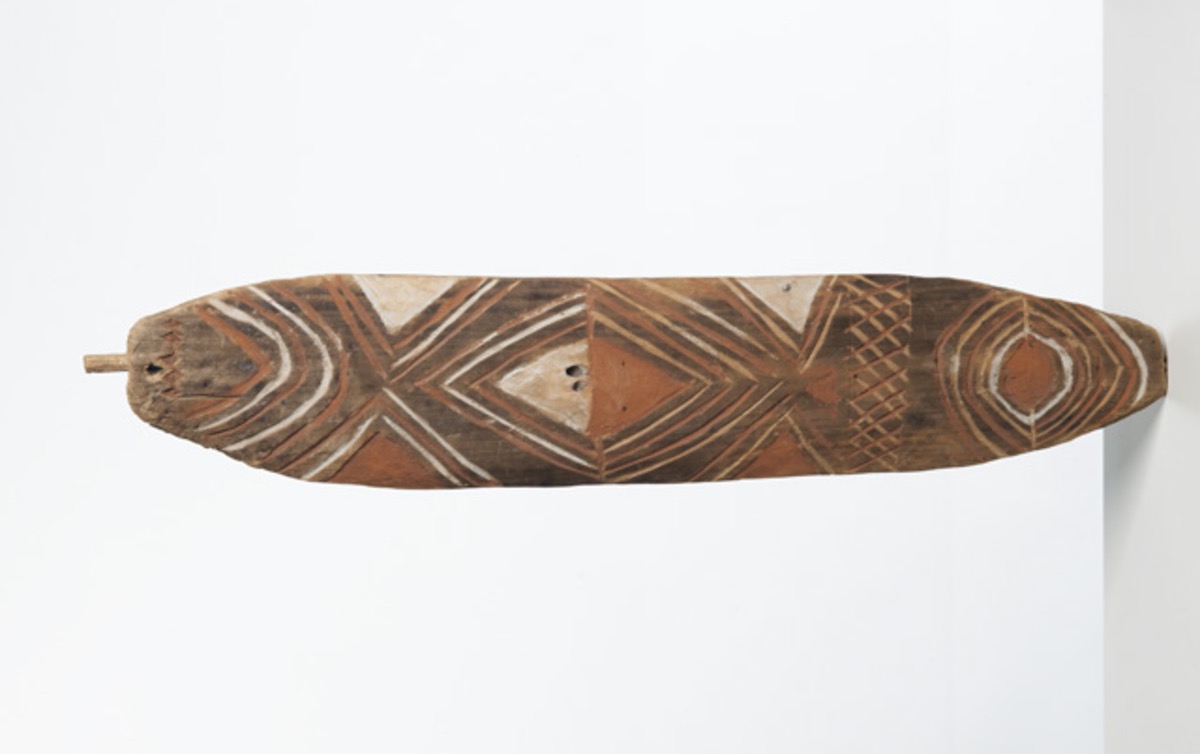
Their neighbours the Bwa keep an elliptical iron plate a foot long whose names mean “it cries” and “it makes noise.” To the faithful, Jean Capron wrote, it is not the instrument of the god Do: “it is the divinity itself.” Do is the “master of the rain” and a power of vegetation, and the Bwa told Capron that “it was Do who brought people cultivation.” Before the first rains Do's masks purify the village, and the Do song asks for “abundant rains… millet, groundnuts, peas, maize.” Up on the Bandiagara cliffs the Dogon give new bullroarers “unfermented millet beer” and call the roar the voice of the Great Mask; when a notable man dies, the prayer spoken over the whirling roarer at night mourns him as a farmer, “grower of small millet, of large millet, of rice, of cotton,” whose “handles of the hoe, of the axe are broken.”
In north-eastern Nigeria the Verre smiths of Cholli ran their harvest season as a chain of rites, and near its end came Nenga Kabusum, which “took place at night, when the Do'os ‘takes hunger and throws it away into the bush’; women must remain indoors throughout,” while the men blew a deep horn and whirled wooden bull-roarers. In central Nigeria the Dodo is the guardian spirit of a whole family of peoples, and the bullroarer is one of its cries: among the Kagoma, “the cry of the Dodo is made by blowing through a tube… The bullroarer is also used for this purpose,” and among the Gwana Jukun the senior Dodo “was brought forth to control the weather twice a year — at sowing and at harvest-time.”
And far to the south, in northern Namibia, the king of the Uukwaluudhi summoned the cloud-callers each year at sowing:
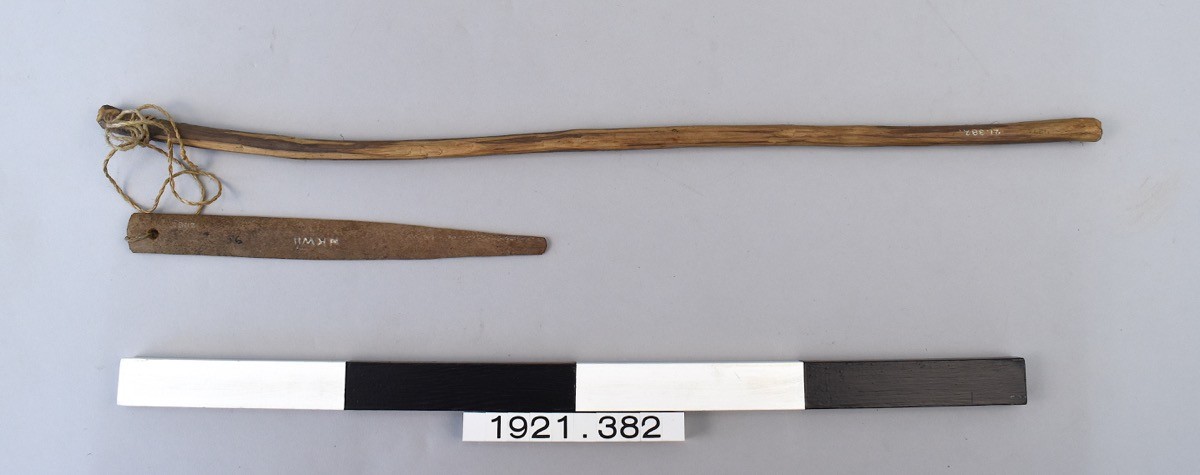
“there are four or five older men, known as ekanjo or men who call the clouds for rain, who are appointed by the chief to keep the custom alive. Each year he summons them to his kraal and instructs them to make the necessary preparations. After a few days they march towards the east in the early morning in order to greet the rising sun, each carrying an instrument made in the shape of a whip … as they pass among the kraals they whirl the instruments above their heads, thus creating a sharp whirring sound to represent the noise made by the wings of huge flying birds. No one is allowed to address them or even to set eyes upon them as this will bring bad luck to such persons and their crops.”
— C. H. L. Hahn (1928), p. 4, quoted in Märit Salokoski, How Kings Are Made, How Kingship Changes (2006), p. 230
When the men came back past the fields, the people working there cried “Rain, rain” and drove their hoes harder into the ground.
The Americas: rain for the corn
In August 1881 John Gregory Bourke, a cavalry officer with an ethnographer's notebook, watched the Snake Dance at Walpi on the Hopi mesas. Behind the file of Antelope priests walked an old man with a feathered bow in his left hand, and “with his right hand this old man rapidly twirled a wooden sling, which emitted the shrill rumble of falling rain.” When the snake-carriers ran the snakes down the mesa to the four quarters, he circled the sacred rock twice, still whirling. Ten years later Bourke said what it was for:
“The medicine-men twirled it rapidly, and with a uniform motion, about the head and from front to rear, and succeeded in faithfully imitating the sound of a gust of rain-laden wind. As explained to me by one of the medicine-men, by making this sound they compelled the wind and rain to come to the aid of the crops.”
— John G. Bourke, The Medicine-Men of the Apache, Ninth Annual Report of the Bureau of Ethnology (1892), p. 476
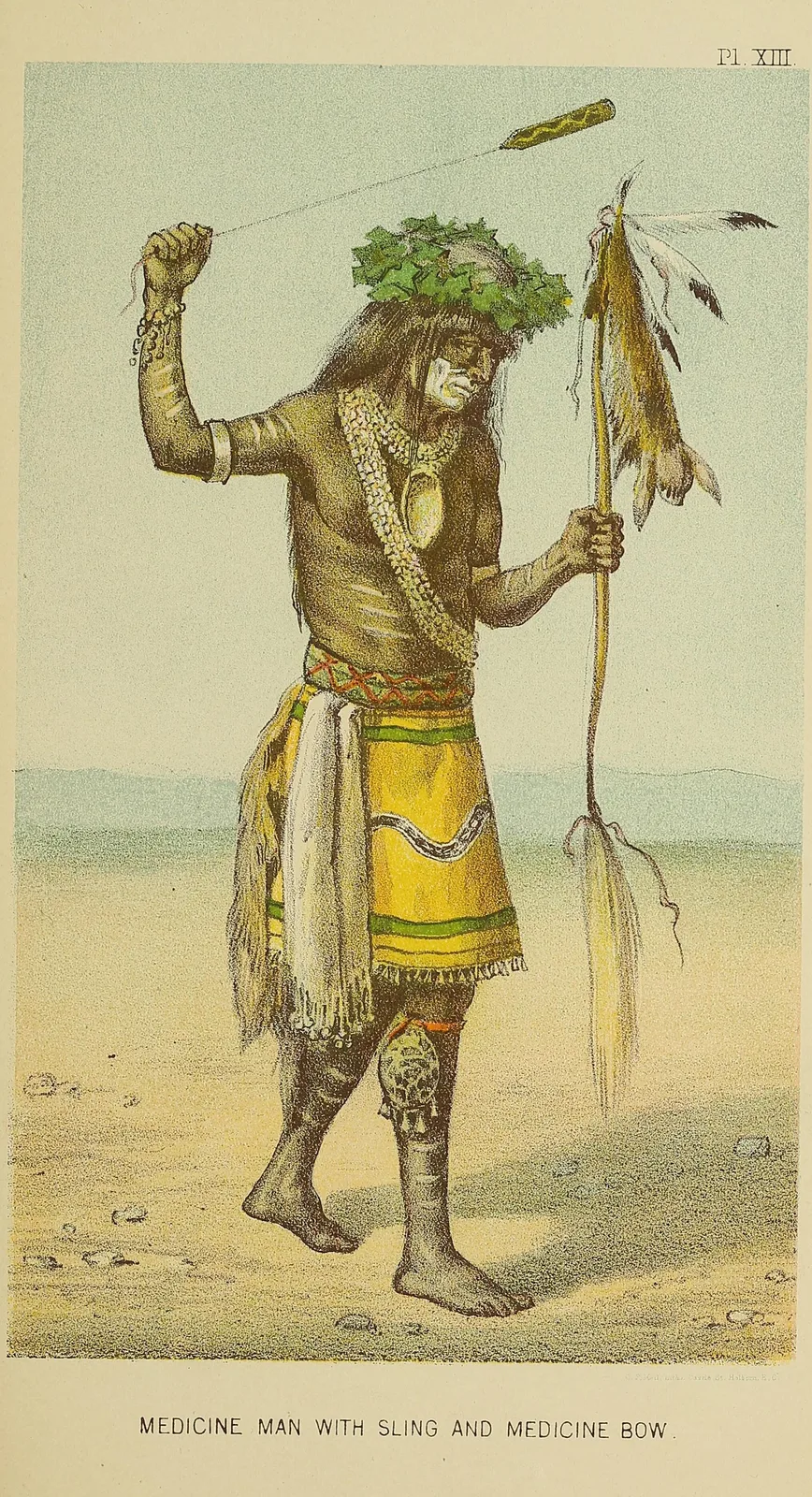
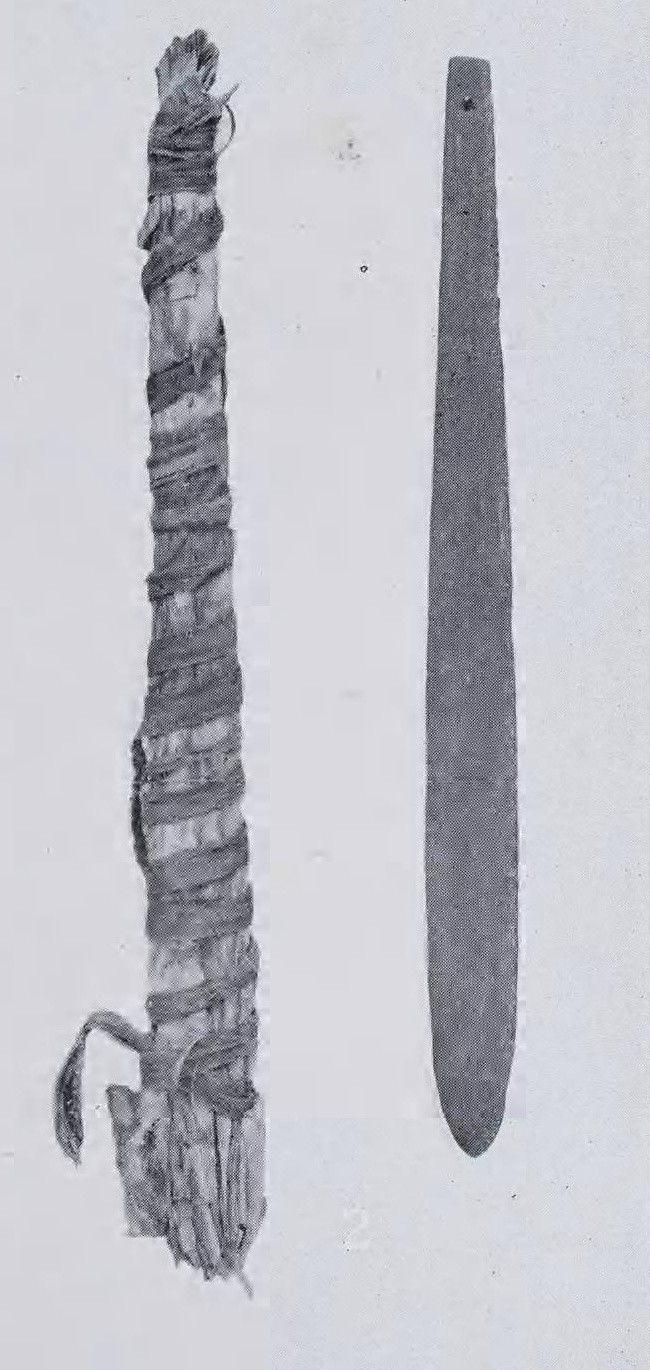
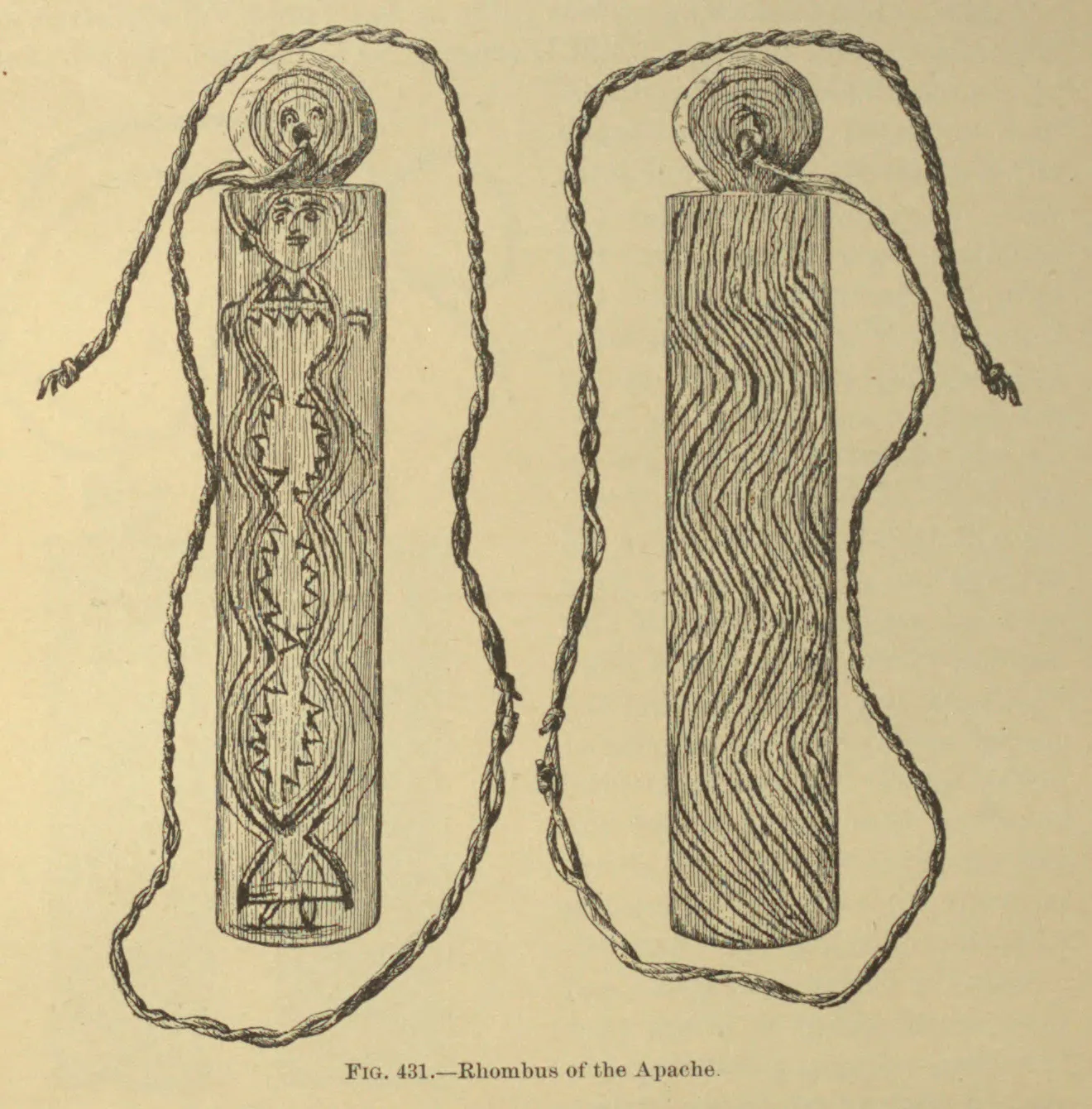
At Zuni, Matilda Coxe Stevenson was careful to say that the rhombus is not whirled, as people imagined it was elsewhere, to work the crowd into a frenzy; it belongs to “the Pueblo tribes, among whom the rhombus is whirled to create enthusiasm among the u'wannami (rain-makers).” Before an altar she saw a warrior whirl it, “calling the clouds to gather quickly. This deafening noise continues throughout the consecrating of the water.” Bourke found it among the Apache “for the same purpose”: in 1884 the season at San Carlos “had been unusually dry, and the crops were parched,” and the medicine-men arranged a procession whose two chief features were a long painted cross and the rhombus, the tzi-ditindi, “the sounding wood,” which he was led to believe was cut from pine struck by lightning on the mountain tops.
In the Sonoran desert the O'odham of Santa Rosa held the Vigita every four years, after the corn, beans, pumpkins and melons were in. The singer's body was painted with white spots for grains of corn, and he carried the bullroarer:
“An important part of the singer's outfit is the bull-roarer, consisting of two flat pieces made of sahuaro rib, the smaller one being held by the hand when in use. The connecting string should be twine of native cotton … They are decorated with symbolic designs, such as those standing for lightning, clouds, turtles, grains of corn, expressing their desire for rain. The buzzing sound produced should be deep, in imitation of the thunder, which brings rain; if the sound is shrill, lightning only will follow.”
— Carl Lumholtz, New Trails in Mexico (1912), p. 95
Five thousand miles south, in the Upper Xingu, the roar comes with a tree crop. At the pequi festival the Wauja men spin fish-shaped matapu boards on long poles, carry them from the plaza to the house of each spirit's “master” and spin them before his door, while the women stay shut indoors, forbidden to see the matapu turning. Among the neighbouring Mehinaku the matapu enters the men's house only in the pequi season; the owners of the pequi orchards sponsor its festival, and fifteen or more boards whirl at once on the plaza.

Greece: the gifts of Demeter
The Greeks remembered farming as a gift handed down in a mystery. When Demeter came to Attica searching for her daughter, Isocrates told the Athenians, she gave their ancestors “these two gifts, the greatest in the world — the fruits of the earth, which have enabled us to rise above the life of the beasts, and the holy rite which inspires in those who partake of it sweeter hopes regarding both the end of life and all eternity.” Athens, he went on, “shared with all men what she had received”: “as for the fruits of the earth, our city has, in a word, instructed the world in their uses, their cultivation, and the benefits derived from them.”
The messenger was Triptolemus. “For Triptolemus,” Apollodorus wrote, Demeter “made a chariot of winged dragons, and gave him wheat, with which, wafted through the sky, he sowed the whole inhabited earth.” Cicero, an initiate himself, could find nothing better among all the gifts of Athens “than the mysteries by which we are polished and softened into politeness from the rude austerities of barbarism. Justly indeed are they called initiations, for by them we especially learn the grand principles of life.” Grain, rite and civilization arrive together, and they arrive from somewhere else.
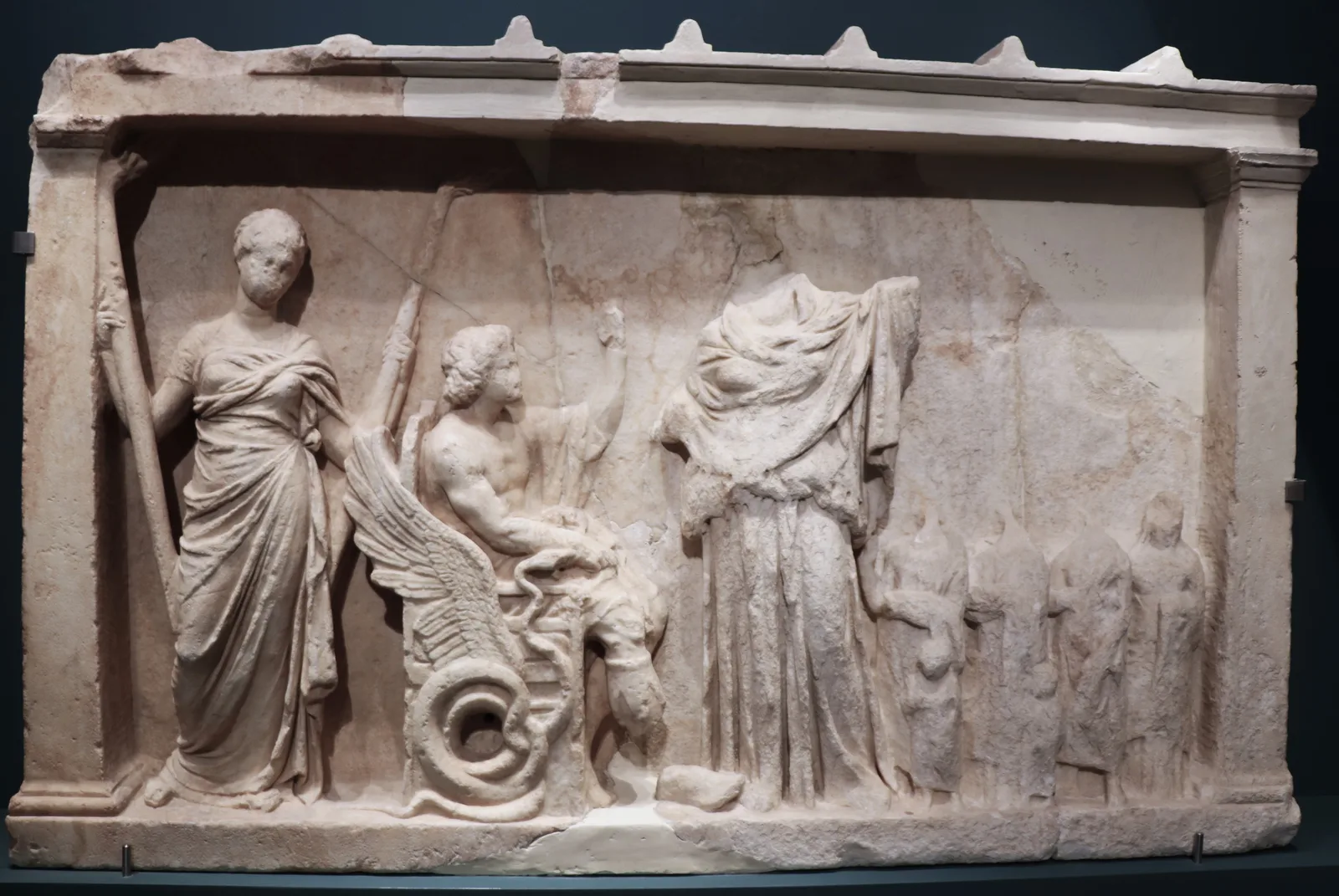
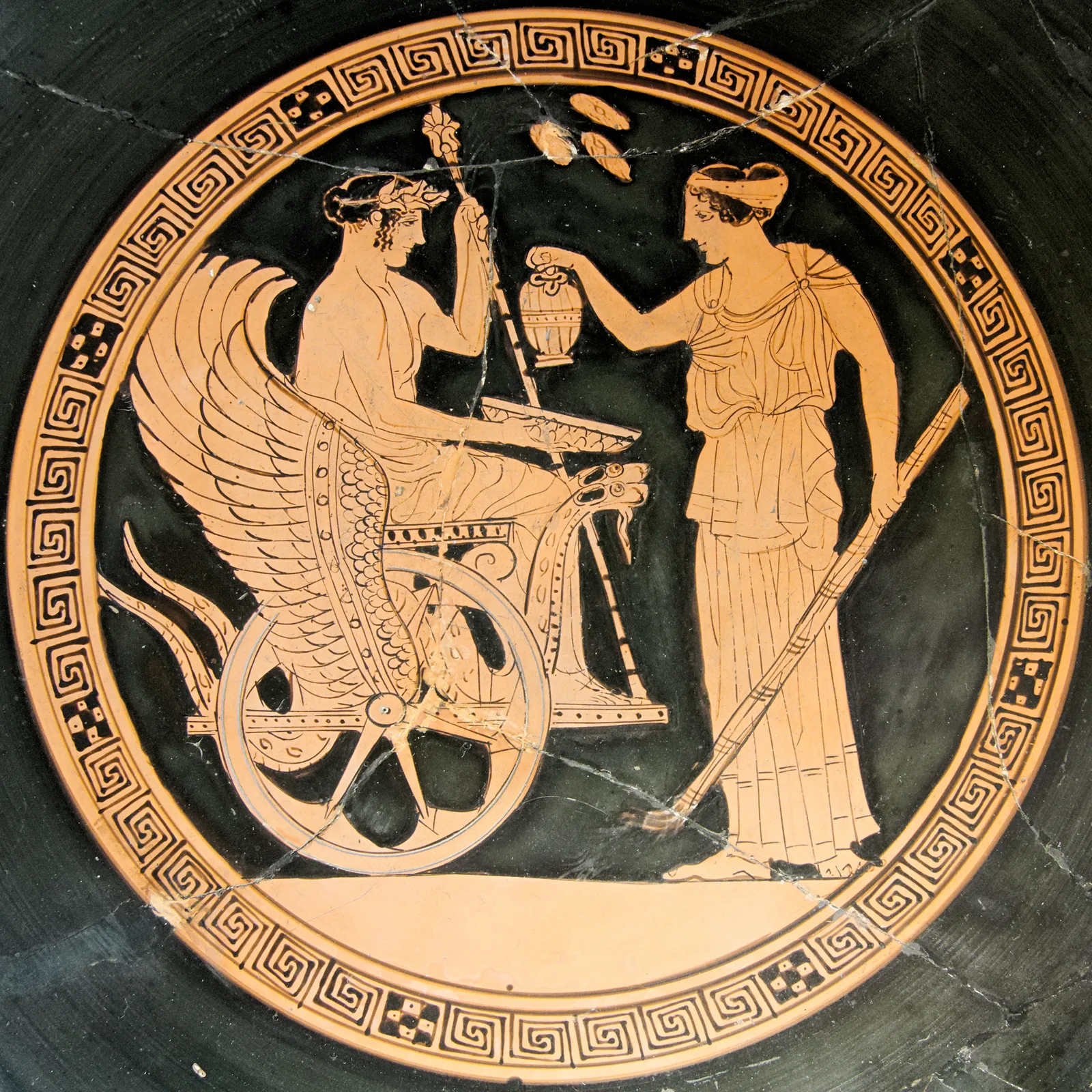
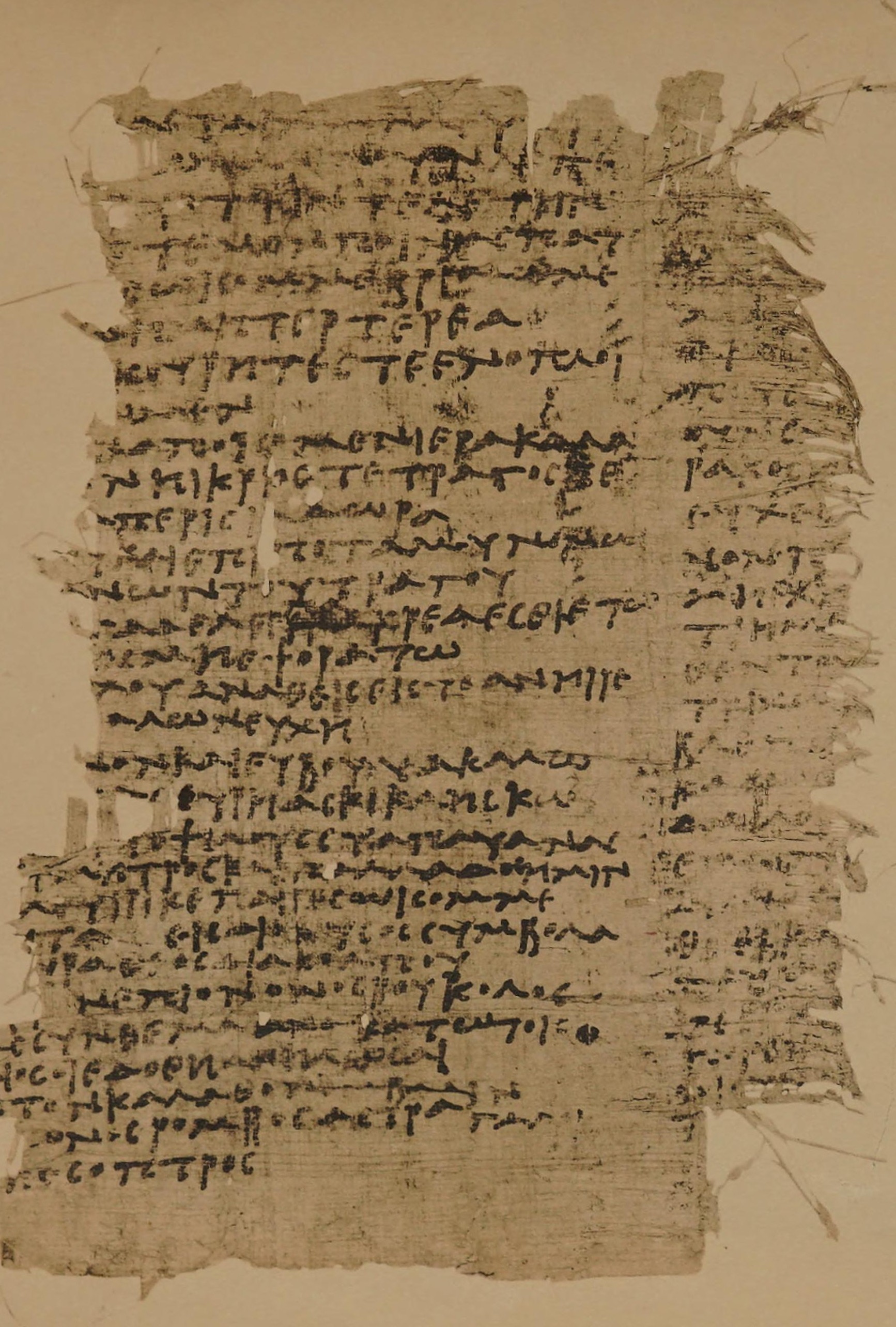
The Greek bullroarer, the rhombos, sounded next door, in the mysteries of Dionysus. Clement of Alexandria told the story the initiates kept: the Titans lured the child Dionysus away with toys, a cone, a rhombos, jointed dolls and golden apples, and tore him to pieces. An ancient note on Clement explains one of them: “The κῶνος [cone] is a little piece of wood, to which a string is fastened, and in the mysteries it is whirled round to make a roaring noise.” The philosopher Archytas mentions the rhomboi whirled in the mysteries, which sound low when swung gently and high when swung hard. A papyrus of the third century BC from Gurob in Egypt, a working text of the rite, tells the officiant to put “cone, rhombos, knucklebones” into the basket. In Clement's book this story follows straight on from Demeter, Persephone and the women's festival of the Thesmophoria.
There is no psychological principle involved which would necessarily group these elements together, and they therefore must be regarded as having been fortuitously grouped in one locality of the world, and then disseminated as a complex.— Edwin M. Loeb, Tribal Initiations and Secret Societies (1929), p. 285
The second coincidence
On the page before, Loeb noted that the Havasupai, the San Carlos Apache and the Papago “associate the bull-roarer with rain.” The harvest makes his point again, and it sits on top of a second coincidence that is larger still.
People with brains like ours lived for hundreds of thousands of years without planting anything. Then, after the end of the last Ice Age, farming began over and over. A survey of the field in 2014 counted at least eleven separate centres of domestication across the Old and New Worlds, falling in two windows: one between about twelve thousand and eight thousand years ago, the second between about eight thousand and four thousand. The Near East began with wheat and barley, China with millet and rice, New Guinea with taro and bananas, Mesoamerica with squash and maize, the Andes with potatoes, West Africa with pearl millet. At Kuk Swamp in the New Guinea highlands, people were already working the wetland margins by about ten thousand years ago, and were building mounds for bananas by seven thousand.
The usual explanation is the weather. The Holocene was warm and stable, so people everywhere found farming at last. The geneticist David Reich, on Dwarkesh Patel's podcast, still finds it astonishing: “It's a crazy observation that people just accept, but it's unbelievable.”
So there are two things to explain. One is that a dozen peoples who had not farmed for a hundred thousand years started in the same few millennia after the Ice Age. The other is that, on the continents where they did, the same secret instrument is sounded over the crop, kept from women and called a spirit. Either could be a coincidence. It is harder to believe both are.
Where the wheat began
In 1997 a team of geneticists fingerprinted the wild and domestic einkorn wheats of the Near East and traced the domestic line to one place: the Karacadağ mountains in south-eastern Turkey. Roughly eighty to a hundred kilometres south-west of those slopes stands Göbekli Tepe, the great enclosure of carved pillars raised by hunters on the eve of farming. Down the Tigris lies Körtik Tepe, one of the oldest villages of the region.
Both sites have yielded flat, leaf-shaped plaques of bone, pierced at one end for a cord and carved with goats, scorpions, snakes and zigzags. Oliver Dietrich and Jens Notroff, who excavate at Göbekli Tepe, gathered thirteen of them from Göbekli, Körtik Tepe, Hasankeyf and Nahal Hemar and noted that they share the general shape of bullroarers. They made a replica in hardwood and swung it; it “produces a deep vibrato sound.” At Körtik Tepe the plaques were laid in graves. And among the uses of the bullroarer in the ethnographic record, Dietrich and Notroff listed rites “ranging from cultic ritual to more profane tasks, like scaring away animals from plantations.”
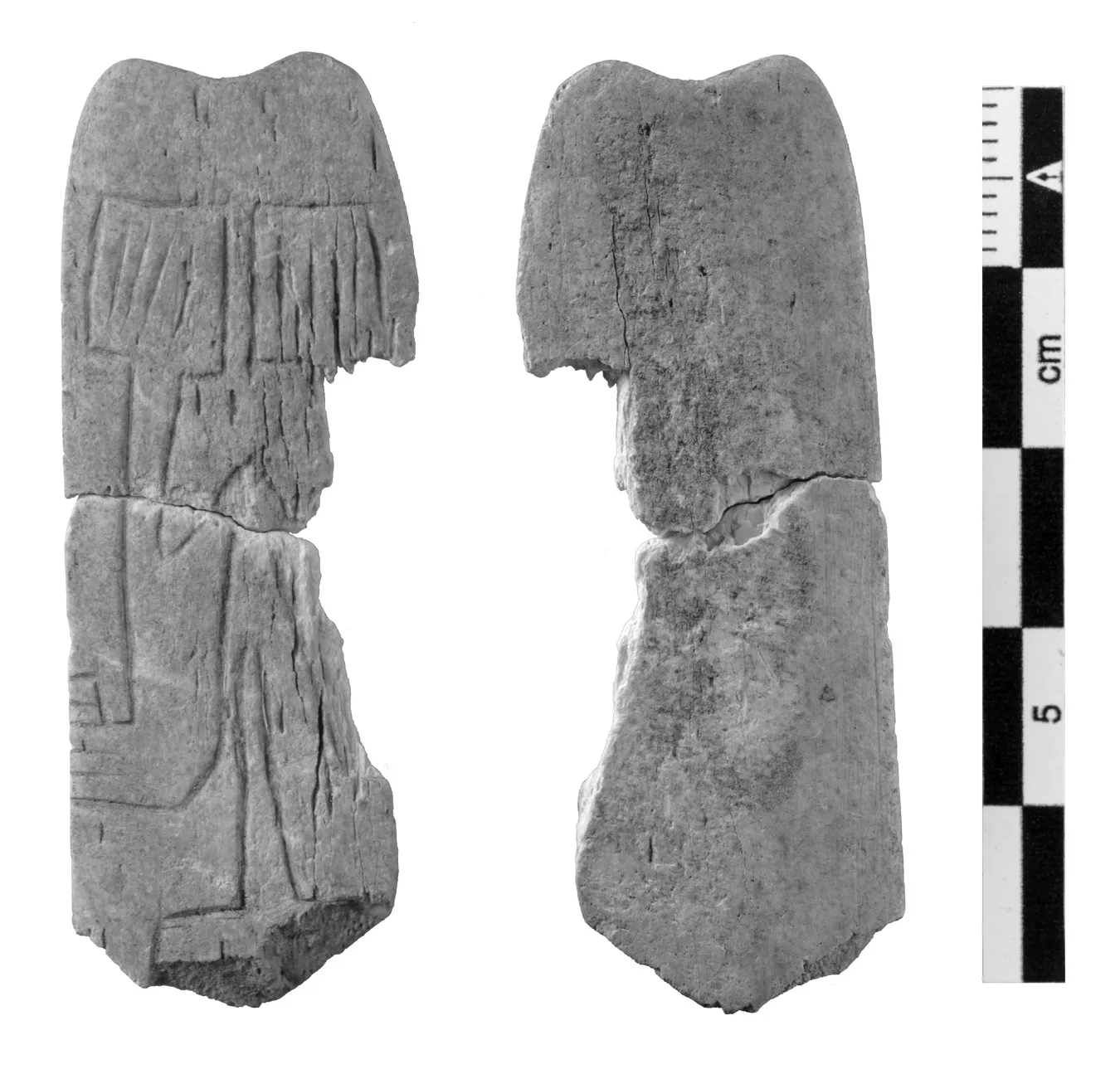
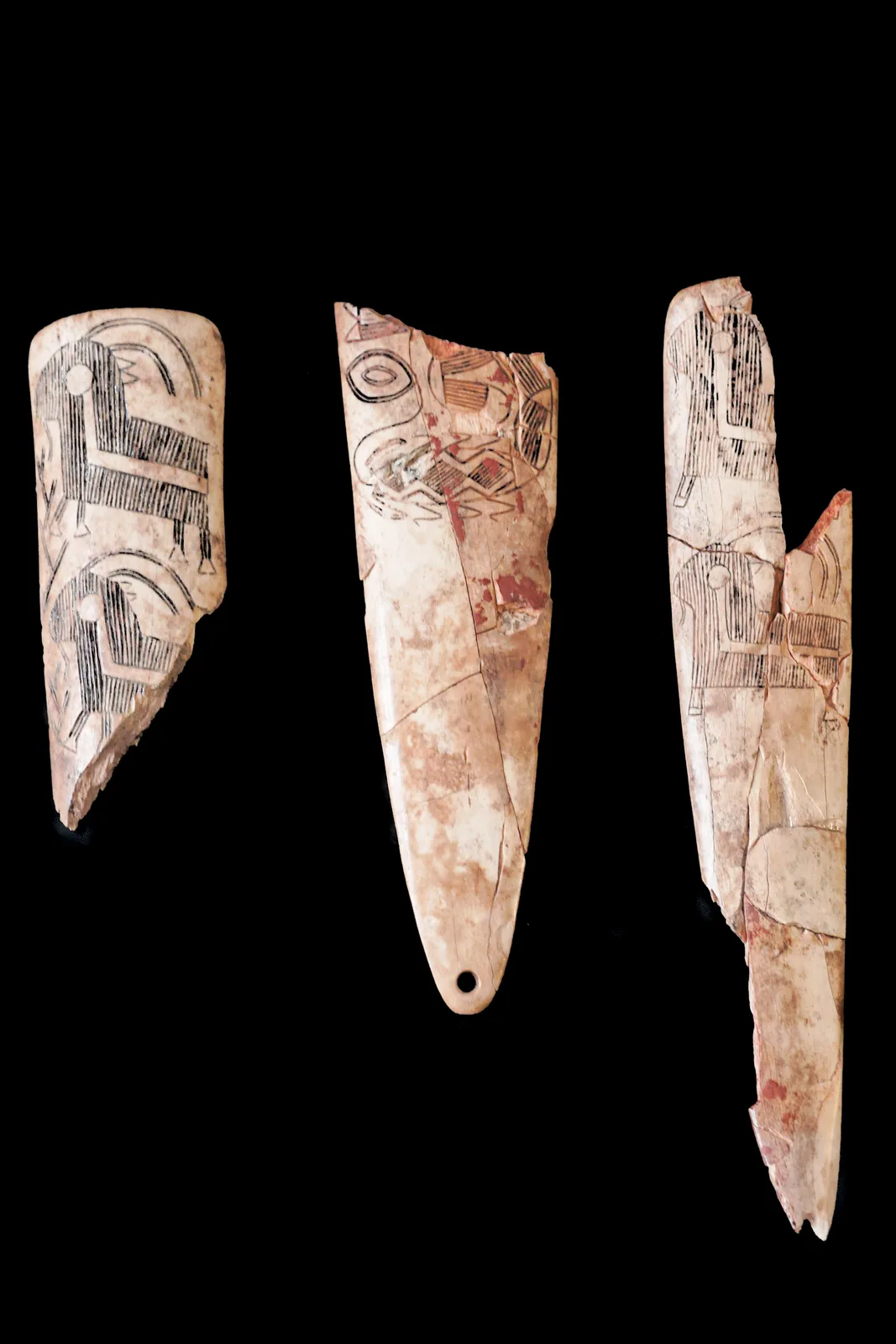
So on the hills where wheat was first tamed there are objects shaped like bullroarers that sound like bullroarers. If the crop-roarer had to start somewhere, it is hard to imagine a better address.
Out of the Near East
Africa is where the trail is clearest. The first farmers on the continent did not invent farming there; they brought it. Ancient DNA from northern Morocco shows that food production began there about 7,400 years ago with migrants of mostly European Neolithic ancestry, who came across from Iberia carrying wheat, barley, lentils, peas, sheep and goats; a later wave of Levantine ancestry arrived with herding. In Egypt, the Near Eastern package of emmer, barley, sheep and goats appears in the Fayum and at Merimde about seven thousand years ago, and the Nile became a corridor through which it passed.
West Africa is the start usually counted as independent. About 4,500 years ago people in the Tilemsi valley of Mali were growing domestic pearl millet, a native African grass. But they were already herding cattle, sheep and goats, animals that came from the Near East, and living, in other words, like the farmers to the north. A review of the crop puts it simply: “Cereal cultivation had spread from the Near East to North Africa about 5000 years ago but with the advent of the dry phase in North Africa, farmers were forced to move south, abandoning the temperate cereals and starting to domesticate more favourable tropical grasses.”
An archaeologist said as much before anyone had found the millet. In 1976 Patrick Munson, who had dug in the Tichitt valley of Mauritania, argued that West African farming grew out of contact with the north: “Near Eastern domesticated crops were demonstrably present in Egypt by 4500 B.C., and Near Eastern domesticated animals were introduced into the central Sahara at a very early date, perhaps prior to 5000 B.C. Thus the ‘lines of communication’ were present.” Herders who knew about planting, he reasoned, faced with Near Eastern crops that would not grow in a summer-rain country, “began experimenting with such wild, summer-rainfall adapted, local species as Pennisetum” — pearl millet. He even drew their road: out of the Sahara “into such southern Saharan highland areas as Aïr and Adrar des Iforas, and from there down such corridors as the Tilemsi Valley into the central valley of the Niger in the vicinity of Timbuktu.” Thirty-five years later the oldest domestic pearl millet in Africa came out of the Tilemsi valley. The story is told in full in “Pearl Millet Was Not an Independent Invention.”
If farming walked into Africa from the Near East, the African harvest rites in this essay need no separate origin. The sowing procession of the Bali, the iron roarer that opens the Bobo sorghum harvest, the Bwa god who “brought people cultivation” and is the roarer itself: these are what the instrument looks like when it has come down the same road as the grain, the herds and the hoe.
New Guinea is further and older. Its gardens at Kuk are as old as almost any on earth, and there is no Neolithic migration to point to. But a cult can travel without a crop. What reached New Guinea need not have been wheat. It could have been the habit of the thing: a men's secret, a spirit's voice, a garden that grows when the right sound passes over it. The Kiwai splinter that tells Méte to slick it with the fluids of sex and swing it over the yams is the closest thing on the map to the Greek story of grain handed down in a mystery, and the Marind carry that same fluid out to their plants. It is not hard to picture the African and Papuan harvest roarers as two branches of one Near Eastern tree.
Before the plow, and after
The bullroarer itself is far older than any of this. Bone and antler roarers come out of the caves of Ice Age France and Spain; the type-specimen from Lalinde is twelve thousand years old and still hums when a replica is swung. As Thunder Before the Plow argues, the instrument spread across the world as the voice of spirits and of the weather long before anyone planted a seed. That is why it is everywhere, among foragers as well as farmers, in the Great Basin and Arnhem Land as well as the Sepik.
So the trail runs in waves. The first carried the instrument itself, with its spirit voice and its rain-making, to every continent. A later one, setting out from the Near East with the first farmers, put the old instrument to work on the crop wherever farming went, which is why the crop-roarer is thickest where Old World farming spread.
The Americas show the older layer plainly. Among the Pomo, acorn-gatherers who planted nothing, “the bull roarer everywhere … was believed to be the voice of Thunder man,” and the Potter Valley people whirled it at the four quarters of the assembly house in what John Hudson's notes call a “Thunder Ceremony or ceremony for rain and praying.” The Hopi, Zuni, Apache and O'odham aim that same thunder at the corn, and the Wauja and Mehinaku bring it out for a tree crop. Whether a later, unrecorded wave carried the harvest use into the Southwest and the Xingu, or the peoples there bent an inherited rain-maker to their fields themselves, the old picture of continents sealed off from one another, each inventing its gods and its harvests alone, does not survive. At the least, the Americas show people taking an inherited instrument and putting it to the same use.
One trail
Look at the map again. The red dots do not scatter evenly across the farming world. They gather in New Guinea, run in a band across the African savanna, and come back in the Southwest and the Amazon, with Greece and the first wheat fields in the middle of the map. In every cluster the details repeat: a board that is a voice, a secret kept from women, a crop that grows or rain that comes when the voice passes over the fields, and, among the Kiwai, a memory that a woman had it first.
One could call each of these an accident, and call the near-simultaneous birth of farming another, and leave the two side by side. Isocrates did not think that way. He said the grain and the holy rite came together, as a gift, and were passed on to the rest of the world. On five continents the same tabooed instrument is sounded over the harvest, and in the few millennia after the Ice Age farming began again and again around the world. Two coincidences that large are easier to believe as one trail. The bullroarer travelled the world before farming and travelled again with it, out of the Near East into Africa and quite possibly toward New Guinea, and wherever it arrived it was set to work on the crop.
Key sources
- Cutler, A. 2026. “The Biggest Coincidence in Human Evolution.” Vectors of Mind, 4 October 2026 — the longer argument behind this essay, and the source of its map.
- Landtman, G. 1917. The Folk-Tales of the Kiwai Papuans. Helsingfors: Acta Societatis Scientiarum Fennicae 47, tale 261, “The First Bull-Roarer,” p. 316, and variant 261A.
- Haddon, A. C. 1901. Head-hunters: Black, White, and Brown, pp. 104–105; Haddon, A. C. (ed.) 1904. Reports of the Cambridge Anthropological Expedition to Torres Straits V, p. 218 and fig. 30.
- Frazer, J. G. 1913. The Golden Bough, 3rd ed., vol. XI, Balder the Beautiful II, p. 232 (Yabim, after Zahn 1911). Sarvasy, H. 2014. A Grammar of Nungon. PhD thesis, James Cook University, p. 25. Girard, F. 1967. “Les gens de l'Igname.” Journal d'agriculture tropicale et de botanique appliquée 14, p. 307 (Buang).
- Seligman, C. G. 1910. The Melanesians of British New Guinea, pp. 299–300 (Waima kaivakuku) and p. 304 n. 1 (Nara). Hamlyn-Harris, R. 1913. “Sacred Sticks or Bull-Roarers.” Memoirs of the Queensland Museum II, p. 38 (Mekeo). Hogbin, I. 1970. The Island of Menstruating Men, pp. 58–59 (Wogeo).
- Howes, D. 2003. Sensual Relations, pp. 143–144 (Kwoma, after Whiting); Howes, D. 2015. “Sensation and Transmission,” in Bull & Mitchell (eds.), Ritual, Performance and the Senses, pp. 155–156 (Ilahita, after Tuzin). Van Baal, J. 1966. Dema, p. 584 (Upper-Bian Marind).
- Hutter, F. 1902. Wanderungen und Forschungen im Nord-Hinterland von Kamerun, pp. 429–431. Frobenius, L. 1898. Die Masken und Geheimbünde Afrikas, pp. 164–165. Frobenius, L. 1913. Und Afrika sprach… III, pp. 297, 306.
- Capron, J. 1957. “Quelques notes sur la société du do chez les populations Bwa du cercle de San.” Journal de la Société des Africanistes 27(1), pp. 86, 104, 108, 127. Griaule, M. 1938. Masques dogons, pp. 175, 254–256.
- Chappel, T., Fardon, R. & Piepel, K. 2021. “Surviving Works: context in Verre arts.” Vestiges: Traces of Record 7(1), p. 82. Meek, C. K. 1925. The Northern Tribes of Nigeria II, pp. 21, 66–67 (Kagoma and Gwana Jukun Dodo). Salokoski, M. 2006. How Kings Are Made, How Kingship Changes, pp. 230–231, quoting Hahn 1928, p. 4 (Uukwaluudhi).
- Bourke, J. G. 1884. The Snake-Dance of the Moquis of Arizona, pp. 159, 168–169, pl. XIII; Bourke, J. G. 1892. The Medicine-Men of the Apache, 9th Annual Report of the Bureau of Ethnology, pp. 476–478. Stevenson, M. C. 1904. The Zuñi Indians, 23rd Annual Report of the Bureau of American Ethnology, p. 115 n. b and p. 492.
- Lumholtz, C. 1912. New Trails in Mexico, pp. 92–95 (O'odham Vigita). Loeb, E. M. 1926. Pomo Folkways, p. 302; Welch, J. R. 2013. Sprouting Valley, p. 159 (Hudson's Potter Valley notes). Ball, C. 2011. “As Spirits Speak.” Journal de la Société des Américanistes 97(1), pp. 105–106 (Wauja); Gregor, T. 1985. Anxious Pleasures (Mehinaku).
- Isocrates, Panegyricus 28–29, trans. G. Norlin (1928). Apollodorus, Library 1.5.2, trans. J. G. Frazer (1921). Cicero, De Legibus 2.36, trans. C. D. Yonge (1853), pp. 444–445. Clement of Alexandria, Protrepticus 2.17–18. Smyly, J. G. 1921. Greek Papyri from Gurob, no. 1. Lang, A. 1884. “The Bull-Roarer,” in Custom and Myth.
- Loeb, E. M. 1929. Tribal Initiations and Secret Societies. University of California Publications in American Archaeology and Ethnology 25(3), pp. 284–285.
- Larson, G. et al. 2014. “Current perspectives and the future of domestication studies.” PNAS 111(17): 6139–6146. Denham, T. et al. 2003. “Origins of agriculture at Kuk Swamp in the highlands of New Guinea.” Science 301: 189–193. Reich, D., on the Dwarkesh Podcast, “Why the Bronze Age was an inflection point in human evolution,” 8 May 2026, at 1:09:02.
- Heun, M. et al. 1997. “Site of einkorn wheat domestication identified by DNA fingerprinting.” Science 278: 1312–1314. Dietrich, O. & Notroff, J. 2016. “A Decorated Bone ‘Spatula’ from Göbekli Tepe.” Neo-Lithics 1/16: 22–31, pp. 27–29.
- Simões, L. G. et al. 2023. “Northwest African Neolithic initiated by migrants from Iberia and Levant.” Nature 618: 550–556. Linseele, V. et al. 2014. “New archaeozoological data from the Fayum ‘Neolithic’.” PLoS ONE 9(10): e108517. Manning, K. et al. 2011. “4500-year old domesticated pearl millet from the Tilemsi Valley, Mali.” Journal of Archaeological Science 38(2): 312–322.
- Munson, P. J. 1976. “Archaeological data on the origins of cultivation in the southwestern Sahara and their implications for West Africa,” in Harlan, de Wet & Stemler (eds.), Origins of African Plant Domestication, pp. 187–209, at pp. 202, 205. Jukanti, A. K. et al. 2016. “Crops that feed the world 11. Pearl millet.” Food Security 8: 307–329, at p. 309, after J. D. Clark 1964. See also “Pearl Millet Was Not an Independent Invention.”