No. EUROPE-007
Bolinkoba cave
Spain · Magdalenian Cantabrian (Abadiño, Bizkaia) · Europe · Iberia
Sacred / spirit
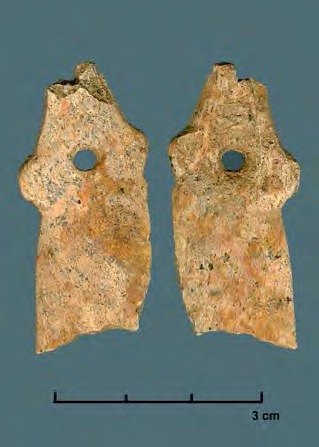
bramadera
bramadera — Spanish name for the bull-roarer (also rombo, zumbador).
Etymology. From Spanish bramar, "to roar, bellow" — the bram- root runs through bramadera, bramador, and bramido. The name evokes a sound "like the roaring of the wind."
On 15 July 2010, in disturbed deposits of Bolinkoba cave at Abadiño in Bizkaia, excavators recovered a small bone fragment, 40.3 mm long and barely 3.7 mm thick, cut from the carefully polished rib of a medium-to-large herbivore (the analyst suspected horse); spongy cells of the bone's interior still cling to its underside. Ignacio Barandiarán Maestu identified it as the proximal head of a bramadera, the slender whirled aerophone known in English as the bull-roarer, in German as Schwirrholz, and likened by early ethnographers to the Australian churinga. Reconstructed whole, the object would have run a lenticular 166 to 168 mm. What makes it unique among the roughly thirty-four Magdalenian bramaderas catalogued across Cantabria, the Pyrenees, and the Dordogne is its head: a centered perforation set in a constricted swelling flanked by a small lug on either side, fittings to secure the cord. Spun at the end of a long string, the cord winds and unwinds with the circling motion, and from that doubled twist comes the instrument's peculiar drone. The piece is assigned to the Magdalenian; the dictionary of the Real Academia, which Barandiarán quotes, calls the object a thing children use as a toy, making a noise like the roar of the wind.
El cordel que une al rombo con quien lo maneja se enrosca sobre sí mismo como efecto del movimiento circular en torno al que lo mueve y luego se desenrosca: de este doble giro nace el zumbido tan singular de ese instrumento.
The cord that joins the rhomb to the one who handles it winds around itself as an effect of the circular movement about the person turning it, and then unwinds: from this double turn is born the so singular drone of that instrument.
Dauvois 2005/2006:232, quoted in Barandiarán Maestu, "La bramadera de hueso," Kobie BAI 6 (2015):152
Particulars
- Object
- Proximal fragment of a bramadera, 40.3 x 19.6 x 3.7 mm, cut from the polished rib of a medium-to-large herbivore; reconstructed complete at 166-168 mm, 20.4 mm wide and 2.5 mm thick through the body. Unique in the corpus for the pair of lateral lugs flanking its perforated head. Found 15 July 2010 in disturbed deposits.
- Function
- Whirled-cord aerophone; ritual sound-maker of the Upper Paleolithic.
Source
Barandiaran Maestu, La bramadera de hueso, Kobie BAI 6 (2015), pp. 149–158; quoting Dauvois (2005/2006), p. 232