No. DIET2016-003
Hasankeyf Höyük elongated bone plaque
Turkey · Upper Tigris · Batman region · Near East · Anatolia
Function not recorded Candidate only
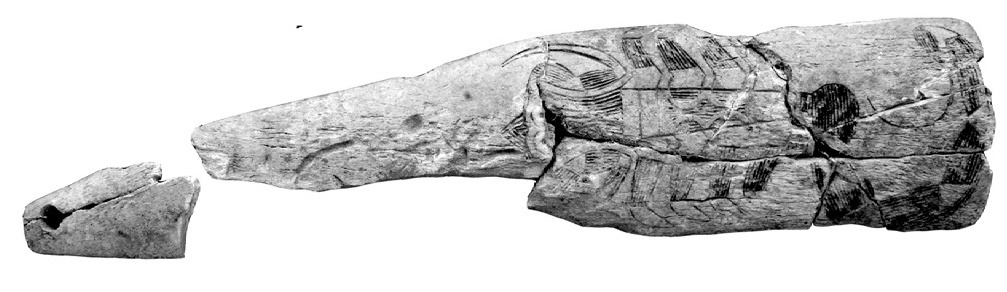
Source term: elongated perforated bone plaque / possible bullroarer comparison
At the early Neolithic settlement of Hasankeyf Höyük on the Upper Tigris, excavators recovered an elongated bone plaque, trapezoidal and tapering to one end, pierced by a single hole at its narrow tip and carved with geometric lines that the excavator Yutaka Miyake read as a scorpion. Oliver Dietrich and Jens Notroff placed it among thirteen similar perforated bone "spatulae" from Pre-Pottery Neolithic sites in southeastern Turkey and the Levant — Göbekli Tepe, Körtik Tepe, Nahal Hemar — objects with a flattened, leaf-shaped form, a hole at the narrow end for a cord, and frequently incised animal or geometric decoration. The whole family of finds resembles bullroarers, the cord-swung noisemakers known from Palaeolithic France onward, though a bullroarer with one broad end usually carries its cord-hole there rather than at the narrow tip; a hardwood replica built to the same dimensions "produces a deep vibrato sound." At Körtik Tepe these objects turn up as grave goods.
Elongated bone plaque, trapezoidal, tapering towards one end. Single terminal perforation at smaller end. Not completely preserved. Carving of geometric forms and lines, interpreted as depiction of a scorpion.
Dietrich and Notroff 2016, Neo-Lithics 1/16:29, Appendix 1, no. 4 (after Miyake 2013:45, Fig. 3)
Particulars
- Object
- Trapezoidal elongated bone plaque with a single terminal perforation and scorpion-like geometric carving.
- Function
- Not recorded.
Source
Oliver Dietrich and Jens Notroff, Neo-Lithics 1/16 (2016): 22-31, Appendix 1 no. 4, after Miyake 2013: 45, fig. 3